Children’s Tears by Ryszard Wierzbicki
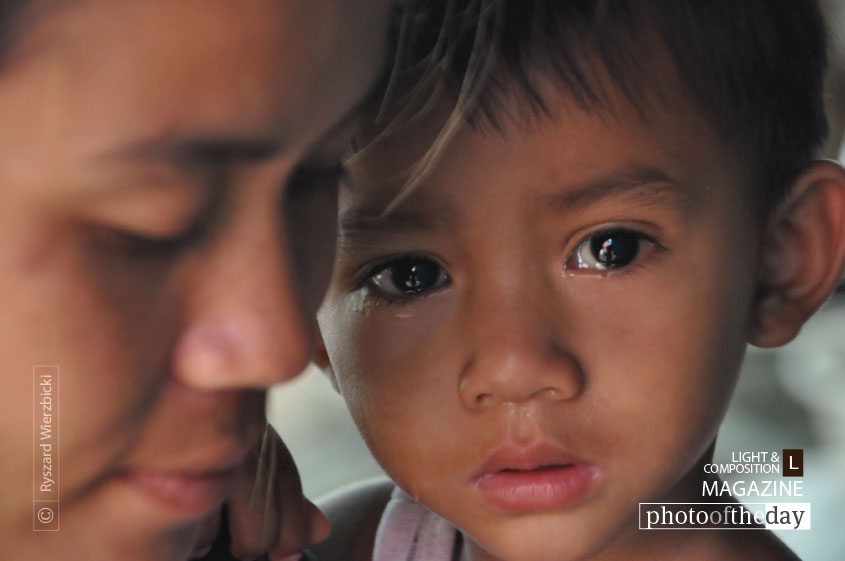
Captured in a small village near Siem Reap, Cambodia, this poignant portrait documents a fleeting moment of childhood vulnerability. The photographer encountered a young boy in the midst of tears, a scene so emotionally resonant that it demanded immediate attention. The narrative shifts instantly when the child notices the camera, his sorrow replaced by a curious, silent pause. This image is award-worthy for its raw, unscripted emotional honesty and the photographer’s ability to bridge the gap between observer and subject, transforming a brief, private moment of distress into a powerful, universal portrait of human connection.
Ryszard Wierzbicki
Born in 1963 and a graduate of the University of Gdańsk, Ryszard Wierzbicki transitioned from a career in social sciences and marketing to become a dedicated photographer and traveler. After relocating to the United Kingdom in 2006, he began documenting his extensive explorations of South-East Asia, often volunteering with organizations supporting orphans. Now based in Swindon, he balances his professional life as a marketing advisor with his deep-seated passions for photography, scuba diving, and organizing international tours, frequently sharing his experiences through his established travel and photography forums.
Resonance Score Breakdown
Transparency Note: The resonance score (12.3/20) is calculated based on social engagement metrics collected before the award announcement.
Expert Photography Reviews · 8
The Weight of a Moment
I dropped my favorite ceramic mug this morning. It didn't shatter, but a jagged chip broke off the rim, and for a second, I just stood there watching the pieces settle on the floor. It felt like a small, sudden grief.
Read the reflection →The Salt of Being
There is a profound honesty in the way a child releases their sorrow. It is not a heavy, complicated thing like the grief we carry as adults, but a sudden, cleansing rain that passes as quickly as it arrives.
Read the reflection →Reviews & Comments
Share your thoughts about this award-winning photograph. Your reviews contribute to the community engagement score.
Most portraits I see are performances, but this boy’s transition from genuine grief to sudden, camera-induced stillness is haunting. It’s the raw, wet texture of his skin against the soft, out-of-focus background that anchors the moment. I’ve stared at this for years, and it still breaks my heart. It endures because it captures the exact second a child’s private world is interrupted by our gaze. That’s why it’s still relevant thirty years later.
The boy’s gaze doesn’t ask for comfort. It asks for stillness. I’ve spent minutes watching the way the light falls across his cheek, catching the salt of a drying tear. It’s a heavy quiet. The background recedes, leaving only the weight of his attention. Nothing here is accidental. The empty corner is not empty. It’s a breath held in the heat of Siem Reap. I feel my own pulse slow down. It’s enough.
The light here isn’t just illumination; it’s a heavy, humid silence pressing against the boy’s skin. He stood in the cooling hour, caught between a sob and a question. I’ve felt that same stillness in the Cambodian heat, where the air holds its breath. It’s a fragile, sacred pause. Looking at his eyes, I feel a sudden, sharp ache in my own chest. He wasn’t posing; he was simply existing, and we were invited to watch.
It’s a decent enough capture, though one wonders if the shutter was pressed in a hurry. The D90’s noise at ISO 1600 is a bit distracting, isn’t it? I’ve spent enough time in the humidity of the tropics to know that true connection requires more than a passing glance. Did he sit with the boy, or just snatch the grief? It’s a sharp moment, but I’m left wishing he’d stayed for the aftermath.
Shadow here isn’t merely the absence of light; it’s the boy’s internal architecture. Wierzbicki captures that fragile transition where grief yields to the intrusion of the lens. It’s haunting. I’ve stared at these dark, recessed eyes, and I feel a cold, existential ache—the realization that we’re all just performing our sorrow for an unseen audience. The darkness doesn’t hide his tears; it gives them the weight of a history he hasn’t yet learned to articulate.
The shutter clicks, and the scene freezes mid-sob. It’s a perfect cut. The boy’s transition from raw grief to that sudden, piercing curiosity is the frame every editor hunts for. At 1/40sec, the motion blur in his eyes feels like a heartbeat caught in amber. I’ve seen a thousand portraits, but this one hits me right in the chest. It’s not just a face; it’s a film that refused to move. He’s holding the screen.
Before the eye identifies the boy, something in the chest tightens. It’s the sudden, sharp activation of a shared vulnerability. When I first saw this, I felt a phantom ache in my own throat. The transition from raw grief to that curious, silent pause is a visceral shift; it’s the moment the nervous system recalibrates. Returning to it a year later, the tears feel less like sorrow and more like a quiet, universal invitation.
At f/6, the focal plane is razor-thin, isolating the boy’s ocular moisture with clinical precision. You can see the light refracting through those tears, revealing a micro-world the naked eye usually misses. It’s a haunting optical feat. I’m genuinely moved by how the 140mm compression renders the skin texture against the soft bokeh. The diffraction of light across those droplets is, in the strictest physical sense, extraordinary. It’s a rare moment where optics perfectly capture human fragility.