The Moon Jelly by Ann Arthur
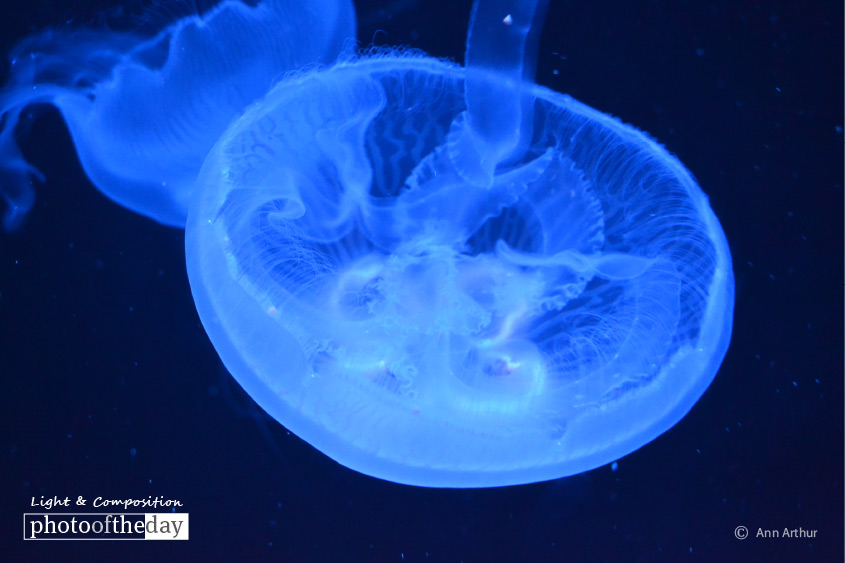
Captured at the Georgia Aquarium, this striking image of the Aurelia Aurita, or moon jellyfish, highlights the creature's ethereal beauty. The photographer was captivated by the jellyfish's ability to shift from translucent white to vibrant pink and orange hues based on its diet. By utilizing a precise 1/15 second exposure, the photographer successfully rendered the delicate, glowing anatomy of the subject against the dark aquatic backdrop. This photograph is award-worthy for its ability to transform a scientific subject into a surreal, painterly composition, showcasing the hidden, colorful wonders of marine life through a unique and observant lens.
Ann Arthur
Born in Kuching, Malaysia, Ann Arthur is a hospitality professional currently based in Birmingham, Alabama. Her journey into photography began during her university years, where she first picked up a camera to document events, eventually evolving her passion into a dedicated pursuit of travel, landscape, and artistic photography. Though she is largely self-taught, Arthur views the camera as a transformative tool that allows her to perceive the world from entirely new perspectives, capturing the beauty of her surroundings with an intuitive and creative eye.
Resonance Score Breakdown
Transparency Note: The resonance score (12.9/20) is calculated based on social engagement metrics collected before the award announcement.
Expert Photography Reviews · 6
The Architecture of Exclusion
We build glass walls to contain the wild, turning the untamable into a spectacle for the price of a ticket. In our modern urban centers, we curate nature as if it were a museum exhibit, stripping away the messiness of the ecosystem to present a sanitized, glowing version of life.
Read the reflection →Drifting in the Dark
I spent this morning trying to organize my bookshelf, but I ended up just sitting on the floor, staring at the dust motes dancing in a single beam of sunlight. It is funny how easy it is to lose track of time when you stop trying to control it.
Read the reflection →Reviews & Comments
Share your thoughts about this award-winning photograph. Your reviews contribute to the community engagement score.
Nice detailing and observation.
Aquarium glass is a tedious barrier, yet Arthur’s managed to find the one angle where the reflections don’t ruin the party. A 1/15th shutter speed is a brave choice for a moving subject; it’s clear she spent hours watching the pulse of these creatures before pressing the shutter. I’ve spent enough time shivering in damp hides to appreciate the patience here. It’s a quiet, painterly effort. She didn’t just find this; she waited for it.
1/15sec at f/4.2, ISO 3200, 38mm. A reckless gamble with motion blur that somehow paid off. The sensor noise at ISO 3200 is aggressive, yet it mimics the organic texture of the jellyfish’s bell. I’ve spent years loathing high-ISO grain, but here, it’s the only thing keeping the subject from looking like a plastic toy. It’s technically flawed, yet the shutter speed choice creates a haunting, ethereal drift. I’m actually impressed by the gamble.
You waited for that shutter to drag at 1/15th of a second, and it paid off. There’s a pulse in this jellyfish that feels almost like a heartbeat. I’ve spent my life chasing people, but looking at this, I felt a strange, quiet stillness wash over me. You didn’t just document a creature; you caught its rhythm. And that’s the truth of it. You were patient, and the light rewarded you for it. Nice work.
It’s quiet in the dark, isn’t it? Ann waited for the pulse, letting the shutter linger at a slow 1/15th to catch that ghostly drift. I’ve spent hours watching tides, but this creature breathes light in a way that feels almost sacred. It’s not just a jellyfish; it’s a soft, glowing prayer suspended in the deep. I find myself holding my own breath, just watching those delicate, shifting colors bloom against the void.
Of the thousands of aquarium shots I’ve reviewed, most are merely clinical. What separates this from the pack is the 1/15 second exposure; it turns the jellyfish into a brushstroke of light rather than a static specimen. It’s haunting. I find myself staring at the way the orange hue bleeds into the void, and honestly, it makes me feel small. In thirty years, this painterly abstraction will still feel like a dream caught in glass.
Before the eye identifies the jellyfish, a sudden stillness settles in the chest. The slow, rhythmic pulse of the Aurelia Aurita mimics a heartbeat, dragging my own breath into its languid, bioluminescent drift. It’s hypnotic. When I return to this piece, I don’t see a creature; I see the weight of my own solitude suspended in dark water. I’ve felt that specific, glowing ache before—a quiet, surreal isolation that follows me into sleep.