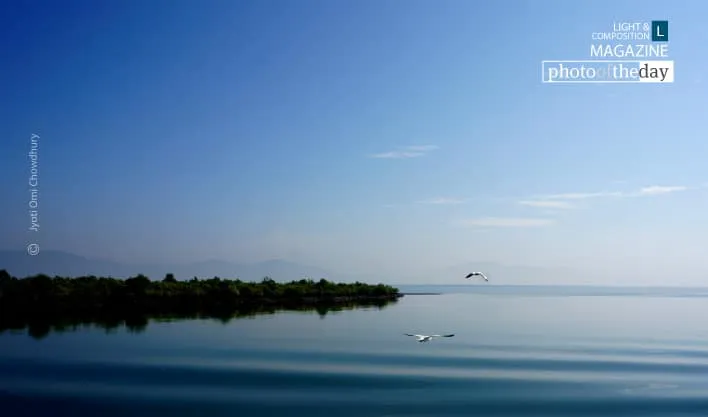
Two Birds by Jyoti Omi Chowdhury
Captured along the Bay of Bengal, this evocative image features two seagulls mirroring the rhythmic, rising and falling motions of life against a backdrop of deceptive serenity. The photographer masterfully utilizes the unstable atmosphere of the region to create a faux-tranquil scene, where the birds become symbols of existence amidst a shifting landscape. The composition is award-worthy for its ability to find profound stillness and natural grace within a volatile environment, demonstrating a keen eye for the subtle interplay between wildlife and the vast, unpredictable horizon.
Jyoti Omi Chowdhury
Born in Dhaka, Bangladesh, Jyoti Omi Chowdhury developed a global perspective through his academic journey across the American prairies, Canada, and Harvard. His photography serves as an exploration of the balance between space and human identity, often documenting life within war-torn regions with a focus on beauty and resilience rather than despair. With his work featured in prestigious publications like Vogue Italia and exhibited in galleries from Berlin to Abu Dhabi, Chowdhury continues to bridge the gap between documentary storytelling and artistic expression.
Resonance Score Breakdown
Transparency Note: The resonance score (14.6/20) is calculated based on social engagement metrics collected before the award announcement.
Expert Photography Reviews · 8
The Salt on the Wind
The air near the water has a specific grit to it, a fine, invisible dust that settles on the back of your throat and tastes of ancient, crushed shells.
Read the reflection →The Weight of the Horizon
There is a curious physics to the way we perceive companionship. We often imagine it as a tether—a line drawn between two points, keeping us from drifting into the vast, unmapped blue. Yet, if you watch the tide, you realize that nothing is truly tethered.
Read the reflection →Reviews & Comments
Share your thoughts about this award-winning photograph. Your reviews contribute to the community engagement score.
Before the eye identifies the birds, a sudden, sharp stillness settles in the chest. It’s a physiological bracing against the vast, gray indifference of the Bay. I find my own breath hitching, matching that precarious, suspended flight. When I return to this, months later, the silence feels heavier, almost predatory. It’s not just nature; it’s the ache of being small against an infinite horizon. I’ve never felt quite so lonely, or so perfectly, terrifyingly anchored.
The horizon line functions as a rigid fulcrum, bisecting the frame with clinical precision. It’s a stark division that forces the two birds into a precarious, rhythmic balance. The negative space isn’t merely empty; it’s a pressurized void that dictates the subjects’ placement. I’m genuinely unsettled by how the birds’ symmetry anchors the vast, shifting tonality of the Bay. It doesn’t rely on sentiment. The architecture holds. It’s a rare, disciplined geometry in a chaotic environment.
The horizon doesn’t divide. It breathes. Two birds drift against a gray void. It’s a quiet tension. I find myself holding my breath, waiting for the wind to shift. The space between them isn’t absence. It’s weight. Nothing here is accidental. The empty corner is not empty. It’s a pause. I’ve spent years looking for this kind of stillness. It’s rare to find such restraint in a frame that could have easily been loud.
Most nature shots are just wallpaper, but these two gulls against the Bay of Bengal’s vast, grey void actually hold my gaze. It’s the tension between the birds’ sharp, frantic wings and that flat, indifferent horizon that makes me stop. I’ve seen thousands of coastal shots, yet this one feels lonely in a way that’ll still sting in thirty years. It’s not just a bird photo; it’s a quiet, cold reminder of our own insignificance.
The Bay of Bengal doesn’t offer stillness easily. Jyoti waited for that precise, fragile alignment where the horizon softens. It’s a quiet ache, watching these two birds drift against such a vast, indifferent expanse. I’ve spent enough dawns by the water to know he stood there long after his legs grew tired, listening to the tide. It’s haunting. He didn’t just capture birds; he caught the moment the wind finally held its breath for him.
At f/13, the Sony’s sensor pushes toward the diffraction limit, yet the 18mm focal length maintains a crisp, expansive depth of field. It’s a sharp rendering of the Bay’s atmospheric haze. I’m genuinely moved by how the lens resolves the birds against that vast, shifting horizon; it’s a rare moment where the optics don’t just capture motion, but freeze the very physics of flight. It’s a precise, hauntingly beautiful intersection of glass and nature.
The palette here evokes a Morandi-esque restraint, where the grey of a bruised, pre-monsoon sky bleeds into the pale, saline wash of the Bay of Bengal. It’s a haunting, monochromatic symphony of desaturated slate and bone-white feathers that makes my own heart ache with a sudden, sharp loneliness. One finds no garish pigments, only the quiet, rhythmic friction of light against water, capturing that fleeting, fragile stillness before the atmosphere inevitably collapses into a storm.
The Bay of Bengal isn’t merely water here; it’s a void pressing against these two birds. Chowdhury doesn’t capture flight, but the crushing weight of the horizon. I’ve stared at these silhouettes until my eyes ached, feeling the cold indifference of the grey expanse. It’s a haunting refusal of comfort. When light fails to define the wings, the shadow takes over, forcing us to confront the silence that precedes the storm. It’s deeply, unsettlingly beautiful.