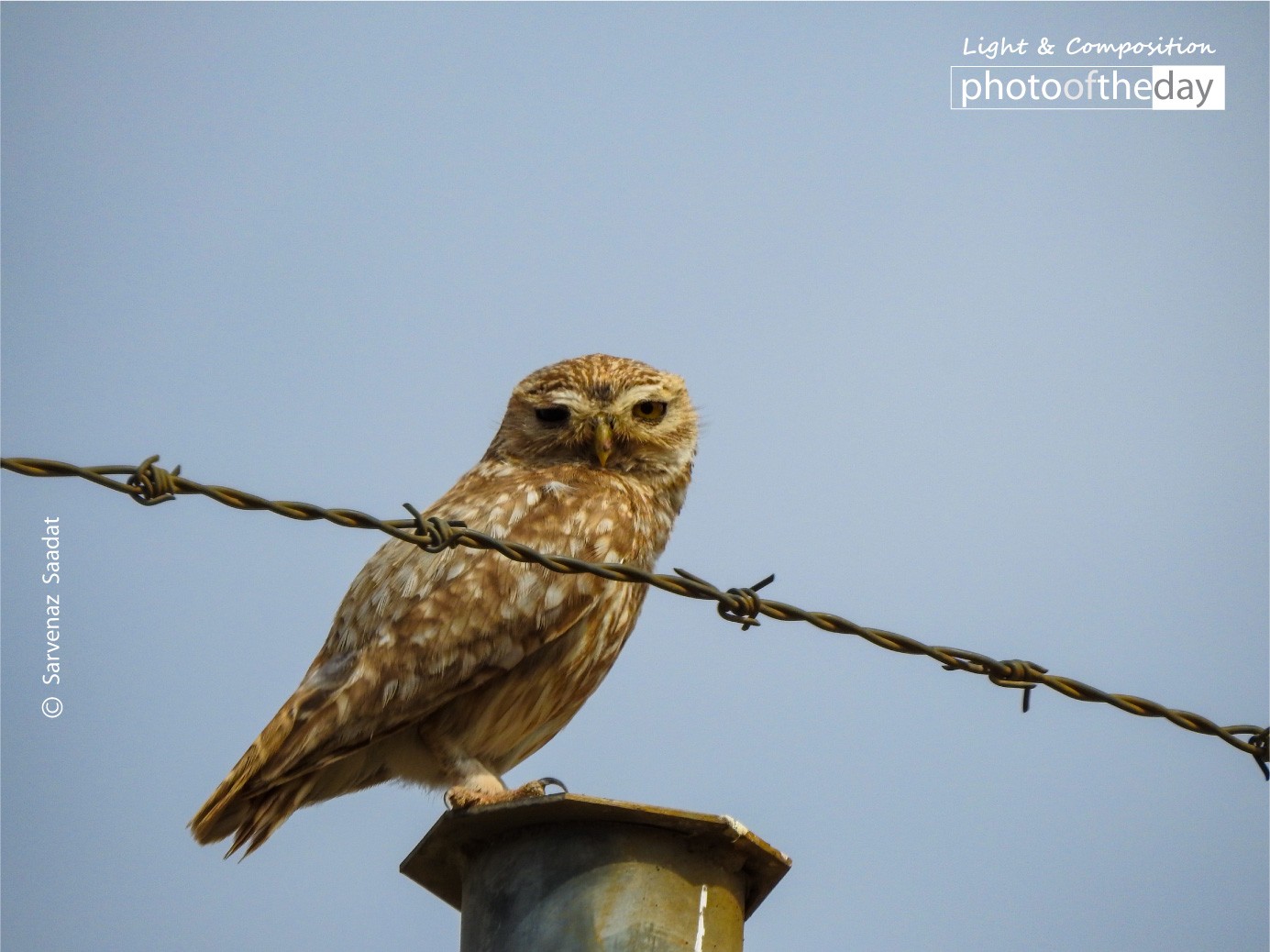
Injured Owl by Sarvenaz Saadat
During a birdwatching excursion in Taleqan, the photographer encountered a small owl, only to discover it was suffering from a significant eye injury. Accompanied by her nieces, she captured this poignant moment, balancing the excitement of discovery with the somber reality of the bird's condition. The image is award-worthy for its intimate portrayal of wildlife, capturing a fragile subject with technical precision. By focusing on the owl's gaze, the photographer invites viewers to empathize with the creature's vulnerability, transforming a chance encounter in the Alborz wilderness into a compelling narrative of nature's resilience and fragility.
Sarvenaz Saadat
Born in 1988, Sarvenaz Saadat is an architect and dedicated amateur photographer based in Karaj, Iran. Her work is deeply rooted in her passion for nature, landscape, and wildlife, a pursuit she has cultivated since her high school years. As an avid birdwatcher and traveler, she frequently explores the wilderness to document the natural world, with aspirations to transition into a professional career in nature photography and formal art studies.
Resonance Score Breakdown
Transparency Note: The resonance score (10.5/20) is calculated based on social engagement metrics collected before the award announcement.
Expert Photography Reviews · 6
The Weight of a Single Eye
There is a quiet, heavy truth in the way we look at things that are broken.
Read the reflection →The Weight of a Feather
The smell of damp earth after a long drought is a heavy, velvet thing that clings to the back of the throat. It is the scent of things waiting to be mended.
Read the reflection →Reviews & Comments
Share your thoughts about this award-winning photograph. Your reviews contribute to the community engagement score.
Staring at this owl, I feel a sharp, hollow ache. It’s a fragile, wounded creature, yet I’m troubled by the proximity. Was it really necessary to bring children along for a close-up session with a distressed animal? An injured bird needs stillness, not an audience. While the focus on that damaged eye is technically sharp, it feels extracted rather than earned. I’d have preferred a wide shot, showing the bird’s isolation, rather than this invasive intimacy.
At 298mm, the Coolpix P900’s sensor struggles against the diffraction limit, yet the focal plane here is surgical. You can see the micro-contrast within the owl’s iris, where the light’s refraction reveals the trauma’s depth. It’s a haunting optical clarity. I’ve spent years analyzing glass, but seeing that singular, damaged gaze through such a modest lens genuinely breaks my heart. It’s a rare moment where the physics of the optics perfectly mirrors the subject’s profound, fragile vulnerability.
The owl’s head is turned, but the shutter fired a fraction too late. I’ve spent my life chasing the exact millisecond of peak tension, and here, the bird’s focus has already drifted. It’s a soft, sad capture, but it lacks the visceral snap of a true peak moment. I feel a genuine ache for the creature’s injury, yet technically, the frame is just a hair off. It’s close, but it’s not the one.
The owl’s blinded eye isn’t merely a wound; it’s a void where the world stops existing. Saadat forces us to confront the darkness that consumes the creature’s sight. I’ve stared at this frame for an hour, and it’s the shadow clinging to those feathers that truly hurts. It’s a heavy, suffocating silence. When light fails, we finally see the cruelty of nature. It doesn’t ask for our empathy; it demands we acknowledge the encroaching dark.
The owl sits. A single eye holds the weight of the Alborz. It’s quiet here. The frame doesn’t crowd the bird; it leaves room for the ache. I’ve looked for a long time. The blurred background isn’t just distance. It’s the silence of a forest that doesn’t care. My chest tightens. Nothing here is accidental. The empty corner is not empty. It is the space where the bird’s pain finally finds a place to rest.
The frame holds, breathless. It’s a tight close-up, the kind that demands silence in the theater. That injured eye isn’t just a detail; it’s the entire narrative arc. I’ve spent years watching wildlife, but this gaze hits different. It’s raw, unblinking, a sequence frozen at the exact moment of vulnerability. The shutter speed caught the stillness perfectly. It’s the frame the editor keeps because the cut would have been a mistake. I’m genuinely moved by its quiet weight.