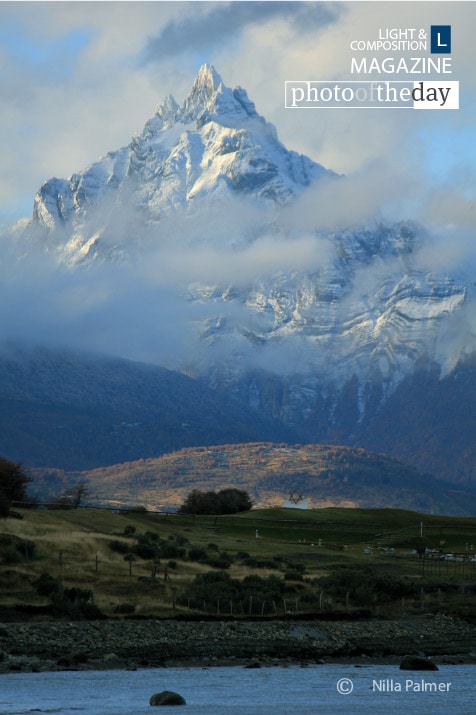
Mystical Ushuaia by Nilla Palmer
Captured in the rugged, ethereal landscape of Tierra del Fuego, this photograph of Ushuaia masterfully conveys the city's reputation as both mystical and inhospitable. The photographer utilized a precise aperture and shutter speed to balance the dramatic, soaring mountains against the vast, atmospheric backdrop of the Beagle Channel. By focusing on the interplay of light and the raw, untamed geography of this gateway to Antarctica, the image transforms a challenging climate into a strikingly picturesque scene. It is this ability to distill the essence of a remote, legendary location into a single, evocative frame that makes the work truly award-worthy.
Nilla Palmer
Based in Brisbane, Australia, Nilla Palmer has cultivated a lifelong passion for photography that began with a 110mm film camera in her youth. Her artistic foundation, built upon formal studies in Communications Design and Multimedia, informs her versatile approach to capturing candid, fleeting moments across the globe. Driven by a desire to inspire audiences to explore far-off lands, Palmer’s work is characterized by an intuitive eye for light and a commitment to revealing the authentic story within every scene she encounters.
Resonance Score Breakdown
Transparency Note: The resonance score (14.6/20) is calculated based on social engagement metrics collected before the award announcement.
Expert Photography Reviews · 8
Where the Map Ends
There is a specific kind of silence that lives at the edge of the world, a quiet so profound it feels like the earth holding its breath before a long winter.
Read the reflection →The Edge of the Map
There is a point where the road stops. Not because the earth ends, but because the mind refuses to go further. We call these places frontiers, as if they were lines drawn on a map, but they are really just thresholds of silence.
Read the reflection →Reviews & Comments
Share your thoughts about this award-winning photograph. Your reviews contribute to the community engagement score.
Thank you:)
Ushuaia isn’t merely a place; it’s a confrontation with the void. Palmer’s lens captures the Beagle Channel’s cold indifference, yet I’m struck by how the shadows refuse to anchor the mountains. They drift, unmoored, suggesting a world that hasn’t quite finished forming. It’s unsettling. Heidegger argued that truth happens in the clearing, but here, the darkness is the only honest participant. It doesn’t invite us in; it reminds us that we’re merely passing through the silence.
At f/5.6, the Canon 550D’s sensor resolves the Beagle Channel’s micro-contrast with surprising fidelity. The focal plane sits perfectly across the jagged ridgeline, avoiding the diffraction limit that often plagues landscape sensors. I’m genuinely moved by how the light refracts through the frigid, dense atmosphere here; it’s a rare, crisp clarity. It doesn’t just capture Ushuaia; it’s a precise optical dissection of the cold, where the lens finally sees what our eyes simply can’t hold.
Most landscapes from Ushuaia rely on the same tired, postcard-perfect mountain peaks. What separates this from the field is the way the Beagle Channel’s cold, grey expanse anchors the frame, forcing the viewer to confront the isolation rather than just the scenery. It’s haunting. I’ve looked at thousands of submissions, and honestly, the biting stillness here makes me shiver. It’s a rare piece that captures the true, inhospitable weight of the world’s end. It’ll endure.
The light here doesn’t just fall; it waits. Nilla stood in the cooling hour, watching the Beagle Channel breathe against those jagged, indifferent peaks. It’s a quiet, shivering sort of beauty. I’ve felt that same biting wind, that moment where the shutter feels like an intrusion on the land’s own silence. She didn’t force the scene. She listened until the mountains finally let her in. It’s a rare, haunting stillness that stays with you.
The slate-grey of the Beagle Channel bleeds into a bruised, melancholic violet, evoking the quiet, dusty stillness of a Morandi study, yet it’s the sudden, piercing ochre of the distant peaks that truly undoes one. It’s a shivering, glacial light that I’ve felt in my own bones, a chromatic dissonance that doesn’t just sit upon the frame but vibrates, turning this desolate, frozen edge of the world into a haunting, painterly symphony of cold.
The Beagle Channel pulls the eye toward the horizon. It’s a cold, grey pull. I feel the wind on my skin just looking at it. The mountains don’t crowd the frame. They recede. They leave room for the water to breathe. It’s a rare restraint. Nothing here is accidental. The empty corner is not empty. It’s the weight of the distance. I’d stay here a long time. It’s quiet. It’s enough.
Ushuaia doesn’t surrender its secrets to the casual tourist. One suspects Nilla spent a fair few shivering hours by the Beagle Channel before the light finally relented. It’s a decent composition, though I’d have preferred a bit more bite in the foreground. Still, there’s a genuine chill in those peaks that reminds me of my own frostbitten fingers in Patagonia. She’s clearly put in the time. It’s an earned view, and that’s worth plenty.
The Beagle Channel’s horizon line bisects the frame with clinical indifference. It’s a rigid division that anchors the soaring peaks. The negative space above the mountains lacks sufficient weight, causing the composition to drift toward the water. I’ve grown weary of such atmospheric softness, yet the structural tension here holds. It doesn’t collapse under its own sentiment. The geometry is precise enough to command attention, even if the sky’s tonality feels somewhat thin. It’s a disciplined, cold architecture.