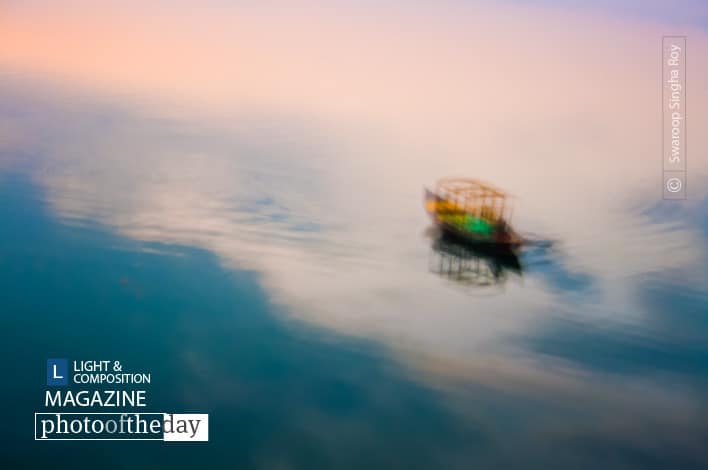
River Painting by Swaroop Singha Roy
Captured during a visit to the Massanjore Dam in Dumka, India, this photograph transforms the Mayurakshi River into a surreal, painterly vision. To achieve this ethereal effect, the photographer utilized a slow shutter speed while hand-holding the camera at dusk, intentionally blurring the movement of local boatmen against the water. The low-light conditions enhanced the vibrancy of the scene, capturing the delicate reflection of clouds on the river's surface. This image is award-worthy for its successful marriage of technical experimentation and artistic vision, turning a simple landscape into a fluid, abstract composition that feels more like a painting than a traditional photograph.
Swaroop Singha Roy
Based in Kolkata, West Bengal, Swaroop Singha Roy is a passionate photographer with a deep-seated love for nature and wildlife. His journey began in childhood, fueled by a curiosity for his father's camera, which eventually evolved into a dedicated pursuit of visual storytelling. While he possesses a particular affinity for capturing the innocence of animals, his work spans diverse environments, from bustling cityscapes to remote villages. For Singha Roy, photography serves as a vital medium for expressing his inner thoughts and documenting the beauty of the world around him.
Resonance Score Breakdown
Transparency Note: The resonance score (11.9/20) is calculated based on social engagement metrics collected before the award announcement.
Expert Photography Reviews · 7
The Blur of Being
I was walking home through the park this evening, and for a split second, I didn't recognize my own street. The rain had just stopped, and the streetlights were smearing across the wet pavement like wet ink on a page. Everything felt soft, unanchored, and strangely fluid.
Read the reflection →The Pulse of Liquid Silk
The smell of wet earth rising after a long drought is a heavy, metallic perfume that clings to the back of the throat. It is the scent of a world waking up, of dust turning into something pliable and soft.
Read the reflection →Reviews & Comments
Share your thoughts about this award-winning photograph. Your reviews contribute to the community engagement score.
This is a great idea for a personalized gift. Turning a wedding, family, or couple photograph into custom artwork makes the gift much more meaningful. https://giyftrush.com/
The river dissolves. It’s not water anymore, but a smear of dusk against the silt. I’ve spent minutes watching the blur of the boatmen. They’re ghosts now. Nothing here is accidental. The empty corner is not empty; it’s a breath held in the dark. It’s quiet. I feel a sudden, sharp ache for the stillness of Dumka. The frame doesn’t hold the river. It holds the silence between the ripples. It’s enough.
The light at Massanjore doesn’t just fall; it breathes. Swaroop stood there in the cooling hour, letting the river’s rhythm dictate his shutter. It’s a quiet surrender. I’ve spent enough evenings by the water to recognize that stillness—the moment the boatmen become ghosts in the current. Looking at these blurred, painterly strokes, I feel a sudden, sharp ache for the silence of that Jharkhand dusk. He didn’t capture the river; he let the river paint itself.
The frame’s architecture relies on the oscillation between horizontal blur and vertical interruption. It’s a precarious balance. The long exposure flattens the Mayurakshi into a singular, viscous plane, yet the boatmen’s silhouettes provide the necessary fulcrum. Without those dark, rigid anchors, the composition would dissolve into mere chromatic noise. It’s technically risky, and frankly, it’s a relief to see such discipline. The spatial tension holds. The eye isn’t allowed to wander; it’s trapped by the geometry.
Movement here isn’t merely blur; it’s the river’s refusal to be pinned down by the shutter. By dragging the camera through the dusk at Massanjore, Roy forces the light to surrender its clarity. I’ve stared at these streaks until my eyes ache, feeling the cold, heavy pull of the water against the boatmen’s ghosts. It doesn’t invite us in. Instead, it hides the truth in the dark, fluid friction between what we see and what remains unsaid.
The Mayurakshi’s surface dissolves into a viscous, bruised violet, echoing the melancholic stillness of a Morandi study where light doesn’t land, but lingers. It’s a liquid alchemy of ochre and slate that makes my heart ache with its quiet, rhythmic instability. One finds here a chromatic tension so profound that the boatmen’s silhouettes become mere ghosts, surrendered to the shifting, tidal currents of dusk. It’s truly exquisite, a haunting, painterly surrender to the river’s dark, shifting soul.
At f/5.6, the diffraction limit hasn’t compromised the micro-contrast of these light trails. By dragging the shutter for 1.6 seconds, Roy has turned the Mayurakshi’s surface into a complex interference pattern of reflected photons. It’s a gorgeous, fluid abstraction of kinetic energy. I’m genuinely moved by how the sensor’s noise at ISO 400 mimics the grain of a physical canvas. It’s not just a blur; it’s a precise, optical dissolution of reality that feels entirely alive.
Most abstract work in this category relies on digital trickery, but here, the 1.6-second exposure captures a genuine, physical rhythm. The deliberate blur of the boatmen against the Mayurakshi’s surface creates a tension between stillness and motion that I haven’t seen elsewhere this year. It’s haunting. I find myself wanting to reach into the frame to touch that water. It’s a rare piece that doesn’t just mimic a painting; it earns its place on the wall.