For the Motherland by Naba Kumar Mondal
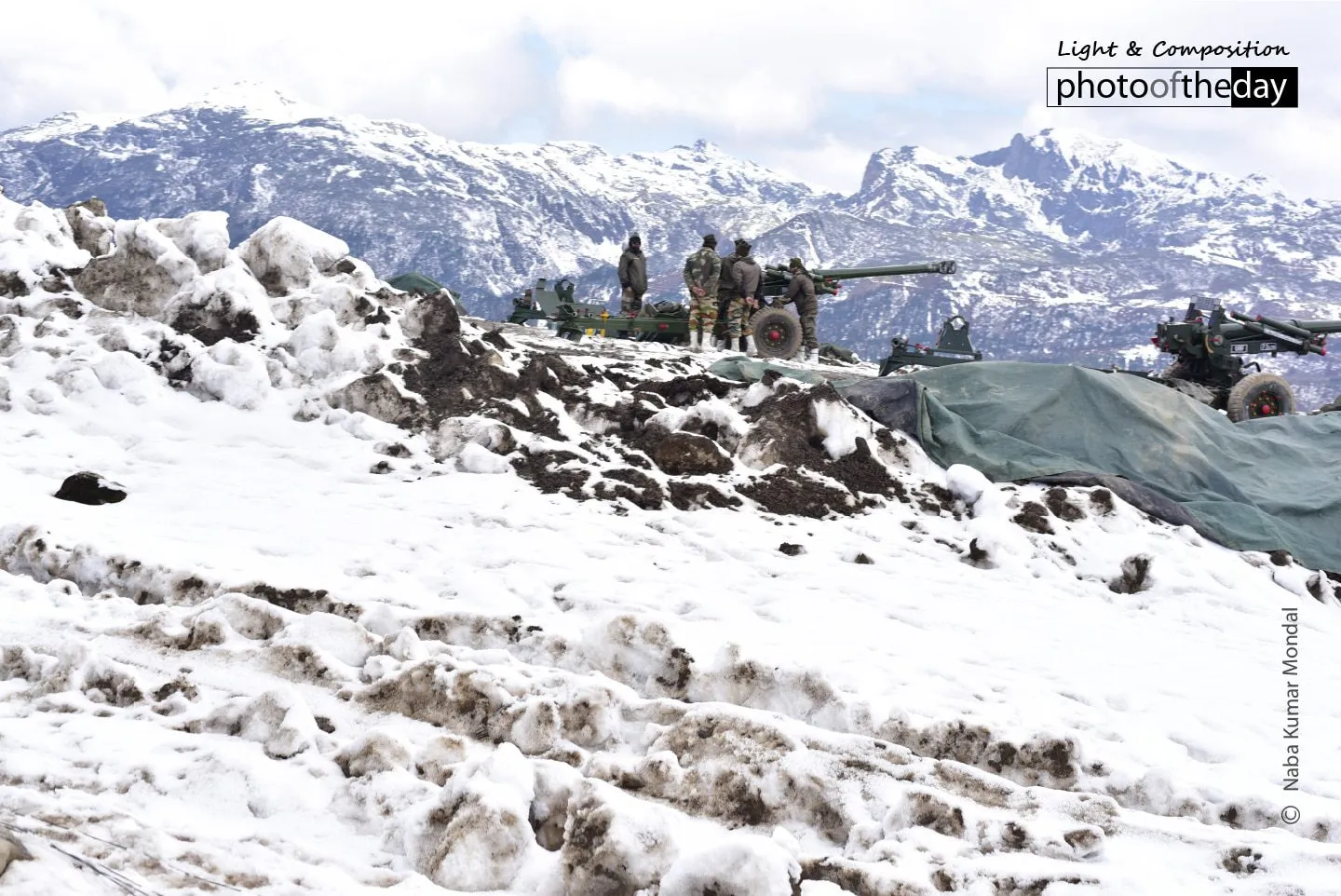
Captured at the formidable Bumla Pass, 15,200 feet above sea level, this image documents the stoic presence of soldiers guarding the sensitive border between India and China. Amidst freezing April temperatures, the photographer sought to immortalize the resilience of those serving in one of the world's most hostile environments. The composition emphasizes the stark, high-altitude landscape and the unwavering vigilance of the troops. This photograph is award-worthy for its ability to transform a geopolitical flashpoint into a poignant human narrative, highlighting the silent, shivering dedication of soldiers who remain the nation's steadfast shield against the elements and the unknown.
Naba Kumar Mondal
Transitioning from a distinguished career as an Electrical Engineer, Naba Kumar Mondal has dedicated his life to the pursuit of visual storytelling. Based in Delhi, India, he travels extensively to capture the vibrant tapestry of human culture, tradition, and the diverse colors of life. His photographic philosophy is rooted in a deep, almost obsessive passion for his craft, which drives him to seek out compelling narratives across the globe. Mondal continues to refine his creative vision, aiming to frame the essence of the human experience through his lens.
Resonance Score Breakdown
Transparency Note: The resonance score (12.0/20) is calculated based on social engagement metrics collected before the award announcement.
Expert Photography Reviews · 7
The Weight of the Watch
Seneca once remarked that it is not the man who has too little, but the man who craves more, who is poor.
Read the reflection →The High Altitude of Duty
Lichens growing on high-altitude rock faces survive by entering a state of extreme dormancy, slowing their metabolism to a near-halt to endure the biting, thin air of the peaks.
Read the reflection →Reviews & Comments
Share your thoughts about this award-winning photograph. Your reviews contribute to the community engagement score.
At 15,200 feet, the air doesn’t just thin; it bites. One can practically feel the frost creeping through the shutter mechanism. Mondal didn’t just snap a frame; he endured the same biting wind as those soldiers. It’s a rare thing to see a lens capture the actual weight of isolation rather than just the scenery. I’ve spent enough nights shivering in the high passes to recognize the cost here. He earned this one, certainly.
The horizon line cuts the frame with surgical precision, forcing the soldiers into a precarious, low-slung geometry. It’s a brutal, necessary division of space. The negative space of the snow doesn’t just surround; it suffocates the subjects, pinning them against the jagged border. I’ve rarely seen such cold, calculated isolation. The composition holds because the weight of the mountain range perfectly counters the human figures. It’s a rigid, unforgiving architecture that finally earns its gravity.
Before the eye identifies the soldiers, something in the chest tightens. It’s the thin, biting air of Bumla Pass that hits first, a physiological mimicry of their isolation. I find myself shivering, not from the cold, but from the weight of their stillness against that vast, indifferent horizon. When I return to this frame a year later, the silence feels louder. It’s a haunting, hollow ache—the realization that they’ve become part of the mountain’s own frozen memory.
Most entries from high-altitude zones rely on the drama of the peaks to do the heavy lifting. Mondal avoids that trap. By anchoring the frame on the soldiers’ rigid, shivering posture against the vast, indifferent snow, he forces us to confront the human cost of borders. It’s haunting. I’ve seen thousands of military portraits, but the way the biting wind seems to carve through their uniforms here makes me shiver. That’s why this endures.
At 15,200 feet, the air is thin, yet the weight of nationalism feels suffocating here. Why must we romanticize these soldiers as mere shields against the unknown? It’s a cold, calculated framing of human endurance. I find myself shivering, not from the April frost, but from the deliberate erasure of the border’s complex history. Whose land are they guarding, and at what cost to their humanity? It’s a beautiful composition, but it’s dangerously hollow.
It’s freezing just looking at this. You didn’t just capture the altitude; you caught the weight of that silence. I’ve spent enough time in thin air to know that look—it’s not just vigilance, it’s endurance. You waited for the wind to drop, didn’t you? I can feel the bite of that cold in their stillness. There’s something honest happening here. You didn’t photograph a border; you photographed the men holding it together. Good work.
At 15,200 feet, the cold isn’t just a backdrop; it’s a collaborator. I look at these soldiers and wonder if they felt seen or just observed. There’s a distance here, a professional wall that hasn’t quite crumbled. Still, that gaze—hardened by the thin air and the weight of the border—hits me right in the chest. It’s a lonely, shivering kind of duty. This face has a whole life in it, hidden behind the frost.