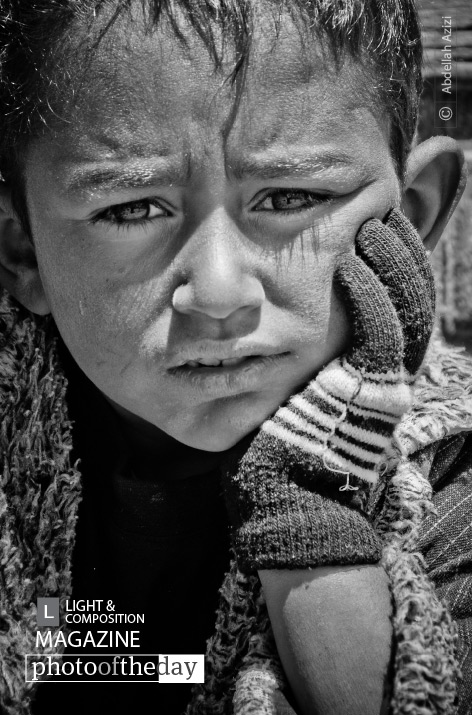
Atlas Child by Abdellah Azizi
Captured within the rugged, high-altitude terrain of the Atlas Mountains, this portrait reveals the profound gaze of a child whose life is defined by the harsh realities of his environment. When invited to pose, the subject offered a stare that seems to transcend time, looking directly through the lens and into the soul of the viewer. The image is award-worthy for its raw emotional honesty and the photographer's ability to capture a moment of quiet, haunting stillness amidst the vast, unforgiving landscape, highlighting the stark contrast between the child's innocence and his challenging existence.
Abdellah Azizi
Hailing from Ouarzazate, Morocco, 25-year-old Abdellah Azizi brings a unique perspective to his craft, shaped by his professional background as a cameraman and lighting technician. His work is deeply rooted in the vibrant culture of Southern Morocco, where he specializes in documenting local landscapes, traditional folkloric bands, and the daily lives of the region's inhabitants. Through his lens, Azizi strives to capture the authentic spirit of the African continent, blending technical precision with a keen eye for human storytelling.
Resonance Score Breakdown
Transparency Note: The resonance score (13.5/20) is calculated based on social engagement metrics collected before the award announcement.
Expert Photography Reviews · 5
The Geography of a Gaze
We often mistake the surface of a person for the whole of their landscape. We see the dust on the skin, the way the light catches a stray hair, and we assume we have mapped the territory.
Read the reflection →The Weight of a Glance
I was waiting for the bus this morning when a young boy standing near the shelter caught my eye.
Read the reflection →Reviews & Comments
Share your thoughts about this award-winning photograph. Your reviews contribute to the community engagement score.
The Atlas dust settles. It’s a heavy, dry silence. The boy’s gaze doesn’t ask for anything. He’s anchored in the frame, yet the vast, blurred earth behind him pulls away. I feel a sudden, sharp ache in my chest. He isn’t posing. He’s simply existing. Nothing here is accidental. The empty corner is not empty. It’s the weight of the mountains, pressing against his stillness. He’s enough. I’d leave it exactly as it is.
The Atlas light doesn’t reveal this child; it interrogates him. Azizi forces the shadows to swallow the periphery, leaving only that gaze—a heavy, geological stare. It’s not innocence we see, but the crushing weight of the mountains etched into skin. I’ve felt that same cold, hollow silence in a Tarkovsky frame. It’s unsettling. The darkness here isn’t a void; it’s the architecture of a life that refuses to be softened by our pity.
The subject’s placement at the extreme right edge creates a precarious spatial tension. It’s a bold gamble. The negative space to the left doesn’t merely breathe; it isolates the figure against the arid, compressed depth of the Atlas terrain. The focal plane is razor-sharp, yet the composition feels dangerously off-balance. I’m unsettled by the lack of a stabilizing fulcrum. It’s a rigid, unforgiving frame that demands total attention. The architecture holds, but barely.
At f/10, the Nikon’s sensor resolves the Atlas child’s skin texture with clinical precision, pushing the limits of the D90’s sensor. The focal plane is razor-thin, yet it captures the micro-contrast of every dust particle. I’m genuinely unsettled by how the diffraction of light across his iris reveals a depth the human eye usually misses. It’s a haunting optical achievement; the lens hasn’t just captured a portrait, it’s dissected the very soul of the high-altitude light.
Most portraits from the Atlas region rely on the exoticism of the landscape, but Azizi avoids that trap. He keeps the aperture at f/10, forcing the background to remain a textured, dusty reality rather than a blurred abstraction. It’s the boy’s unblinking, heavy-lidded stare that haunts me; I’ve looked at it for days and still feel a sharp, quiet ache in my chest. This will endure because it doesn’t romanticize poverty; it simply refuses to look away.
Thank you all.