Line of Trees by Ahmed Sabbir
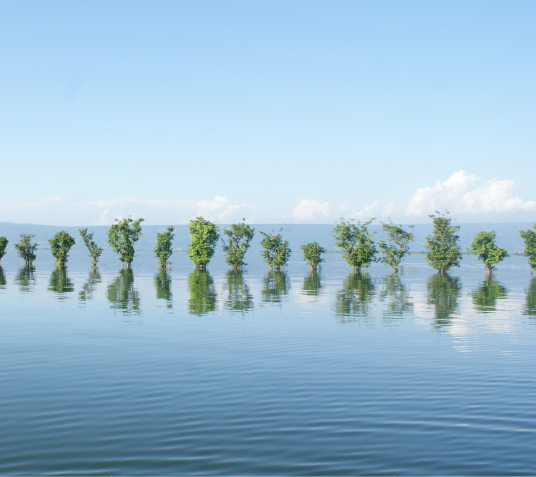
Captured in the serene expanse of Tanguar Haor, Bangladesh, this image portrays a striking line of trees reflected in perfectly still waters. The photographer was moved by the profound tranquility of the landscape, prompting an immediate pause in their journey to document the ethereal harmony between the blue sky and the submerged horizon. This photograph is award-worthy for its masterful use of composition and the evocative, meditative quality it captures, transforming a simple natural scene into a timeless, breathtaking vista that invites the viewer to experience the quiet majesty of the Bangladeshi wilderness.
Ahmed Sabbir
Based in Dhaka, Bangladesh, Ahmed Sabbir is a dedicated travel photographer who balances his professional life as a musician with a deep-seated passion for exploration. His work is driven by the belief that traveling and engaging with diverse cultures and natural landscapes allows for a more profound appreciation of life. Through his lens, Sabbir seeks to document the hidden beauty of his home country, capturing moments that reflect his personal philosophy of curiosity and connection to the planet.
Resonance Score Breakdown
Transparency Note: The resonance score (11.4/20) is calculated based on social engagement metrics collected before the award announcement.
Expert Photography Reviews · 4
The Weight of Stillness
There is a particular kind of silence that arrives when the wind dies. It is not an absence of sound, but a presence of something heavier. In the north, we wait for the water to turn to glass, to become a mirror that refuses to show us ourselves.
Read the reflection →The Mirror of Silence
If the world were to suddenly cease its turning, would we finally see ourselves, or would we simply be startled by the stillness?
Read the reflection →Reviews & Comments
Share your thoughts about this award-winning photograph. Your reviews contribute to the community engagement score.
The stillness of Tanguar Haor is deceptive. One suspects the photographer simply drifted by, saw the reflection, and clicked. It’s a pleasant enough view, but it lacks the grit of a long vigil. I’ve spent enough mornings shivering in damp reeds to know when a scene has been truly earned. This feels like a lucky encounter rather than a commitment. It’s pretty, certainly, but I’m left wondering if he ever bothered to return.
The cerulean expanse of Tanguar Haor bleeds into the submerged horizon, echoing the melancholic, dust-choked light of a Morandi still life. It’s a symphony of bruised indigos and the pale, watery turquoise of a dying summer sky. I’ve found myself breathless, lost in that liquid mirror where the trees dissolve into charcoal ghosts. One doesn’t merely look at these reflections; one drowns in their quiet, chromatic ache, feeling the cool, damp silence of Bangladesh against one’s skin.
Tanguar Haor isn’t just water; it’s a mirror demanding an accounting of the soul. Sabbir’s trees don’t merely reflect; they anchor the sky to the silt, refusing to let the light dissolve into mere prettiness. I’m unsettled by how the darkness clings to the roots, a heavy, silent gravity that pulls the gaze downward. It’s a somber meditation on stillness. I’ve stared at these shadows long enough to feel the cold, damp weight of the earth beneath.
Of the thousands of landscapes I’ve judged, most drown in their own stillness. Sabbir’s work avoids that trap because the horizon isn’t just a line; it’s a razor edge dividing two identical worlds. The trees don’t just sit there—they anchor the frame, preventing the blue void from swallowing the viewer. It’s haunting. I found myself holding my breath, waiting for a ripple that never comes. That’s why it’ll still matter in thirty years.