Indian Silverbills by Saniar Rahman Rahul
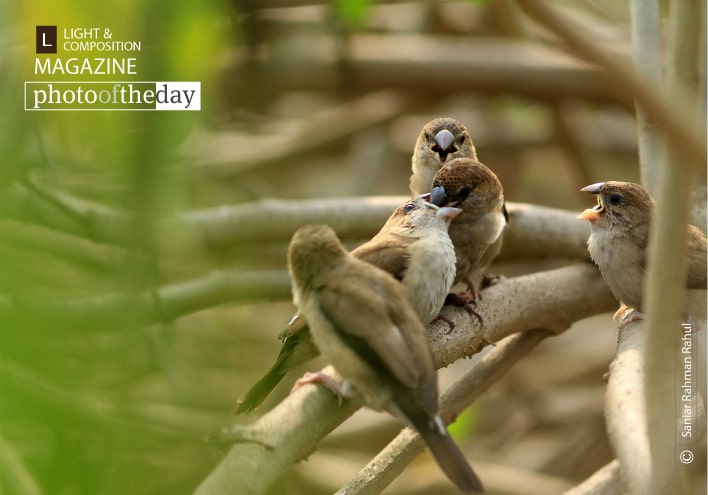
On a crisp winter morning in Ekuriya, near Dhaka, the photographer set out to capture the Siberian Ruby Throat, only to encounter a family of Indian Silverbills just feet away. The birds displayed a remarkable lack of fear, allowing the photographer to document the intimate moment as the parents arrived to feed their young. This image is award-worthy for its rare, candid proximity to wildlife and the tender interaction between the parent and its offspring, captured with technical precision that highlights the delicate textures of the birds against their natural environment.
Hala abdou
Born in cairo,she lives in alexandria ,she have many courses about food photography,and learn herself more & more by reading and search about this kind if photography,firstly she takes photos with phone then have acamera ,she takes many sessions for products ,and many personl projects,she proud herself because she is agood mum foe 3 children & wife beside good photographer Current Location alexandria,cairo Instagram https://www.instagram.com/p/B2OhXMvB8rU/?igshid=nv5wjoyi4r5p Facebook https://www.facebook.com/soma.ahmed.77398143 Best Achievements & Exhibitions None Award Winner Photo of the Day Camera Canon77d Lenses and Gears Lens50 Softbox Tryboid
Resonance Score Breakdown
Transparency Note: The resonance score (11.8/20) is calculated based on social engagement metrics collected before the award announcement.
Expert Photography Reviews · 8
The Weight of a Whisper
In the quiet corners of the natural world, there is a language that does not rely on volume. We often mistake stillness for an absence of activity, assuming that because a creature is not moving, it is not participating in the great, humming machinery of life.
Read the reflection →The Weight of a Whisper
The smell of dry grass always brings me back to the edge of a field, where the air feels thin and brittle against the skin. I remember the sensation of holding my breath, trying to become as still as a stone so that the world might forget I was there.
Read the reflection →Reviews & Comments
Share your thoughts about this award-winning photograph. Your reviews contribute to the community engagement score.
In Ekuriya, we find a quiet kinship. We watch these Silverbills and it’s as if we’re eavesdropping on a conversation between generations. The parent leans in, a gesture so tender it makes my own heart ache for the simplicity of home. Rahul didn’t just snap a bird; he listened to the rhythm of their morning. It’s a portrait of devotion, captured in the soft light of a winter dawn. This is a photograph that asks to be returned to.
The frame holds its breath. It’s a tight, intimate close-up, the kind of shot an editor keeps because the rhythm is perfect. The feed is a flicker of motion frozen in amber. I’ve spent years chasing this kind of stillness; it’s rare to catch such raw, domestic tenderness in the wild. The shutter speed caught the exact moment of connection. It’s beautiful. You don’t cut away from a scene this honest. It’s a film that refused to move.
The morning air in Ekuriya must have been biting, yet Saniar waited until the light softened into that pale, winter gold. It’s a quiet miracle when wild things lose their fear. Watching the parent feed its young, I’m struck by the tenderness of the moment; it’s almost sacred. He didn’t force this encounter. He simply listened to the stillness, and the birds allowed him into their private, fragile world. It’s a beautiful, humble act of attention.
At f/5, the 300mm focal plane is razor-thin, yet it resolves the Silverbills’ plumage with startling clarity. The diffraction limit hasn’t softened those intricate barbs, and the bokeh is a function of aperture that isolates the subjects perfectly against the Ekuriya brush. I’m genuinely moved by the way the light catches the parent’s beak; it’s a rare, microscopic intimacy. It’s not just a bird photo—it’s a precise, optical triumph that captures life’s fleeting, fragile geometry.
The diagonal axis formed by the branch dictates the visual flow, anchoring the subjects within the frame’s lower quadrant. It’s a rigid geometry that forces the eye toward the interaction. The negative space above provides necessary breathing room, preventing the composition from collapsing under its own detail. I’ve rarely seen such disciplined spatial tension in wildlife work. It doesn’t rely on sentiment; the structural weight of the birds against the blurred background holds the frame perfectly.
The palette here recalls Morandi’s dust-choked stillness, where the silverbills’ plumage, a muted taupe like weathered parchment, dissolves into the parched, ochre grasses of Ekuriya. It’s a quiet, monochromatic symphony of beige and pale clay that feels almost tactile, and I’ve found myself breathless at how the soft, diffused winter light renders their delicate forms. One doesn’t merely see these birds; one feels the gentle, hushed warmth of their fragile, feathered existence against the earth.
Most wildlife shots are just trophies, but this one hits differently. I’ve seen thousands of bird photos where the subject is sharp but the soul is missing. Here, the tension in the feeding interaction—that tiny, frantic exchange—is what makes it endure. It’s not just the technical precision of the 300mm lens; it’s the intimacy. Honestly, it makes me hold my breath. In thirty years, we’ll still care about this quiet, fleeting moment of survival.
One suspects the Siberian Ruby Throat was the intended prize, yet the Silverbills proved a far more rewarding consolation. It’s rare to see such intimacy without the birds sensing a threat. I’ve spent enough mornings in the damp grass to know that kind of trust isn’t given; it’s earned through absolute stillness. It makes my own joints ache just looking at it. Rahul clearly sat long enough to become part of the scenery. A fine, quiet achievement.