The Tibetan Cowboy by Barry Cawston
Seeking an alternative perspective on Tibet beyond the iconic Potala Palace, the photographer captured this striking image of a modernist pumping station set against the rugged Himalayan landscape. The scene took on a surreal quality when a young Tibetan man, possessing a distinct, James Dean-like coolness, entered the frame. By juxtaposing the rigid, industrial structure with the man’s sophisticated, Savile Row-inspired attire, the photograph offers a poignant commentary on the shifting cultural identity of the region under external influence. This masterfully composed moment highlights the photographer's ability to find profound, unexpected narratives within changing environments.
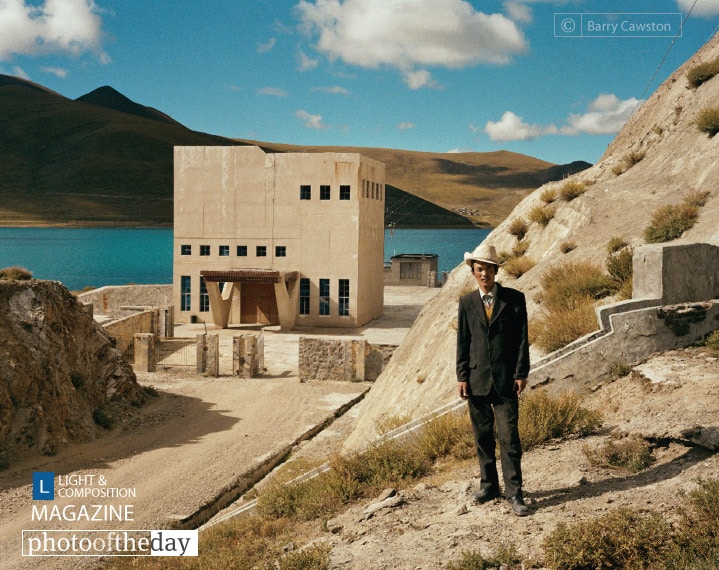
Barry Cawston
Based in Axbridge, Somerset, Barry Cawston is a distinguished freelance photographer whose work has appeared in prominent publications such as The Guardian and The Sunday Telegraph. Known for his technical precision, he primarily shoots with a large-format field camera and produces his own traditional color darkroom prints, often at a monumental scale. Beyond his commercial success, Cawston co-directs The Drugstore Gallery and has earned significant recognition, including the South West Art Award and the Nikon Endframe Award, while maintaining a robust exhibition presence in major art centers across London and Europe.
Resonance Score Breakdown
Transparency Note: The resonance score (15.1/20) is calculated based on social engagement metrics collected before the award announcement.
Expert Photography Reviews · 6
The Grit of New Skins
The smell of cold iron always brings me back to the winter my father worked the rail yards. It is a sharp, metallic scent that clings to the back of the throat, tasting faintly of copper and dry, frozen wind.
Read the reflection →The Suit and the Stone
In the high, thin air of the mountains, history is often written in stone and silence. We tend to imagine the past as a static thing, a museum piece preserved under glass, untouched by the frantic pace of the modern world. Yet, culture is not a monument; it is a river.
Read the reflection →Reviews & Comments
Share your thoughts about this award-winning photograph. Your reviews contribute to the community engagement score.
Hi
I love this photo, I first saw it on the programme Show me the Monet. Please can you let me know if this available to buy in poster form.
Thank you
The ochre dust of Lhasa clings to the pumping station’s concrete, a shade reminiscent of Morandi’s muted, chalky palettes, yet it’s the man’s jacket—a deep, melancholic indigo—that truly haunts me. It’s a jarring, beautiful dissonance against the Himalayan sky, a blue so cold it feels like a sudden intake of breath. I’m utterly captivated by how this singular, saturated hue anchors the entire frame, turning a mere industrial relic into a profound, chromatic ache.
The pumping station’s cold, industrial geometry doesn’t merely frame the man; it consumes his history. I’m unsettled by how the deep, unforgiving shadows beneath the structure swallow the landscape’s sacred silence. It’s a brutal collision of modernity and myth. When I look at the way the light dies against his tailored coat, I feel a genuine ache for what’s being erased. The darkness here isn’t empty—it’s the heavy, suffocating weight of a culture being rewritten.
The industrial geometry of the pumping station anchors the frame, providing a brutalist counterpoint to the organic sprawl of the mountains. The subject’s placement creates a precise fulcrum, balancing the rigid steel against the soft, atmospheric depth. It’s a rare instance where the tension doesn’t collapse under the weight of its own irony. I’m genuinely unsettled by how perfectly that silhouette disrupts the horizon line. The composition holds. It’s a disciplined, architectural triumph.
Setting up a Wista in the thin air of Lhasa isn’t for the faint of heart. Most would’ve snapped a digital frame and retreated to a warm hotel. Instead, Cawston waited for the intersection of industrial grit and that young man’s quiet defiance. It’s a rare, earned moment. I’ve spent enough hours shivering behind a tripod to respect the discipline here. He didn’t just find this; he sat in the cold until it finally arrived.
The light here is thin, high-altitude, and unforgiving. It doesn’t flatter the pumping station; it strips it bare. I’ve spent enough time in the mountains to know that stillness isn’t empty—it’s heavy. When this young man walked into the frame, he brought a strange, modern friction to that ancient, silent air. It’s unsettling. I find myself shivering, not from the cold, but from the sudden, sharp realization that the world is changing right before our eyes.
Most travel photography is just visual noise, but this sticks. Of the thousands I’ve reviewed, few capture the friction of modernity like this. The pumping station’s brutal geometry against that boy’s effortless, tailored cool creates a tension that’s genuinely unsettling. It’s the kind of cultural collision that’ll still feel relevant in thirty years. Honestly, it makes me ache for a world that’s disappearing. It’s not just a portrait; it’s a document of a shifting soul.