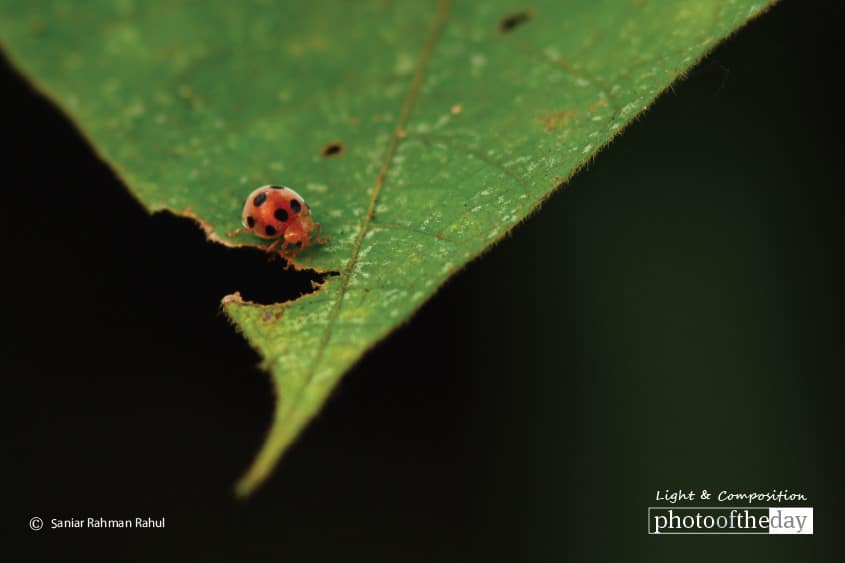
Ladybug by Saniar Rahman Rahul
Captured during an arduous eight-kilometer trek into the Rema-Kalenga Wildlife Sanctuary, this image highlights the delicate beauty of a ladybug amidst one of Bangladesh's most biodiverse natural landscapes. The photographer utilized a wide-angle perspective to ground the tiny subject within the vast, dry evergreen forest, demonstrating a keen eye for the intricate details of the natural world. This photograph is award-worthy for its ability to transform a fleeting encounter during a long journey into a compelling macro study, showcasing both patience and technical precision in a challenging, remote environment.
Saniar Rahman Rahul
Based in Dhaka, Bangladesh, Saniar Rahman Rahul is a seasoned Art Director at Grey Worldwide with a career deeply rooted in the creative arts. His journey into photography began in childhood, inspired by his father's work, and was later refined through his extensive professional background in graphic design and advertising. Since winning his first major photography award in 2010, Rahul has balanced his high-level career in the advertising industry with a passionate pursuit of nature and close-up photography, consistently capturing the rich biodiversity of his home country.
Resonance Score Breakdown
Transparency Note: The resonance score (12.5/20) is calculated based on social engagement metrics collected before the award announcement.
Expert Photography Reviews · 8
The Smallest Weight
I spent an hour this morning trying to fix a loose hinge on my kitchen cabinet. It was a tiny, stubborn thing that kept slipping out of place, no matter how hard I tightened the screw.
Read the reflection →The Weight of the Small
Why do we assume that significance is measured by scale? We spend our lives looking for the grand, the loud, and the monumental, convinced that truth must reside in the things that tower over us. Yet, there is a quiet, persistent defiance in the minute.
Read the reflection →Reviews & Comments
Share your thoughts about this award-winning photograph. Your reviews contribute to the community engagement score.
The 17mm focal length forces a violent spatial tension between the ladybug’s minute mass and the forest’s sprawling geometry. It’s a precarious balance. The frame doesn’t collapse, though it nearly does under the weight of the peripheral blur. I’m genuinely unsettled by how the insect anchors such a vast, chaotic plane. It’s a rare instance where the wide-angle choice justifies the distortion. The composition holds, barely, through sheer, cold, mathematical discipline. It’s an architectural triumph.
Most macro shots isolate the subject, but Rahul’s choice of a 17mm lens forces the ladybug to share the frame with the vast, encroaching forest. It’s a risky gamble that pays off; the scale makes the insect feel vulnerable, not just pretty. I’ve seen thousands of bugs, yet this one actually made me hold my breath. It’s the tension between that tiny, vibrant speck and the overwhelming, muted wilderness that ensures this will still matter in thirty years.
Using a 17mm lens for a ladybug is a defiant, almost perverse choice. Most would reach for a macro prime to obsess over wing patterns, but Rahul forces us to confront the forest’s crushing scale instead. It’s a gamble that pays off. I’m genuinely unsettled by how the insect dissolves into the bokeh. Why resolve the subject when you can resolve the atmosphere? It’s closer to Sugimoto’s blurred horizons than typical wildlife photography. Truly refreshing.
You walked eight kilometers for this, and I can feel the humidity of that forest in the frame. Most people would’ve reached for a macro lens, but you chose a wide angle. That’s the choice of someone who cares about the world, not just the bug. It’s quiet, humble, and honest. I’ve spent enough time in the brush to know that patience. You didn’t just take a picture; you sat with the forest. That’s real.
A single red dot against the vast, dry floor of Rema-Kalenga. It’s a quiet defiance. I’ve walked forests like this, feeling small, but Rahul finds the scale I usually miss. The ladybug isn’t just a subject; it’s an anchor. The surrounding brown earth breathes. Nothing here is accidental. The empty corner is not empty. It’s a pause. I find myself holding my breath, waiting for the insect to move. It doesn’t. It just exists.
The frame holds its breath. A wide 17mm lens shouldn’t work here, yet it pulls the entire forest into the ladybug’s orbit. It’s a masterclass in scale. I’ve trekked through humidity like that, and honestly, the sheer stillness makes my lungs ache. The cut would’ve been a mistake; the environment is the protagonist. Rahul didn’t just snap a bug; he directed a silent epic. It’s the frame the editor keeps because it refuses to blink.
The forest floor in Rema-Kalenga doesn’t give up its secrets easily. After eight kilometers, Saniar must have felt the damp, heavy silence of the sanctuary pressing in. He didn’t just find a ladybug; he waited for the light to settle upon it. It’s a quiet, grounding perspective. I’ve spent hours in similar thickets, and looking at this, I feel a sudden, sharp ache for that stillness. He listened to the land, and it spoke back.
Why does the ladybug occupy such a sliver of this vast, dry forest? By choosing a 17mm lens, Rahul forces a tiny creature into a landscape that doesn’t belong to it. It feels like a colonial imposition of scale. I find myself frustrated by the distance here. Is the forest a backdrop for our human curiosity, or a home we’re merely invading? It’s technically sharp, but it leaves me feeling cold and deeply detached.