Untitled by Shirren Lim
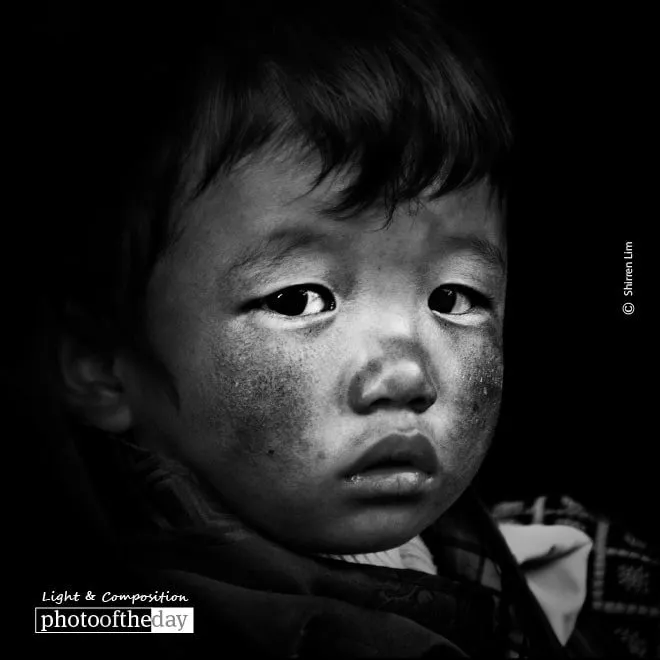
Captured during the vibrant Trongsa Festival in Bhutan in December 2012, this portrait shifts the focus from the main event to the quiet observers. While the crowd was swept up in the festival's gaiety, the photographer turned her lens toward a young boy whose doleful expression stood in poignant contrast to the surrounding celebration. This image is award-worthy for its keen observational skill, capturing a moment of profound, unscripted sincerity that cuts through the noise of the festival. It serves as a powerful testament to the photographer's ability to find deep, human narratives in the periphery of grand spectacles.
Shirren Lim
Born in Penang Island, Malaysia, in 1970, Shirren Lim is a Jakarta-based photographer who discovered her true passion for the craft in 2009. Specializing in portraiture, she seeks to capture the raw sincerity and beauty of human expression, aiming to document humanity in its most authentic forms. Her work is characterized by an intense, earthy aesthetic and a minimalist compositional style that strikes at the heart of her subjects. Inspired by the iconic imagery of Steve McCurry, she strives to create powerful, world-changing photographs that resonate with viewers across the globe.
Resonance Score Breakdown
Transparency Note: The resonance score (11.5/20) is calculated based on social engagement metrics collected before the award announcement.
Expert Photography Reviews · 8
The Margin of the Crowd
Public spectacles are often designed to manufacture a singular, collective experience. We are invited to cheer, to watch, and to lose ourselves in the rhythm of the event. Yet, the city—or the village square—is never truly a monolith.
Read the reflection →The Weight of Silence
We are taught to look for the center of the room. We are told that the loudest voice holds the truth, that the brightest color defines the day. But truth is often found in the periphery, in the space where the noise fails to reach.
Read the reflection →Reviews & Comments
Share your thoughts about this award-winning photograph. Your reviews contribute to the community engagement score.
Perfect expression captured. Superb click.
The boy’s face anchors the frame at the golden ratio’s intersection, creating a perfect vertical axis against the chaotic bokeh of the festival. I’m struck by how the diagonal of his shoulder pulls the eye toward the negative quadrant, balancing the heavy visual mass of his traditional attire. It’s a precise spatial equation. The geometry doesn’t just contain his melancholy; it amplifies it. I’ve rarely seen such a complex, crowded scene solved with such elegant, rigid order.
The boy’s gaze echoes the haunting, unvarnished directness of August Sander’s portraits, yet it’s stripped of that Weimar-era clinical distance. Lim finds a quiet gravity here that reminds me of Dorothea Lange’s Migrant Mother, though the context is entirely inverted. I’m genuinely moved by how she isolates this singular, doleful presence against the festival’s blur. It’s a rare, piercing stillness that manages to hold its own against the weight of a century’s worth of ethnographic portraiture.
Before the eye identifies the boy’s face, a sudden stillness anchors the chest. It’s a heavy, hollow quiet that pulls the breath inward. Amidst the festival’s blur, his gaze doesn’t just watch; it waits. I’ve returned to this portrait for years, and each time, that doleful, unblinking stare triggers a familiar ache in my own throat. It’s the weight of being small in a world that’s far too loud. It’s a haunting, beautiful solitude.
The festival’s roar fades into the periphery here. Shirren stood in the cooling, thin air of the Himalayas, waiting for the crowd’s noise to settle into this boy’s stillness. I’ve felt that same heavy silence in the mountains; it’s a weight that demands total surrender. The light doesn’t just illuminate his face; it listens to his solitude. Looking at his eyes, I feel a sudden, sharp ache for the quiet places we’ve all left behind.
In the middle of the Trongsa Festival’s roar, Shirren Lim found a boy who wasn’t listening to the music. We look at his eyes and we feel the weight of a silence that doesn’t belong in a crowd. It’s a heavy, beautiful solitude. I find myself wanting to sit beside him, just to ask what he’s thinking. It’s a portrait that asks to be returned to, because it reminds us that stories live in the quiet.
Most festival photography is just noise, a frantic chase for color that fades by next week. What separates this from the thousands of snapshots I’ve reviewed is the boy’s stillness. He isn’t performing for the lens; he’s anchored in a private, heavy melancholy that makes the surrounding gaiety feel hollow. It’s a haunting, quiet ache that I still feel in my chest years later. That’s why this survives; it’s a truth that doesn’t age.
You didn’t get distracted by the festival’s noise. While everyone else was chasing the dancers, you saw this boy. It’s a heavy, quiet look he’s wearing, and it hit me right in the chest. You waited for that specific stillness, and it pays off. You weren’t just taking a picture; you were listening to him. And that’s why this works. You found the human truth hiding in the periphery. I respect that.
The ochre of the boy’s robe, reminiscent of a weathered Morandi still life, anchors this frame in a melancholic warmth that feels almost tactile. It’s the bruised, dusty gold of a Himalayan sunset, clashing beautifully against the cool, shadow-drenched blues of the periphery. I’m truly undone by how the light clings to his solemn features; it’s a chromatic ache, one that lingers long after one has looked away from his quiet, unyielding gaze.