Moses-in-the-cradle by Siew Bee Lim
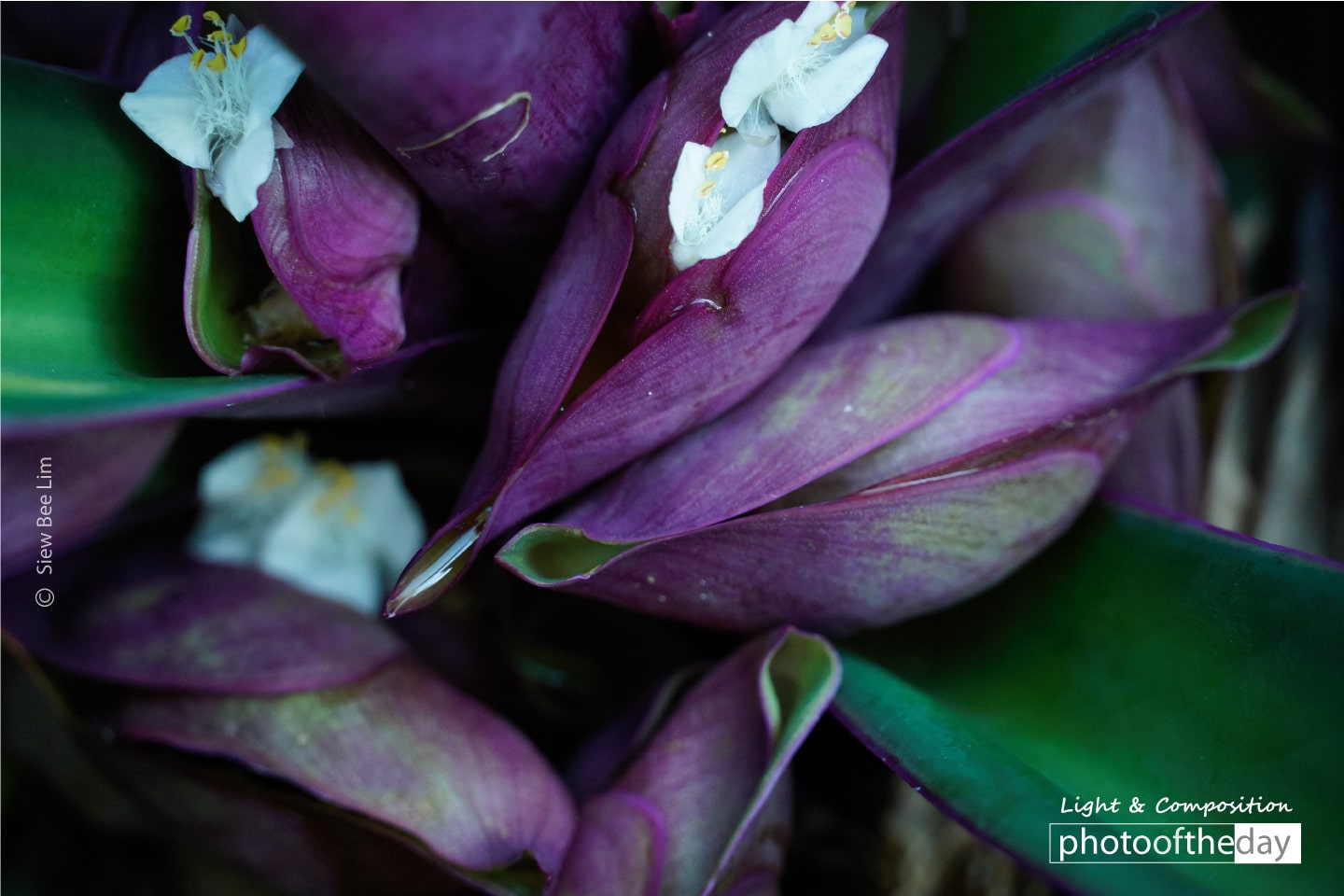
Captured in the soft light of an early February morning, this intimate close-up of a Moses-in-the-cradle plant reveals the intricate beauty of nature at ground level. By utilizing a high ISO to illuminate the frame, the photographer highlights the striking contrast between the vibrant purple undersides of the leaves and the delicate, shell-shaped buds from which white flowers emerge. This image is award-worthy for its masterful focus on texture and depth, transforming a humble herb into a compelling study of botanical dimension and light.
Siew Bee Lim
Born in Singapore in 1965, Siew Bee Lim is a dedicated photographer who balances her professional background as a programmer with a growing passion for the visual arts. Though she initially explored photography as a young adult, her journey has evolved into a formal pursuit of excellence through the Light & Composition platform. Drawing inspiration from her lifelong appreciation of Chinese painting and a desire to refine her technical craft, she now focuses on capturing the subtle textures and hidden details of the natural world.
Resonance Score Breakdown
Transparency Note: The resonance score (10.4/20) is calculated based on social engagement metrics collected before the award announcement.
Expert Photography Reviews · 5
The Quietude of Veins
There is a specific, hushed quality to the light that filters through dense foliage just before the heat of the day takes hold. It is a filtered, green-tinged clarity, the kind that forces you to slow your breathing and look closer at the architecture of the small.
Read the reflection →The Architecture of Small Things
I often find myself walking the back alleys of the mind, looking for the places where the city stops shouting and starts whispering.
Read the reflection →Reviews & Comments
Share your thoughts about this award-winning photograph. Your reviews contribute to the community engagement score.
The morning air in Singapore holds a heavy, quiet stillness. Siew Bee Lim didn’t just photograph this plant; she knelt before it, waiting for the light to reveal those hidden purple depths. It’s a humble, sacred geometry. I find myself holding my breath, feeling the damp earth beneath my own knees. She’s listened to the way the light cradles these delicate buds, turning a simple herb into a quiet, living prayer. It’s truly beautiful.
Nature doesn’t wait for the light to hit just right, but Siew Bee Lim caught it. That purple underside against the white bloom? It’s sharp. I’ve spent my life chasing people, but this botanical study hits me like a Winogrand frame—it’s about the tension of the growth. One tenth of a second later and the light shifts, the texture flattens. You nailed the timing. It’s a quiet, decisive moment in a chaotic world. I love it.
Karl Blossfeldt’s rigorous botanical typologies haunt this frame, yet Lim avoids his clinical detachment. The purple undersides of the Tradescantia spathacea evoke a painterly depth that feels almost tactile. I’m genuinely struck by how the 135mm compression isolates those shell-shaped buds against the soft, diffused morning light. It’s a quiet, elegant departure from the sterile macro studies I’ve endured for decades. It doesn’t just document a plant; it breathes a rare, intimate life into the foliage.
1/200sec at f/5.6, ISO 1600, 135mm. It’s a noisy compromise. That ISO 1600 on an APS-C sensor introduces luminance noise that muddies the delicate textures of the Moses-in-the-cradle. Why f/5.6? At 135mm, the depth of field is already razor-thin. I’d have preferred a tripod and base ISO to preserve the leaf structure. It’s technically sloppy, yet I’m strangely drawn to the purple hues. The optics didn’t fail, but the sensor settings certainly did.
The light hits those purple undersides like a slow fade-in on a lush, humid set. It’s a tight, claustrophobic frame, yet it breathes. The focus is razor-sharp, catching the shell-shaped buds just as they’re ready to break. I’ve spent hours in editing suites looking for this kind of tension. It’s a quiet, rhythmic pulse of nature. Honestly, I’d kill to have captured that exact light. The cut would have been a mistake; it’s perfect.