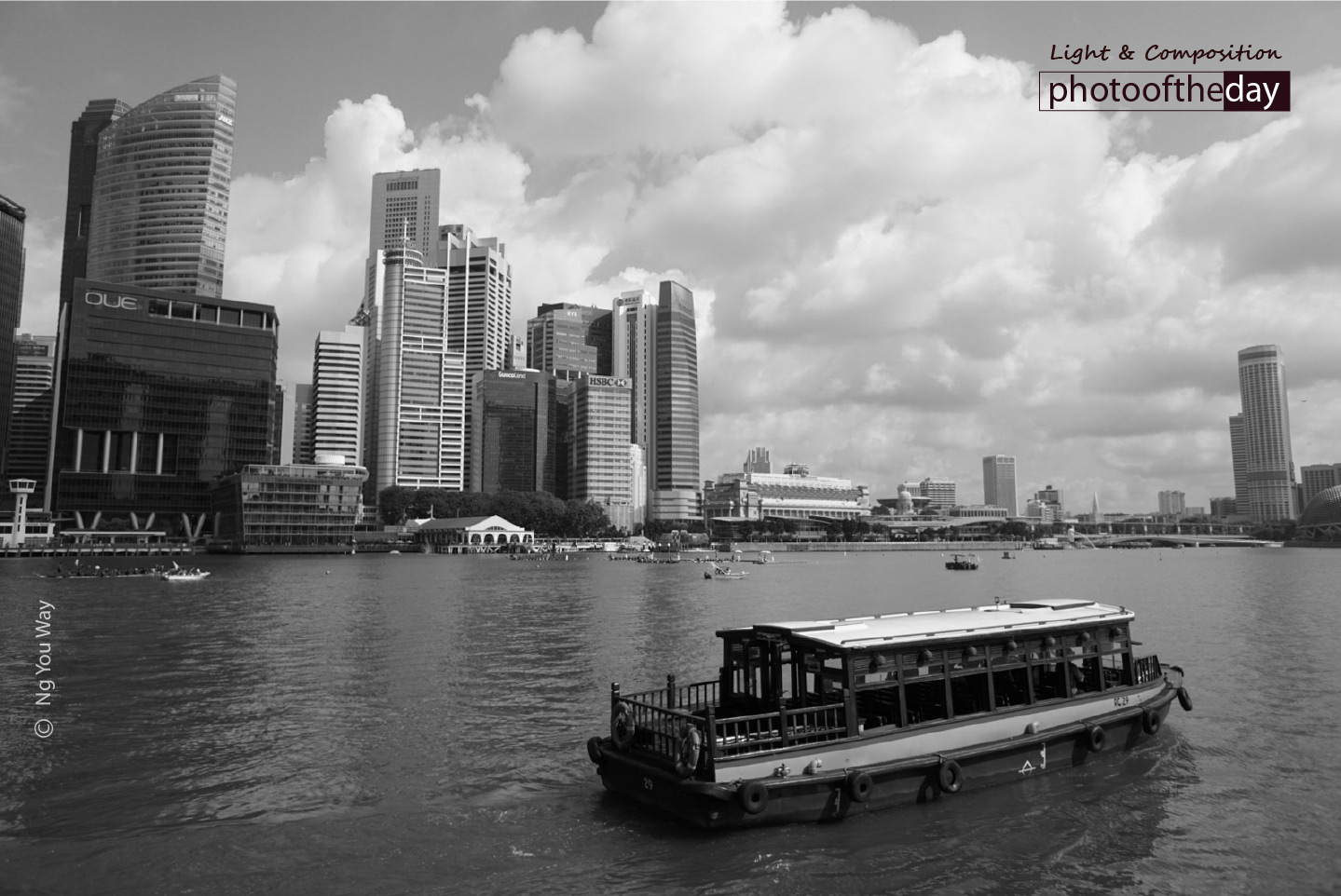
The Sunny Island by Ng You Way
Captured at The Esplanade, this photograph serves as a poignant reflection on Singapore’s dual identity. The composition juxtaposes the relentless energy of the city's business district against the serene, cradling waters of the harbor. By framing the boats that ferry visitors across this landscape, the photographer highlights the harmony between industrial progress and the natural beauty of the 'sunny island.' The image is award-worthy for its thoughtful balance of architectural scale and tranquil atmosphere, successfully distilling the essence of a nation defined by both its bustling economic machine and its peaceful maritime heritage.
Ng You Way
Ng You Way is a Singapore-based photographer who discovered her passion for the craft later in life. Driven by a deep curiosity for global cultures, she balances her professional commitments with a dedicated pursuit of photography, aiming to share her unique perspective of the world with an international audience. Her work reflects a keen sensitivity to her surroundings, capturing the intricate stories hidden within the landscapes and daily rhythms of her homeland.
Resonance Score Breakdown
Transparency Note: The resonance score (12.6/20) is calculated based on social engagement metrics collected before the award announcement.
Expert Photography Reviews · 4
The Architecture of Stillness
Seneca once observed that we are often more frightened than hurt, and that we suffer more in imagination than in reality.
Read the reflection →The Architecture of Ambition
Cities are rarely built for the people who inhabit them; they are built for the people who own them.
Read the reflection →Reviews & Comments
Share your thoughts about this award-winning photograph. Your reviews contribute to the community engagement score.
The Esplanade’s aluminum cladding pushes the lens toward its diffraction limit, yet the micro-contrast remains sharp enough to resolve the sun’s specular highlights on the harbor. It’s a rare moment where the focal plane perfectly aligns with the geometry of the architecture. I’m genuinely moved by how the chromatic aberration is suppressed across those complex curves. It’s not just a city shot; it’s a precise calibration of light meeting glass, and it’s absolutely breathtaking.
The shutter speed here is perfect. It’s a long, steady take that lets the harbor breathe while the city hums in the background. I love how the boats cut through the frame, providing the rhythm this composition demands. It’s a quiet, cinematic pause in a frantic metropolis. If you’d pushed the exposure any further, the stillness would’ve shattered. You’ve captured the exact moment the city stops to look at itself. It’s a beautiful, held breath.
The Esplanade’s spikes usually demand a clinical, razor-sharp rendering, but here, the motion blur softens that aggressive architecture into something almost organic. It’s refreshing. Why resolve every steel panel when you can capture the city’s pulse instead? This approach feels closer to Hiroshi Sugimoto’s long-exposure theatres than to standard architectural documentation. I’m genuinely moved by how the harbor’s movement dissolves the rigid business district. It’s a brave, necessary rejection of the expected technical perfection.
It’s a tidy composition, though one wonders if the photographer simply happened upon this light while strolling past the Esplanade. I’ve spent enough damp mornings waiting for the harbor to settle to know that convenience rarely yields depth. The framing is competent, yet it lacks the grit of a long-term commitment to the location. I’d have preferred to see the tide turned or the sky bruised. It’s pleasant, but it hasn’t cost enough.