The Black Shoulder Kite by Saniar Rahman Rahul
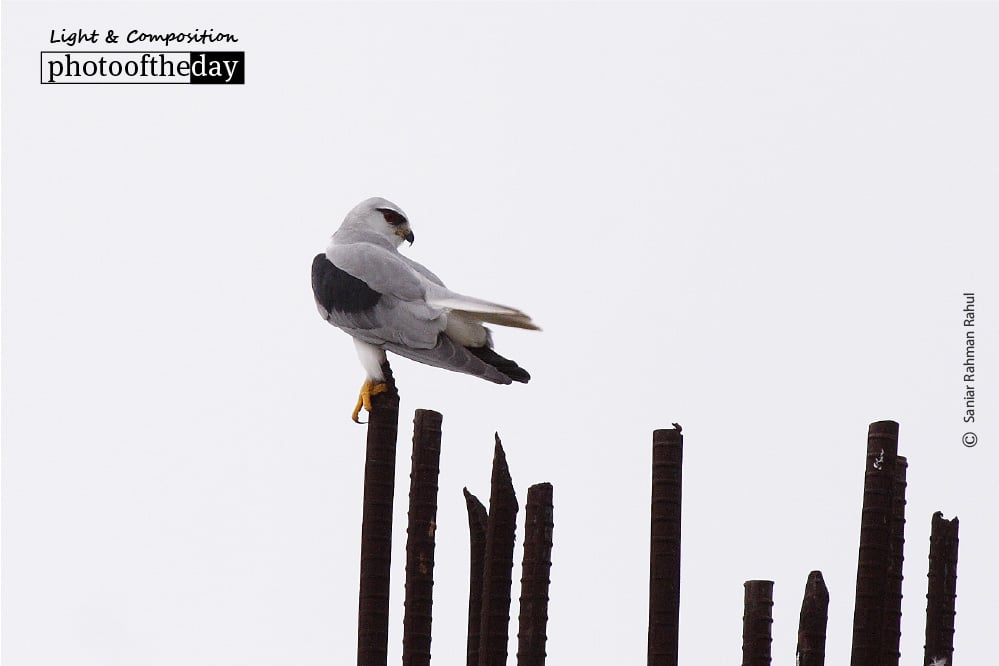
Captured at Jahangirnagar University, a renowned sanctuary for migratory birds in Bangladesh, this striking image features a black-shouldered kite in its natural habitat. The photographer expertly documents the small raptor, highlighting its distinct features and graceful presence in an open landscape. By focusing on the bird's sharp gaze and intricate plumage, the image provides an intimate look at a species often compared to its counterparts in Africa and Eurasia. This photograph is award-worthy for its technical precision and the photographer's ability to capture the quiet, wild essence of a raptor within a bustling university environment.
Saniar Rahman Rahul
Based in Dhaka, Bangladesh, Saniar Rahman Rahul is an accomplished Art Director at Grey Worldwide with a deep-rooted passion for visual storytelling. His journey into photography began in childhood, inspired by his father, and was later refined through his extensive professional career in graphic design and advertising. Since winning his first major photography accolade in 2010, Rahul has balanced his high-level creative work in the advertising industry with a dedicated pursuit of wildlife and nature photography, consistently demonstrating a keen eye for composition and detail.
Resonance Score Breakdown
Transparency Note: The resonance score (13.0/20) is calculated based on social engagement metrics collected before the award announcement.
Expert Photography Reviews · 7
The Architecture of Stillness
There is a particular kind of silence that belongs only to the hunter. It is not the absence of sound, but a sharpening of the air, a suspension of breath where the world holds its pulse to see what might emerge from the tall, dry grass.
Read the reflection →The Weight of a Feather
I keep a single, iridescent feather tucked inside the pages of a book I rarely open. It is frayed at the edges, a small, brittle ghost of a creature that once navigated the vast, indifferent currents of the sky.
Read the reflection →Reviews & Comments
Share your thoughts about this award-winning photograph. Your reviews contribute to the community engagement score.
The shutter snaps, and the world stops. It’s a freeze-frame of pure predatory intent. That gaze—piercing, locked, unblinking—it’s the kind of tension an editor prays for in a close-up. I’ve watched enough raptors to know this bird isn’t just sitting; it’s calculating the next strike. The bokeh softens the university background into a blurred, cinematic wash, isolating the kite’s lethal elegance. It’s a perfect cut. Honestly, I felt my own pulse quicken just looking at those eyes.
The kite waits. It’s a sharp point against the vast, pale sky. I’ve spent minutes just breathing with it. The bird doesn’t move. The surrounding space isn’t vacant; it’s a weight. It’s heavy with the silence of the university grounds. Nothing here is accidental. The empty corner is not empty. It’s a breath held. I feel my own pulse slow down. It’s rare to find such stillness in a frame. Truly rare.
Technical precision is a bore. While the jury praises this kite’s sharp gaze, I’m left craving the kinetic energy of its flight. Why resolve every feather when you could capture the violent, blurred velocity of a predator? It’s technically competent, sure, but it feels static. I’d trade this clinical clarity for a smear of motion, something closer to Sugimoto’s long-exposure theatres. It’s a missed opportunity to turn a bird into a ghost.
Before the eye identifies the raptor, a sudden stillness anchors the chest. The kite’s gaze is a sharp, predatory needle, piercing the soft blur of the university grass. It’s an activation of the nerves, a sudden alertness I’ve felt only when watching a storm gather. When I return to this, I don’t see a bird; I feel the cold, detached hunger of the wild. It’s haunting how something so small can command such absolute, breathless silence.
The focal plane here is razor-thin, perfectly isolating the kite’s nictitating membrane. At this aperture, the bokeh renders the Jahangirnagar foliage into a soft, creamy wash, preventing any chromatic aberration from bleeding into those sharp, slate-grey feathers. It’s a triumph of diffraction control. Honestly, seeing that piercing crimson iris resolved with such clinical, terrifying clarity makes my heart skip. It’s not just a bird; it’s a masterclass in how glass can finally outpace the limitations of our own eyes.
In the quiet of Jahangirnagar, we meet a gaze that isn’t human, yet it feels deeply familiar. Saniar Rahman Rahul didn’t just capture a bird; he sat with a presence. We look into those red, piercing eyes and we understand the weight of a wild life observed with patience. It’s a portrait of stillness amidst the bustle. I find myself holding my breath, caught in that sharp, golden stare. It’s a photograph that asks to be returned to.
Rahul’s kite evokes the clinical precision of Eliot Porter’s ornithological studies, yet it’s the juxtaposition against the encroaching human landscape that intrigues me. It’s a sharp, modern echo of the Victorian obsession with taxonomy, but with a restless, contemporary anxiety. I’ve spent decades staring at raptors in frames, but the intensity in this bird’s eye—that piercing, predatory clarity—actually made me catch my breath. It’s a rare, haunting intersection of wild instinct and our own fragile, encroaching world.