Sangam Point by Lothar Seifert
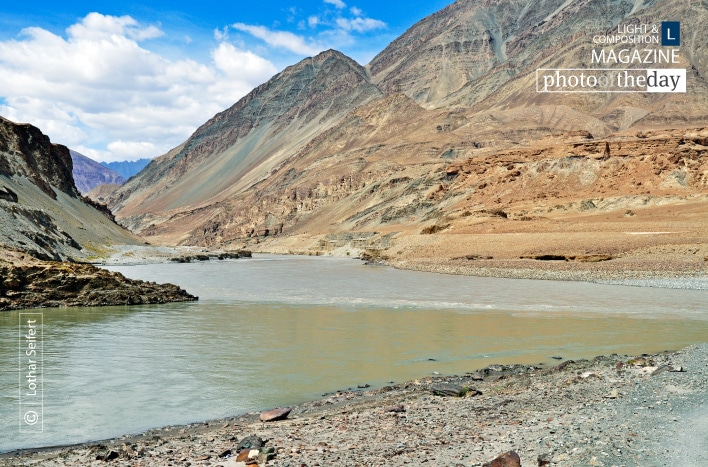
Captured at the dramatic confluence of the Indus and Zanskar rivers in Ladakh, this image showcases the raw, rugged beauty of the Himalayan landscape. Lothar Seifert utilized a 32mm focal length to frame the stark contrast between the winding, silt-laden waters and the towering, snow-capped peaks that define this high-altitude region. The photograph is award-worthy for its masterful composition and technical clarity, effectively conveying the immense scale and spiritual serenity of the Sangam point. By balancing the natural textures of the riverbanks with the vast, imposing mountain backdrop, the image serves as a poignant testament to the wild, untouched majesty of northern India.
Lothar Seifert
Born in 1955, Lothar Seifert is a German design engineer based in Upper Lusatia who balances his professional career with a profound passion for photography. His extensive travels across Asia, particularly through Nepal, Kashmir, and Ladakh, have deeply influenced his work, fostering a distinct focus on road and portrait photography that highlights both cultural diversity and human solidarity. Beyond his artistic pursuits, Seifert is a dedicated humanitarian who actively supports schooling and welfare projects for children in the Himalayas, using his photography as a tool to promote environmental conservation and global understanding.
Resonance Score Breakdown
Transparency Note: The resonance score (11.5/20) is calculated based on social engagement metrics collected before the award announcement.
Expert Photography Reviews · 7
Where Rivers Learn to Speak
We often mistake the edges of a map for the edges of our world. We draw lines across mountains and rivers, naming them borders, as if the earth itself recognizes the jurisdictions we impose upon it. Yet, geography has a memory that predates our fences and our settlements.
Read the reflection →Where Two Paths Become One
Can two things ever truly become one, or do they merely learn to share the same space while holding onto their original selves?
Read the reflection →Reviews & Comments
Share your thoughts about this award-winning photograph. Your reviews contribute to the community engagement score.
The confluence of the Indus and Zanskar rivers creates a sharp, diagonal vector that anchors the frame. It’s a rigid geometry. The silt-laden currents provide a necessary counterweight to the static, snow-capped peaks. I’m genuinely unsettled by how the river’s path forces the eye toward the edge, yet the composition doesn’t collapse. It’s a precarious balance of mass. The spatial tension holds, even if the landscape itself threatens to spill beyond the frame’s discipline.
The confluence hits you like a sudden cut to wide. The Indus and Zanskar collide, and the frame holds its breath. It’s a brutal, silent edit where the silt-heavy water meets the jagged, indifferent peaks. I’ve spent hours staring at these textures; it’s the kind of stillness that makes your pulse drop. Seifert didn’t need a pan or a zoom here. He knew the shot was already finished. It’s the frame the editor keeps forever.
The Indus and Zanskar meet here, a quiet collision of silt and stone. I’ve spent enough mornings in the mountains to know that silence isn’t empty; it’s heavy. Lothar waited for the light to soften against those jagged peaks, catching the exact moment the rivers surrendered their colors to the valley. It’s a humbling sight. I find myself holding my breath, feeling the thin, cold air of Ladakh settle deep in my own lungs.
Before the eye identifies the confluence, something in the chest tightens. The silt-heavy Indus meeting the Zanskar doesn’t just sit there; it demands a physiological surrender to scale. I feel a sudden, sharp drop in my own pulse, a quiet vertigo triggered by those jagged, snow-dusted peaks. When I return to this a year later, the silence of Ladakh still clings to my skin. It’s a cold, breathless ache that follows me into sleep.
The confluence creates a perfect diagonal vector, slicing the frame into a 1:2 ratio of silt-heavy water against arid stone. The mountain peaks anchor the vertical axis, providing a stable visual gravity that prevents the composition from sliding off the edge. I’m genuinely struck by how the river’s curve resolves the tension between the jagged peaks and the flat banks. It’s a beautifully solved spatial equation; the geometry here doesn’t just exist, it breathes.
The silt-heavy, glacial turquoise of the Indus colliding with the Zanskar’s deeper, bruised indigo creates a chromatic friction that’s utterly intoxicating. It’s a Morandi-esque study in geological patience, where the arid, ochre-dusted slopes don’t merely frame the water but participate in a silent, tectonic dialogue. I’ve found myself breathless before this confluence, mesmerized by how the light renders the peaks in a cool, Vermeer-like clarity that makes the very air feel thin, ancient, and profoundly sacred.
The confluence at Sangam Point isn’t architecture, yet it demands a structural reading. The river’s silt-laden flow acts as a datum, carving through the mass of the mountains like a circulation path through a brutalist void. I’m struck by how the light hits those jagged slopes; it’s cold, unforgiving, and makes the scale feel almost impossible to inhabit. It’s a reminder that nature builds with a permanence that makes our own thresholds look remarkably fragile.