The White-collared Blackbird by Saniar Rahman Rahul
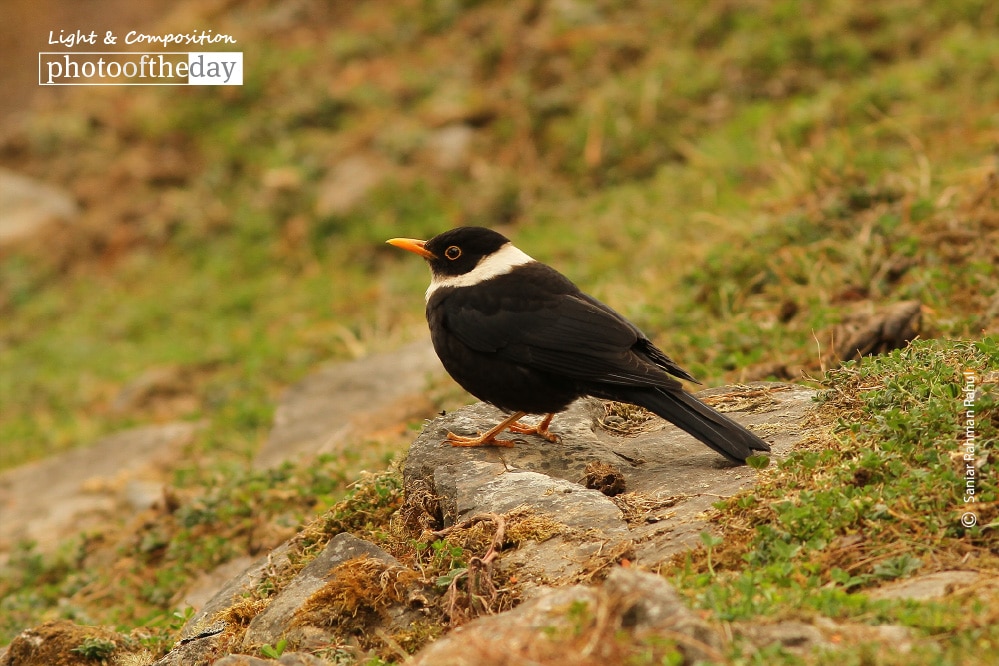
Captured amidst the lush, high-altitude landscapes of Bhutan, this portrait of the White-collared Blackbird highlights the striking elegance of a species native to the moist montane forests of the Indian subcontinent. The photographer expertly isolates the bird against its natural habitat, emphasizing the subtle textures of its plumage and the quiet intensity of its presence. This image is award-worthy for its technical precision and the photographer's ability to document a elusive avian subject within its remote, rugged environment, offering viewers a rare and intimate glimpse into the biodiversity of the Himalayan region.
Saniar Rahman Rahul
Based in Dhaka, Bangladesh, Saniar Rahman Rahul is an accomplished Art Director at Grey Worldwide with a deep-rooted passion for visual storytelling. His photographic journey began in childhood, inspired by his father’s work, and was later refined through his extensive professional background in graphic design and advertising. Since winning his first major award in 2010, Rahul has balanced his high-profile career in the advertising industry with a dedicated pursuit of wildlife and nature photography, consistently demonstrating a keen eye for composition and creative detail.
Resonance Score Breakdown
Transparency Note: The resonance score (1.4/20) is calculated based on social engagement metrics collected before the award announcement.
Expert Photography Reviews · 4
The Weight of a Wing
There is a silence that belongs only to the high places. It is not the absence of sound, but the presence of something held back. In the mountains, the air thins until it feels like glass.
Read the reflection →The Borders We Draw
We often speak of the city as a human construct, a grid of concrete and policy designed to contain our movements and define our status. Yet, we forget that the city is merely one layer of a much older geography.
Read the reflection →Reviews & Comments
Share your thoughts about this award-winning photograph. Your reviews contribute to the community engagement score.
f/5.6 at 400mm, 1/500s, ISO 800. A calculated gamble on shutter speed that barely holds the plumage detail. The depth of field is razor-thin, isolating the bird from the Bhutanese canopy effectively. It’s a clean execution of a difficult avian shot. I’ve spent hours tracking subjects in similar light; it’s exhausting work. Rahul’s decision to prioritize the eye’s sharpness over a lower ISO was the correct technical trade-off. The bird’s presence is undeniable. Precision wins here.
Most wildlife shots are just trophies, but this one lingers. I’ve seen thousands of bird portraits where the subject is merely a sharp cutout, yet here, the soft, mossy bokeh of the Bhutanese forest anchors the blackbird in a genuine, breathing world. It’s the way the white collar catches the light against those deep, velvet feathers that gets me—I actually caught my breath. It’s not just documentation; it’s a quiet, enduring piece of Himalayan history.
Before the eye identifies the bird, a sudden stillness settles in the chest. That stark white collar against the obsidian feathers triggers a sharp, rhythmic pulse. It’s an activation of the senses, a quiet tension held in the throat. I’ve returned to this portrait three times today, and each time, the bird’s gaze feels like a secret shared in the thin mountain air. It doesn’t just document nature; it demands a pause in my own breathing.
Technical precision is a bore. While the jury obsesses over the bird’s crisp plumage, I’m left cold by such clinical documentation. It’s a missed opportunity to capture the frantic, kinetic energy of the Himalayan forest. Why resolve every feather when you could have blurred the movement into a ghost of the mountain? I’d trade this static clarity for a single, intentional smear of color. It’s technically sound, sure, but it’s utterly devoid of risk.