Migration Caravan by Ryszard Wierzbicki
Captured in the vast expanse of the Ngorongoro crater in Tanzania, this photograph depicts a line of gnu antelopes migrating across the landscape. The photographer utilized a telephoto lens to compress the scene, emphasizing the rhythmic movement of the herd against a backdrop of dramatic, towering clouds that convey the raw, monumental power of nature. Taken in September 2011, the image is award-worthy for its masterful composition and the evocative atmosphere created by the interplay between the wildlife and the shifting African skies, capturing a timeless moment of natural migration.
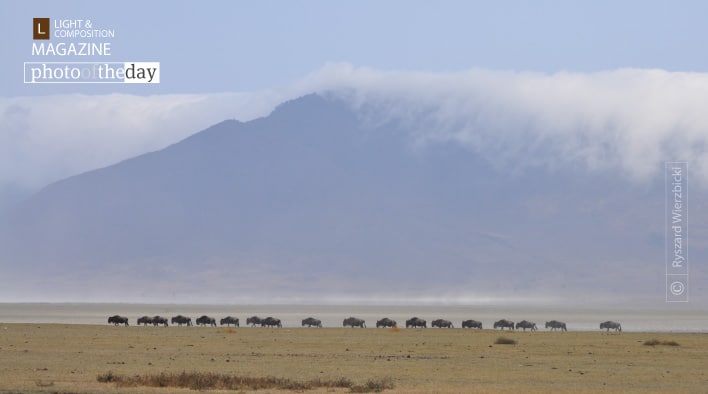
Exposure 1/500sec @ f/11 | ISO 200 | Focal Length 85mm
Ryszard Wierzbicki
Born in Poland in 1963, Ryszard Wierzbicki transitioned from a career in social sciences and marketing to pursue his deep-seated passion for photography and exploration. After emigrating to the United Kingdom in 2006, he dedicated himself to traveling, scuba diving, and documenting the world, eventually establishing online communities for fellow adventurers. His work is heavily influenced by his extensive travels through South-East Asia and his commitment to humanitarian efforts, reflecting a life defined by curiosity and a desire to capture the beauty of the natural world.
Resonance Score Breakdown
Transparency Note: The resonance score (13.0/20) is calculated based on social engagement metrics collected before the award announcement.
Expert Photography Reviews · 8
The Geometry of Belonging
We often mistake movement for progress, yet there is a profound, ancient order in the way living things navigate a landscape. When we look at the way a collective body traverses a space, we are witnessing a map of necessity.
Read the reflection →The Rhythm of the Unseen
In the study of thermodynamics, there is a concept known as entropy—the inevitable slide toward disorder. Yet, when we look at the natural world, we see the opposite: a stubborn, rhythmic insistence on order.
Read the reflection →Reviews & Comments
Share your thoughts about this award-winning photograph. Your reviews contribute to the community engagement score.
We watch this line of gnu, a rhythmic pulse against the heavy, brooding sky of Ngorongoro. It’s not just wildlife; it’s a procession of ancestors. Ryszard listened to the crater’s silence before he clicked, capturing that ancient, weary determination in their gait. I feel a sudden, sharp ache in my chest looking at their collective journey. They aren’t just moving; they’re carrying the weight of the earth. It’s a portrait of endurance we shouldn’t ever forget.
At f/11, the diffraction limit begins to soften the micro-contrast, yet the 85mm focal length compresses the gnu into a rhythmic, geometric sequence. It’s a fascinating optical trade-off. While the sensor’s resolution doesn’t quite resolve every individual hair, the atmospheric haze creates a soft, painterly bokeh as a function of the aperture. I’m genuinely moved by how the light scatters across those distant, brooding clouds; it’s a beautiful, physical manifestation of the crater’s immense scale.
The compression of the 85mm lens forces the herd into a singular, rhythmic line. It’s a rigid geometry that anchors the frame against the chaotic weight of the sky. The horizon line acts as a fulcrum, balancing the heavy mass of the gnu against the atmospheric density above. It’s structurally sound, though I’d prefer a tighter crop on the lead animal. The spatial tension holds, even if the clouds threaten to dissolve the frame’s discipline.
The compression here is honest work. One doesn’t catch that rhythm by stumbling out of a jeep for five minutes. Wierzbicki clearly sat in the dust until the herd aligned with those heavy, brooding clouds. It’s a quiet, disciplined frame. I’ve spent enough hours waiting for the sky to turn that specific shade of charcoal to appreciate the patience involved. He didn’t just find this; he earned the silence of that migration. A respectable effort.
The compression here creates a rhythmic datum, turning the herd into a living facade. It’s an architectural sequence of solid and void, where the animals act as structural columns against the sky’s heavy, vaulted ceiling. I’m struck by how the telephoto lens flattens the depth, forcing us to read the migration as a tectonic shift. It’s a brutal, beautiful reminder that nature builds its own thresholds, and honestly, it makes me feel incredibly small.
You waited for that line to stretch across the crater floor, didn’t you? There’s a rhythm here that feels like a heartbeat. I’ve spent enough time in the dust to know that silence isn’t empty; it’s heavy. Looking at these gnu against those bruised clouds, I feel a sudden, sharp ache for the sheer scale of the wild. You didn’t just capture animals. You caught the weight of their long, relentless journey. It’s honest work.
The line of gnu cuts the frame. It’s a rhythmic pulse against the weight of the sky. I’ve spent minutes watching them move, yet they don’t arrive. They just are. The vast, grey expanse above isn’t merely weather. It’s the silence of the crater. It’s heavy. It makes me hold my breath. Nothing here is accidental. The empty corner isn’t empty. It’s the space where the migration breathes. It’s enough.
The frame holds its breath. A rhythmic, dark pulse of gnu cuts across the crater floor, compressed by the glass into a singular, driving force. It’s a tracking shot that refuses to pan. I feel the dust in my own throat watching them march toward that heavy, bruised sky. The editor would never cut this; it’s the perfect, silent beat before the storm breaks. Wierzbicki knew exactly what he was holding when the shutter clicked.