Faro de Aveiro by Cristina del Fresno
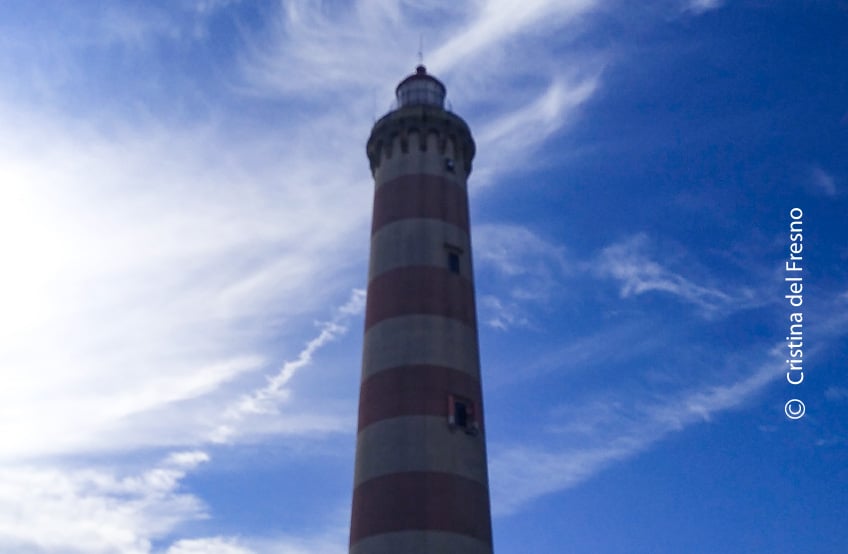
Captured on a vibrant, windswept day in Aveiro, Portugal, this photograph highlights the striking red and white stripes of Europe’s tallest lighthouse. The photographer skillfully framed the structure against a dynamic sky, where the interplay of brilliant blue hues and dramatic cloud formations emphasizes the coastal atmosphere. By balancing the bold architectural geometry of the lighthouse with the natural movement of the wind-tossed clouds, the image captures the essence of a perfect seaside excursion. This composition is award-worthy for its clean, graphic aesthetic and its ability to transform a functional landmark into a vivid, evocative portrait of the Portuguese coastline.
Cristina del Fresno
Born in Spain in 1990, Cristina del Fresno balances a professional career in finance with a deep-seated passion for capturing the world's natural beauty. Based in Madrid, she frequently travels to document diverse subjects, ranging from marine landscapes and mountain ranges to historical architecture and wildlife. Her work is driven by a desire to immortalize the dreamlike vistas she encounters during her global explorations, reflecting a keen eye for both the grandeur of nature and the intricate details of the built environment.
Resonance Score Breakdown
Transparency Note: The resonance score (9.5/20) is calculated based on social engagement metrics collected before the award announcement.
Expert Photography Reviews · 7
The Tallest Thing I Knew
When I was seven, my grandfather took me to the edge of the harbor to show me the lighthouse. I remember the way the paint peeled in long, sun-baked strips, and how my neck ached from trying to find where the top met the clouds.
Read the reflection →The Weight of the Beacon
There is a specific silence that belongs to the coast, the kind that follows the departure of a ship. It is not an empty silence; it is a heavy, waiting thing, like the space left in a bed when the person who slept there has finally risen.
Read the reflection →Reviews & Comments
Share your thoughts about this award-winning photograph. Your reviews contribute to the community engagement score.
The lighthouse’s bold stripes flatten into a graphic pattern, stripping away the tactile reality of its vertical mass. It’s a clean, postcard-perfect geometry, but I’m left craving the threshold—the transition from the salt-sprayed exterior to the dark, spiraling void within. I’d trade that dramatic sky for a glimpse of how the light actually hits the interior masonry. It’s pretty, sure, but it doesn’t tell me what it feels like to climb those stairs.
Most architectural shots of Aveiro’s lighthouse are just postcards. What separates this from the field is the tension between the rigid, candy-cane geometry and those chaotic, bruised clouds. It’s a rare moment where the sky feels like it’s actively trying to swallow the structure whole. I’ve seen thousands of these, but this one actually makes me feel the salt spray. It’s not just a landmark; it’s a record of a day that refused to be tamed.
The lighthouse’s verticality anchors the frame, yet the composition’s true weight rests on the rhythmic alternation of the red and white bands. It’s a rigid, graphic discipline that demands attention. The clouds provide a necessary counterpoint to this structural severity, preventing the frame from collapsing into mere pattern. I’m honestly relieved the horizon line remains so uncompromisingly level. It doesn’t drift. The spatial tension holds, even if the sky threatens to overwhelm the lighthouse’s base.
Those red and white stripes scream for attention, but where’s the pulse? It’s a clean graphic study, sure, but it’s static. I’m looking for the human element, that Winogrand chaos that makes a frame breathe. The clouds are moving, yet the lighthouse feels frozen in a vacuum. One tenth of a second later and maybe a seagull cuts the frame, adding life. I’d trade that perfect blue sky for a single, messy, unrepeatable human heartbeat.
It’s refreshing to see such crisp, saturated reds. Down where I usually work, those wavelengths vanish within five metres, swallowed by the water column. Here, the lighthouse stripes against that deep Atlantic blue feel almost defiant. I’m genuinely envious of how easily the light hits this structure without a single particle of backscatter to ruin the clarity. It’s a clean, sharp geometry that doesn’t have to fight the refractive index of the sea to exist.
The lighthouse’s crimson bands, reminiscent of a Turner sunset bleeding into the Atlantic, clash against the sky’s cerulean depths with such violent, rhythmic intensity that one’s breath catches in the throat. It’s a chromatic collision, a Morandi-esque stillness interrupted by the raw, salt-stung vitality of Portugal’s coast. I’ve found myself utterly transfixed by how these pigments don’t merely decorate the architecture; they define the very air, vibrating with a fierce, windswept, and unapologetic emotional resonance.
The lighthouse stripes are sharp, but the sky feels a bit too convenient. One suspects the photographer arrived, clicked, and left before the salt air truly bit. It’s a clean graphic, certainly, but I’ve spent enough freezing mornings in Aveiro to know that light rarely gifts you such perfect clouds on a whim. It’s a pleasant enough postcard, though I’m left wondering if she ever bothered to return when the wind wasn’t quite so polite.
Impresionante
Me gusta la perspectiva.
Fotografía perfecta de un faro impresionante