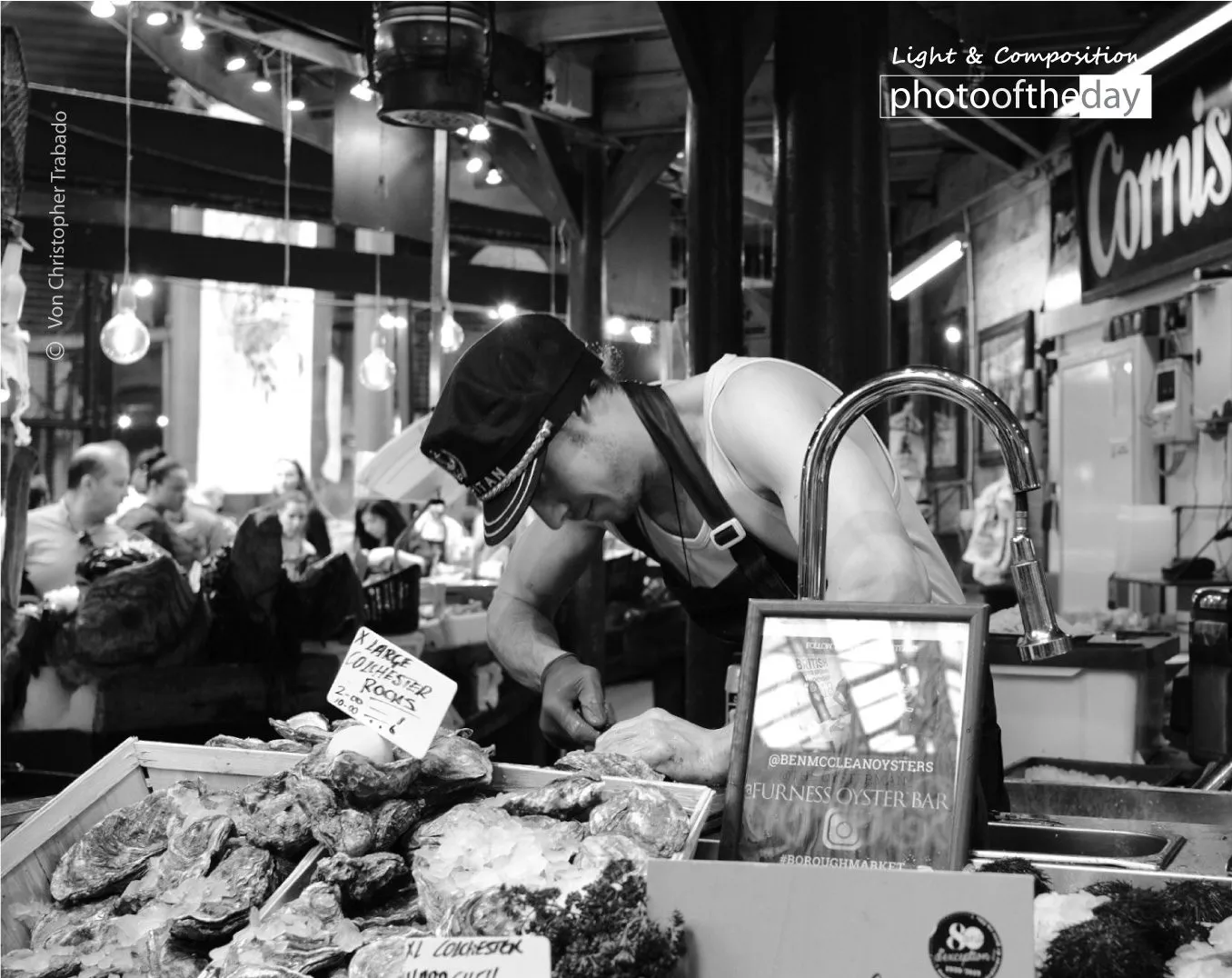
Oyster Shucker by Von Christopher Trabado
Captured amidst the bustling energy of London’s historic Borough Market, this portrait of an oyster shucker serves as a poignant homage to the city's hardworking spirit. The photographer utilized a wide aperture of f/2.8 to isolate the subject from the vibrant, chaotic backdrop, ensuring the shucker’s focused expression remains the focal point. By documenting a trade that has persisted through centuries of market history, the image bridges the gap between London's ancient roots and its modern daily life. This photograph is award-worthy for its authentic storytelling, masterful use of natural light, and the respectful, intimate connection established between the photographer and the subject.
Von Christopher Trabado
Based in London, Von Christopher Trabado is a dedicated self-taught photographer with a keen eye for the overlooked details of urban life. His work spans street photography, landscape, and architecture, serving as both a creative outlet and a method for documenting the rhythm of his surroundings. By exploring the streets of London and its periphery, Trabado captures the essence of daily existence, transforming ordinary moments into compelling visual narratives that celebrate the character of the city and its inhabitants.
Resonance Score Breakdown
Transparency Note: The resonance score (11.4/20) is calculated based on social engagement metrics collected before the award announcement.
Expert Photography Reviews · 5
The Rhythm of the Blade
There is a quiet dignity in the repetition of a craft. When the hands move in harmony with the task, the world outside—the noise of the crowd, the rush of the day—begins to fade into a soft, indistinct hum.
Read the reflection →The Labor of the Threshold
We often mistake the city for a collection of monuments or a map of transit lines, forgetting that it is, at its core, a ledger of human exertion.
Read the reflection →Reviews & Comments
Share your thoughts about this award-winning photograph. Your reviews contribute to the community engagement score.
Trabado’s shucker echoes the gritty, unvarnished humanism of Bill Brandt’s London, yet the X-T20’s clinical sharpness pulls it into our digital present. It’s a delicate balance. While the shallow depth of field isolates the subject, I’m struck by how the blurred market bustle mimics the impressionistic bokeh of early street photography. It’s a familiar trope, sure, but the subject’s weary, focused gaze feels startlingly immediate. I haven’t seen that specific, tired dignity captured quite like this in years.
Before the eye identifies the shucker, the chest tightens. There’s a rhythmic, metallic coldness here that vibrates against the market’s blur. I feel the salt-damp air in my own lungs, a sudden, sharp ache of labor. When I return to this a year later, the focus isn’t on the oyster, but on the isolation of his hands. It’s a quiet, visceral reminder that we’re all just carving out space in the noise.
Borough Market’s iron bones usually dictate the rhythm here, but Trabado’s frame collapses that vast, vaulted datum into a shallow, blurred suggestion. It’s a shame; I’d love to see how the light hits those Victorian trusses. Still, the shucker’s focus against the bokeh of the market’s chaotic fenestration feels honest. It’s a fleeting, tactile moment. I find myself wanting to reach out and touch the cold, wet shell—it’s a visceral, human anchor in a shifting space.
The curator praises the isolation of the subject, but I find that clinical separation a bit stifling. Why resolve the shucker so perfectly against the blur? It’s technically competent, sure, but it misses the kinetic, visceral grit of Borough Market. I’d have loved to see the motion bleed into the subject, echoing the frantic pace of the blade. It’s a safe portrait; I’m left craving a bit more chaos in the frame.
At f/2.8, the XF 23mm renders the shucker’s hands with a crispness that defies the market’s chaotic bokeh. The focal plane is razor-thin, yet it captures the precise diffraction of light across the damp oyster shell. I’m genuinely moved by how the lens resolves those microscopic saline textures, revealing a tactile reality our eyes usually blur. It’s a rare instance where the glass doesn’t just record the subject; it elevates the physics of the trade.