The Savior by Tamal Debnath
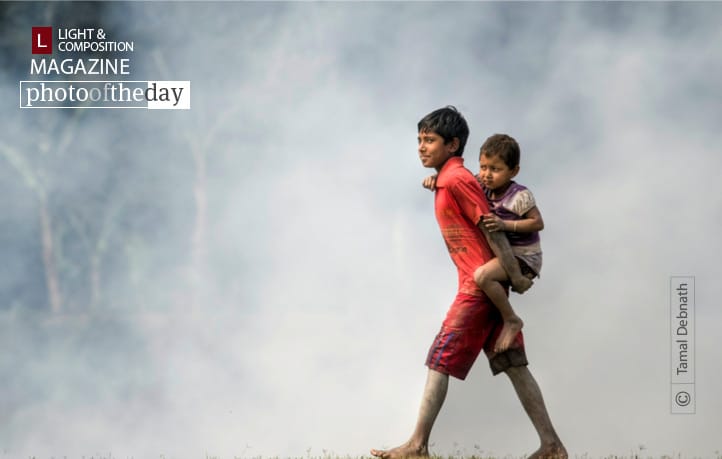
Captured at the expansive wetlands of Rasik Bil, this poignant image emerged from an unexpected turn of events. While initially seeking to photograph kingfishers, the photographer witnessed a local boy carrying his younger sister through a thick haze of smoke from agricultural fires. This candid moment of protection and resilience, framed against the atmospheric backdrop of the smoldering fields, captures a profound human connection. The photograph is award-worthy for its raw emotional weight and the photographer’s ability to pivot from frustration to documenting a powerful, spontaneous narrative of brotherhood and survival in the face of environmental hazards.
Tamal Debnath
Based in Coochbehar, West Bengal, Tamal Debnath is an English language teacher and dedicated amateur photographer. Since beginning his photographic journey in 2008, he has cultivated a deep passion for the craft, viewing his camera as a constant companion and a tool for lifelong learning. By observing the work of others and finding inspiration in his daily surroundings, he strives to capture the authentic human experience, transforming ordinary moments into compelling visual stories.
Resonance Score Breakdown
Transparency Note: The resonance score (11.9/20) is calculated based on social engagement metrics collected before the award announcement.
Expert Photography Reviews · 8
The Weight We Carry
I was walking home from the market yesterday when I saw a young boy helping his grandmother navigate a steep curb. He didn't look like he was doing it out of duty; he just reached out, took her arm, and adjusted his pace to match hers without a second thought.
Read the reflection →The Weight of Another
We are taught that to carry is a burden. We measure the distance, the strain on the spine, the way the breath hitches when the load is heavy. But there is a different kind of weight—the kind that anchors us to the earth when everything else is drifting away.
Read the reflection →Reviews & Comments
Share your thoughts about this award-winning photograph. Your reviews contribute to the community engagement score.
The frame’s geometry is its salvation. The boy’s verticality cuts through the horizontal haze, creating a necessary fulcrum against the smoldering background. It’s a rigid architecture of survival. The negative space doesn’t just breathe; it isolates the subjects, forcing the eye toward the tension of their grip. I’ve rarely seen such brutal clarity in a candid moment. The composition holds because it refuses to collapse into sentimentality. It’s a structural triumph of the highest order.
Smoke isn’t merely atmospheric here; it’s a shroud, a suffocating veil that forces the light to struggle for existence. Debnath captures the boy not as a savior, but as a silhouette carving a path through the void. It’s haunting. I’ve stared at that haze for an hour, feeling the weight of the air pressing against my own lungs. When the shadows swallow the horizon, we aren’t looking at a landscape anymore; we’re looking at survival itself.
The smoke hangs heavy, a grey veil over the wetlands of Rasik Bil. He stood there in the haze, waiting for kingfishers, but found something far more sacred. The light is choked, filtered through agricultural fires, yet it illuminates the boy’s quiet resolve. I’ve felt that sudden shift in the air when a scene demands your presence. It’s a heavy, aching beauty. He didn’t just capture a moment; he listened to the land’s own fragile, smoldering breath.
Smoke swallows the horizon. The boy carries his sister through the haze. It’s a heavy, grey void. I’ve spent minutes staring at the empty space behind them. It’s not just smoke. It’s the weight of the air itself. Nothing here is accidental. The empty corner is not empty. It holds the silence of their struggle. I feel a sudden, sharp ache in my chest. They’re walking into nothing, yet they’re holding everything together.
At f/8, the 280mm focal length compresses the atmospheric particulate, turning smoke into a soft, scattering medium that renders the boy’s silhouette with surgical precision. The diffraction of light across those hazy particles creates a depth I’ve rarely seen in documentary work. It’s physically haunting how the lens resolves the texture of his skin against that blurred, smoldering backdrop. I’m genuinely moved by how the optics capture such raw, fragile humanity amidst the physics of the haze.
The ochre haze of burning fields clings to the air like a Turner landscape, suffocating the light in a bruised, sepia-toned melancholy that makes my own chest ache. It’s a palette of scorched earth and muted, charcoal-grey despair, yet the boy’s skin glows with the soft, luminous warmth of a Vermeer interior. One finds here a chromatic tension so profound that the smoke itself feels like a physical weight, pressing against the fragile, golden resilience of human love.
Most photographers would have packed up the moment the kingfishers failed to appear. It’s the amateur’s instinct to blame the light and retreat to the car. Debnath didn’t. He stayed in the smoke, enduring the stinging eyes and the haze. I’ve spent enough damp mornings waiting for a sunrise that never came to respect that kind of persistence. He didn’t find this moment; he earned it by simply refusing to leave the field.
Most documentary work fades because it’s merely descriptive. What separates this from the thousands of snapshots I’ve reviewed is the smoke. It doesn’t just obscure the background; it forces the viewer to focus on the boy’s grip. I find myself holding my breath looking at his knuckles. He isn’t just walking; he’s shielding a life. Thirty years from now, we won’t remember the camera settings, but we’ll still feel the weight of that small, soot-stained burden.
❤❤
On foot?