The Camel Polo Player by Shirren Lim
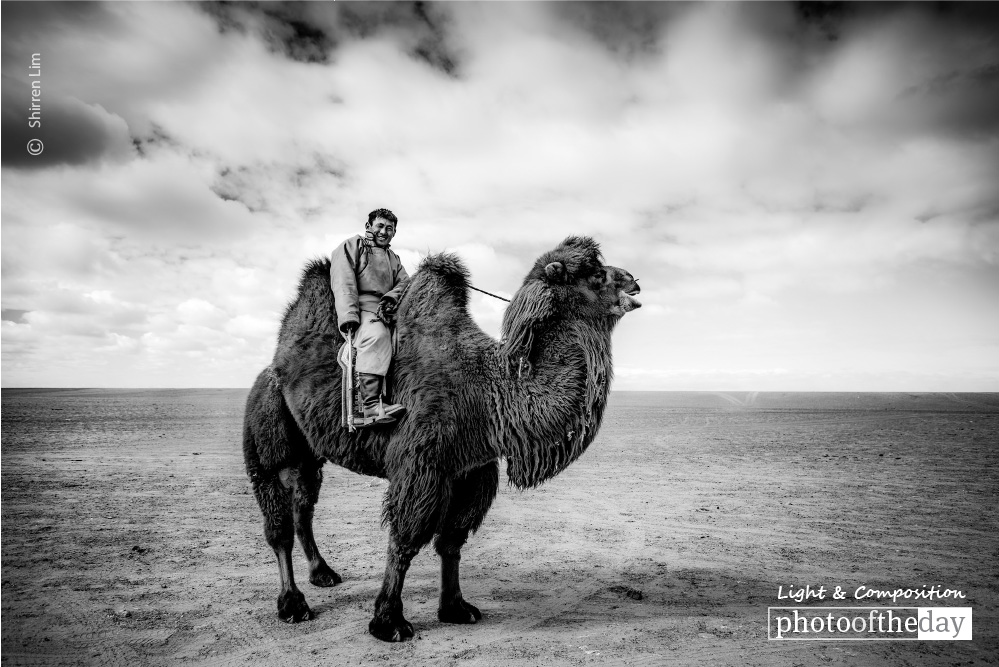
Captured in the quiet aftermath of a camel polo competition in Bulgan, Western Mongolia, this portrait documents a fleeting moment of connection. As the crowds dispersed under a moody, overcast sky, the photographer encountered a local man resting atop his camel. Opting for a low-angle perspective, the photographer emphasized the subject's stature against the dramatic, cloud-filled horizon. This image is award-worthy for its raw, authentic portrayal of Mongolian life, where the photographer’s deliberate choice of angle and timing transforms a simple post-match interaction into a compelling, timeless study of human character and cultural atmosphere.
Shirren Lim
Born in Penang Island, Malaysia, in 1970, Shirren Lim is a Jakarta-based photographer who discovered her true passion for the craft in 2009. Specializing in portraiture, she seeks to capture the sincere, uncovered expressions of humanity with an intense and earthy aesthetic. Heavily influenced by the iconic work of Steve McCurry, Lim strives to create images that resonate with the same emotional depth and global impact, aiming to document moments that reveal the heart of her subjects.
Resonance Score Breakdown
Transparency Note: The resonance score (11.3/20) is calculated based on social engagement metrics collected before the award announcement.
Expert Photography Reviews · 4
The Grit of the Plains
The smell of dry, sun-baked earth always brings me back to the feeling of coarse wool against my neck. It is a scent that clings to the back of the throat, tasting faintly of minerals and long-forgotten rain.
Read the reflection →The Weight of the Horizon
When a camel sheds its winter coat, it does so in ragged, uneven patches, a slow unraveling that leaves the animal looking frayed and vulnerable before the new growth takes hold.
Read the reflection →Reviews & Comments
Share your thoughts about this award-winning photograph. Your reviews contribute to the community engagement score.
Before the eye identifies the camel, a sudden stillness settles in the chest. The low angle forces a physical shift, making me feel small, almost reverent, beneath that heavy Mongolian sky. It’s the weight of the silence after the match that lingers; I’ve felt that specific, dusty exhaustion in my own bones. When I return to this, I don’t see a portrait. I see the quiet, lonely endurance of a man who’s already moved on.
There’s a quiet dignity here that I find genuinely moving. By waiting for the crowds to disperse, Lim allowed the animal to settle into its own rhythm rather than forcing a spectacle. That low angle doesn’t just frame the man; it respects the camel’s presence as a partner, not a prop. It’s a rare, earned moment of stillness. I’ve spent enough time in the field to know when a photographer has truly earned their seat.
1/250sec at f/4.0, ISO 64, 24mm. A wide-angle choice that forces the subject into the frame’s distortion. At 24mm, the camel’s snout shouldn’t be this close, yet it works. The low angle justifies the focal length, grounding the rider against that heavy Mongolian sky. It’s a sharp, calculated risk. I’ve seen too many portraits ruined by lazy glass, but here, the optics actually serve the narrative. It’s technically sound. I find the restraint quite refreshing.
The low angle forces a dialogue between the camel’s mass and the vast, overcast datum of the Mongolian sky. It’s a spatial tension I rarely see captured. By elevating the subject, Lim turns the rider into a threshold between earth and void. I’m struck by the way the light softens the animal’s hide, grounding the structure of the scene. It’s not just a portrait; it’s a study of how we occupy an infinite, unbuilt landscape.