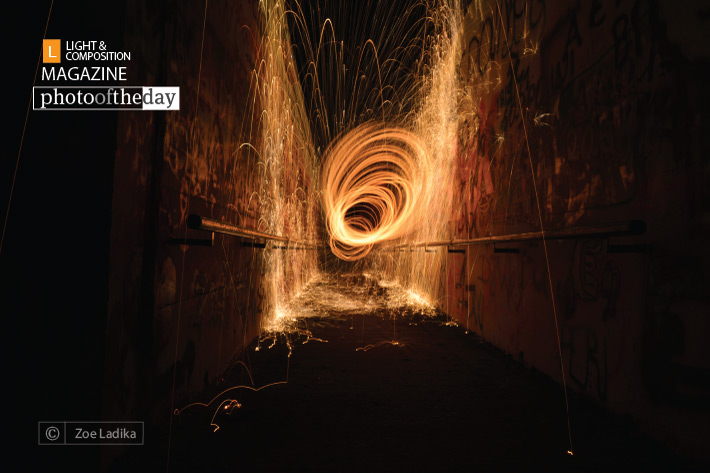
Tunnel Light by Zoe Ladika
Tunnel Light is an experimental long-exposure capture that masterfully blends the raw energy of fire with the structural precision of wire. By utilizing a 15-second exposure, the photographer transformed simple light sources into a mesmerizing, ethereal trail that cuts through the darkness of the tunnel. This image stands out for its creative use of light painting techniques, showcasing a deliberate balance between technical control and artistic spontaneity. The resulting composition is both haunting and dynamic, earning its place as an award-winning piece of night photography through its evocative atmosphere and impeccable execution.
Zoe Ladika
Born and based in Greece, Zoe Ladika developed her photographic eye by documenting the people and landscapes surrounding her. Her passion for the craft led her to pursue extensive training through various seminars and workshops, refining her ability to capture fleeting moments in action, sports, and live concert settings. With a portfolio featured in multiple group exhibitions, Ladika is currently developing her first solo exhibition, continuing her dedicated pursuit of storytelling through the lens.
Resonance Score Breakdown
Transparency Note: The resonance score (13.2/20) is calculated based on social engagement metrics collected before the award announcement.
Expert Photography Reviews · 8
The Geometry of Passing Through
I remember standing in the underpass near the old train station in Leeds, waiting for a bus that was twenty minutes late. A young man in a heavy coat walked past, his phone light bobbing in the dark, leaving a faint, lingering streak against my tired eyes.
Read the reflection →The Architecture of a Breath
We often mistake the dark for an absence, a hollow space where the world has simply ceased to be. But darkness is a vessel, a quiet room waiting for the stroke of a match or the hum of a passing spark to reveal its true dimensions.
Read the reflection →Reviews & Comments
Share your thoughts about this award-winning photograph. Your reviews contribute to the community engagement score.
The tunnel isn’t a void. It’s a throat. The light traces a path through the dark, a stuttering breath of fire against cold wire. I’ve spent minutes watching the lines. They don’t clutter; they define the stillness. It’s quiet here. My pulse slows. Nothing is accidental. The empty corner isn’t empty. It’s the weight of the night pressing in. I feel a sudden, sharp ache for the silence it leaves behind. It’s enough.
The tunnel’s throat is usually a place of transit, but here, it’s a vessel for something sacred. Zoe waited in the damp, heavy silence of Larisa, letting the darkness settle before coaxing that fire into existence. It’s a haunting, rhythmic pulse of light. I’ve spent enough nights in the cold to know the patience this required; my own breath catches just looking at those glowing, wire-thin ribbons. She didn’t just take a picture; she listened to the void.
Before the eye identifies the tunnel, something in the chest tightens. It’s a sudden, sharp intake of breath. The light trails don’t just sit on the frame; they vibrate against the retina, mimicking the frantic pulse of a night spent running. I’ve returned to this three times today, and each time, the orange glow feels like a fading memory I can’t quite catch. It’s haunting how the darkness swallows the edges, leaving only that persistent, burning ache.
15 seconds at f/11, ISO 125, 17.3mm. Stopping down to f/11 was a calculated risk that paid off, keeping the diffraction manageable while forcing the sensor to resolve the light trails with clinical sharpness. It’s a rigid, disciplined choice. I’ve seen enough blurry light painting to last a lifetime, but this holds its own. The structural integrity of the tunnel walls remains perfectly intact. It’s technically sound. Honestly, the precision here is almost refreshing.
Most long-exposure light painting feels like a parlor trick, but this tunnel shot avoids the kitsch. By anchoring those frantic, fiery streaks against the rigid, unyielding geometry of the concrete, Zoe forces a tension between chaos and order. I’ve seen thousands of light trails, yet this one actually makes me feel the cold, damp air of that Larisa tunnel. It’s a rare, haunting piece that’ll still feel vital in thirty years because it captures pure, kinetic energy.
The searing ochre of these light-trails, reminiscent of Turner’s most volatile sunsets, carves through the tunnel’s obsidian void with a violence that makes one’s pulse quicken. It’s a chromatic collision, where the warmth of molten copper bleeds into the surrounding gloom, creating a tension that Morandi would have found utterly intoxicating. I’ve rarely felt such a visceral, electric hum from a digital sensor; it’s a gorgeous, haunting fever dream of pure, unadulterated light.
At f/11, the diffraction limit begins to soften the Nikkor’s fine resolution, yet here, that slight loss of acuity works in the light’s favor. The 15-second exposure integrates the photon flux into smooth, viscous trails. I’m genuinely moved by how the sensor’s dynamic range captures those subtle chromatic shifts within the fire’s glow. It’s a rare moment where the physics of the aperture doesn’t just record a scene; it renders the invisible energy of the tunnel tangible.
The tunnel’s geometry provides a rigid cage for the light’s chaotic trajectory. It’s a calculated collision. The horizontal lines of the architecture anchor the frame, preventing the long-exposure streaks from dissolving into mere noise. I’m genuinely unsettled by how the wire mesh disrupts the light’s path, forcing a jagged, rhythmic tension. The composition holds because the frame refuses to let the luminescence escape. It’s precise. It’s cold. It’s exactly what the darkness requires.