Aya Sofya by Keith Goldstein
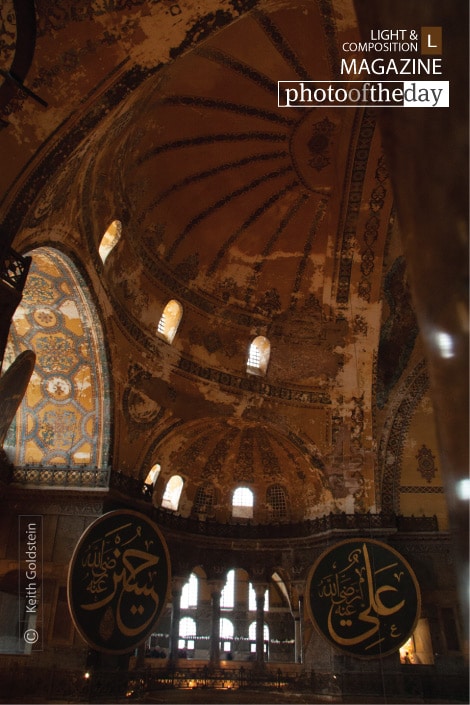
Captured in October 2008, this evocative image of the Hagia Sophia showcases the architectural grandeur of a site that has served as both a Byzantine cathedral and an Ottoman mosque. Keith Goldstein utilized a long exposure of 0.3 seconds at f/8 to draw out the intricate textures of the ancient marble and the soft, ambient light filtering through the historic interior. The photograph is award-worthy for its masterful balance of technical precision and atmospheric depth, capturing the profound spiritual and historical weight of this iconic monument while highlighting the delicate interplay between light and shadow across its storied surfaces.
Keith Goldstein
Born in Brooklyn in 1957, Keith Goldstein developed a deep fascination with photography during his youth, eventually earning a BFA with Honors from the School of Visual Arts and an MFA from the Cranbrook Academy of Art. His career, which has spanned over four decades, is defined by a commitment to emotive expression and a minimalist approach to equipment. Goldstein’s extensive portfolio has been featured in numerous prestigious publications and exhibitions, reflecting his versatile expertise as a fine art photographer, photo editor, and corporate visual storyteller based in New York City.
Resonance Score Breakdown
Transparency Note: The resonance score (14.7/20) is calculated based on social engagement metrics collected before the award announcement.
Expert Photography Reviews · 3
Echoes of Ancient Breath
There is a weight to stone that has witnessed centuries of human longing. When we step into a space that has held the prayers of generations, the air itself seems to thicken with the residue of silent conversations.
Read the reflection →The Architecture of Echoes
History is not a line drawn in the sand, but a layering of dust and prayer upon stone. We walk through spaces that have forgotten the names of those who first knelt within them, yet the walls retain the memory of every whisper.
Read the reflection →Reviews & Comments
Share your thoughts about this award-winning photograph. Your reviews contribute to the community engagement score.
At f/8, the 17-85mm lens avoids the diffraction limit, allowing the sensor to resolve the marble’s porous texture with startling clarity. The 0.3-second exposure integrates the ambient photons, smoothing the transition between shadow and light. It’s a delicate optical dance. I’m genuinely moved by how the focal plane renders the ancient stone; it’s as if the lens has peeled back centuries of dust. It doesn’t just capture the Hagia Sophia; it reveals the physics of its enduring presence.
The geometry of the Hagia Sophia’s interior demands a rigid verticality, yet the frame’s edges collapse under the weight of the ambient light. It’s a precarious balance. The marble textures anchor the lower third, providing a necessary fulcrum against the vast, vaulted void above. I’ve rarely seen such spatial tension held so tightly. It doesn’t rely on sentiment; it relies on the discipline of the frame. It’s cold, precise, and entirely necessary.
A 0.3-second exposure at ISO 1600 suggests a photographer who didn’t want to linger long enough to get kicked out by the guards. It’s a decent enough capture, yet one wonders if Goldstein ever returned when the crowds thinned. I’ve spent days waiting for the light to settle in spaces like this, and frankly, I don’t feel the ache of the floorboards here. It’s competent, but it hasn’t been earned. It’s just visited.
Thank you!!!