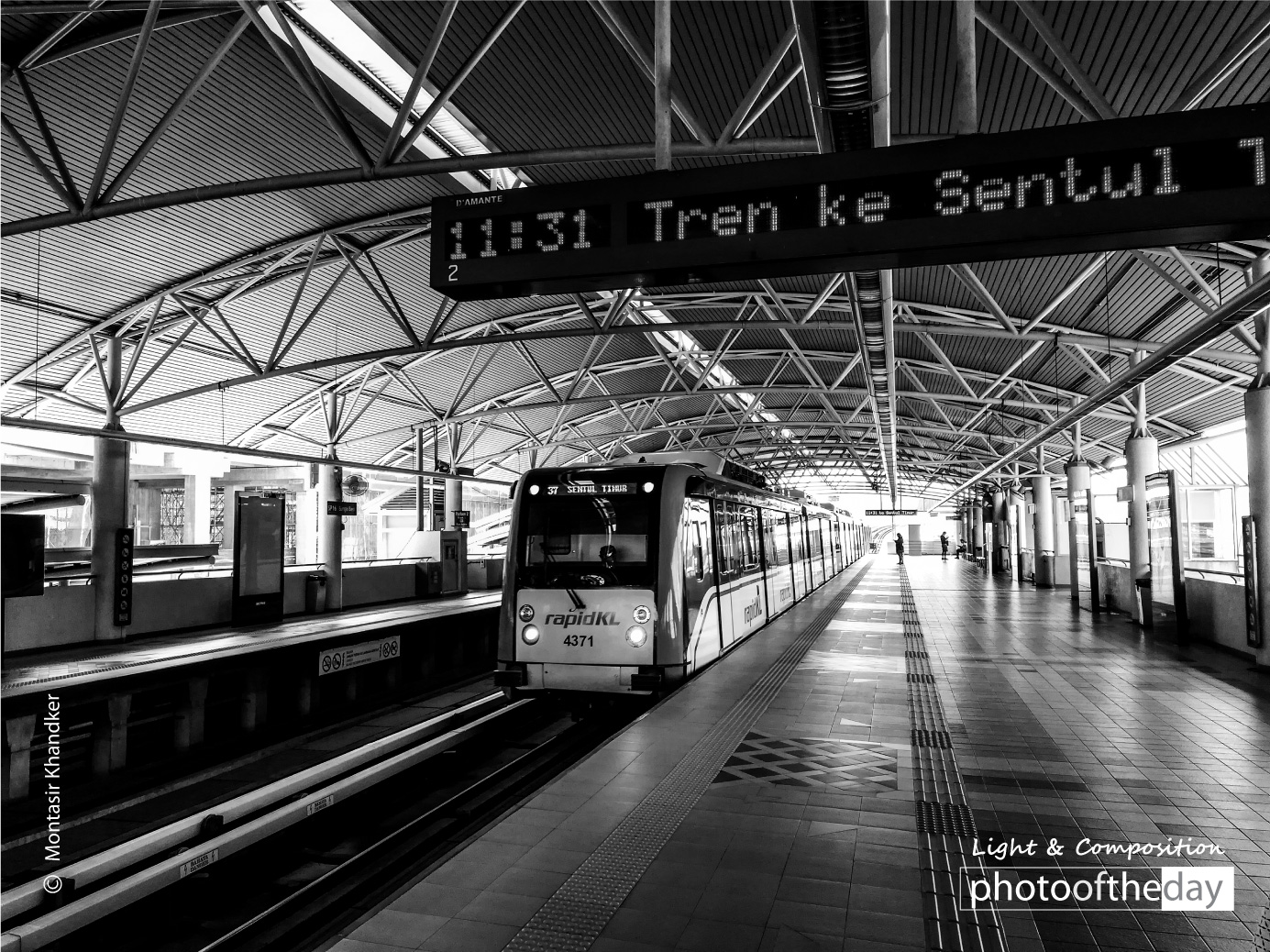
Tren ke Sentul Timur by Montasir Khandker
Captured along the Sri Petaling line of the Rapid KL network, this photograph documents the rhythmic transit of the train to Sentul Timur. The photographer focuses on the intersection of urban infrastructure and daily movement, utilizing the stark contrast of black and white photography to emphasize the geometric lines of the station. By isolating the train within its environment, the image transforms a mundane commute into a compelling visual narrative. The composition is particularly noteworthy, earning high marks for its deliberate framing and ability to evoke the atmosphere of Kuala Lumpur’s public transportation system.
Montasir Khandker
Born and raised in Bangladesh, Montasir Khandker is a Malaysia-based photographer who began his creative journey during his college years with a Yashica Electro 35 rangefinder. Though he identifies as an amateur, his work is defined by a deep commitment to visual storytelling and the pursuit of captivating imagery. Khandker’s photography reflects his keen eye for the narratives hidden within everyday environments, blending his personal history with his current life in the vibrant urban landscape of Kuala Lumpur.
Resonance Score Breakdown
Transparency Note: The resonance score (8.9/20) is calculated based on social engagement metrics collected before the award announcement.
Expert Photography Reviews · 8
The Rhythm of Transit
I keep a small, rusted skeleton key in a velvet pouch, though I have long since forgotten which door it once opened. It is heavy for its size, cold to the touch, and carries the weight of a threshold I can no longer cross.
Read the reflection →The Geometry of Going Home
I often find myself standing on a platform in the city, watching the steel veins of the transit system pulse with the weight of people I will never know.
Read the reflection →Reviews & Comments
Share your thoughts about this award-winning photograph. Your reviews contribute to the community engagement score.
The platform stretches. Steel meets shadow. I’ve stood on these platforms, waiting for the hum of the train to break the stillness. Here, the geometry doesn’t crowd the frame. It breathes. The vast concrete expanse isn’t just infrastructure; it’s a pause. I feel a sudden, sharp loneliness looking at it. Nothing here is accidental. The empty corner is not empty. It’s a quiet invitation to wait. It’s enough.
The architecture here is sharp, but it’s cold. I’m looking for a pulse in the commuters, yet they’re just silhouettes against the geometry of the station. It’s a clean composition, sure, but it feels like a grab shot. I don’t see a conversation here; I see a transit system. I’d trade all these perfect lines for one pair of eyes looking back. It’s technically sound, but it doesn’t tell me who these people are.
Khandker’s geometry echoes the stark, structural precision of early Bauhaus photography, yet it’s the kinetic blur that catches me off guard. It’s a sharp departure from the static, high-contrast rigidity of the 1930s. While the framing recalls the rhythmic repetition found in Kertész’s urban studies, there’s a modern, cold detachment here that feels distinctly twenty-first century. I’ve seen a thousand train stations, but this particular tension between steel and motion genuinely makes me stop.
The geometry here is sharp, but it’s almost too clinical. I’m looking for the pulse of Kuala Lumpur, not just the steel of the train. It’s clean, sure, but where’s the human friction? Cartier-Bresson would’ve waited for a face in that window, a ghost in the transit. One tenth of a second later and the shadow has moved, the frame has collapsed. I wanted to feel the commute, but it’s just cold architecture.
Stripping away the chromatic spectrum reveals a stark, charcoal-heavy silence that feels like a Morandi still life rendered in concrete and steel. It’s a monochromatic ache, where the absence of pigment forces one to confront the brutal, rhythmic geometry of the transit line. I’m breathless at how the silver-grey light clings to the train’s metallic skin, turning a mundane commute into a haunting, rhythmic meditation on the cold, industrial pulse of Kuala Lumpur’s urban veins.
The sharp, rhythmic geometry of the station’s steel beams creates a cage of light and shadow that feels almost architectural in its severity. It’s a cold, industrial stage. When the commuter finally appears, they’re swallowed by this rigid urban grid, their solitude amplified by the vast, repeating lines of the platform. I’m struck by how small they seem against the transit network’s weight. It’s not just a commute; it’s a quiet surrender to the city’s pulse.
One suspects Khandker spent a fair few humid afternoons on that platform waiting for the geometry to align just so. It’s a clean, disciplined frame, though I’d have preferred a bit more grit in the shadows. Still, the way the train slices through those concrete ribs shows a commendable patience. I’ve spent enough time shivering on platforms to respect the commitment here. It’s a decent bit of work, earned through sheer, stubborn persistence.
We look at these geometric lines and feel the hum of the city, but where are the people? Montasir Khandker captures the architecture of the Sri Petaling line, yet I find myself searching for the souls who inhabit this transit. It’s a rhythmic, lonely dance of steel. I’m struck by a sudden, quiet ache for the stories left untold in these empty seats. It’s a photograph that asks to be returned to, if only to find someone waiting.