Tête-à-tête by Shirren Lim
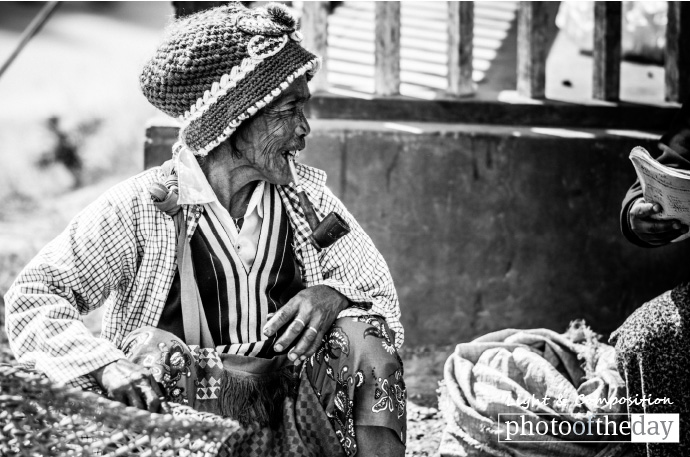
In the quiet town of Mindat, Myanmar, the photographer captured a poignant moment of human connection within the local market. Drawn to the striking presence of a Chin State woman adorned with traditional facial tattoos, the photographer waited patiently for the subject to turn into a side profile while smoking a pipe. This deliberate patience allowed for a candid, intimate exchange that highlights the dignity and history etched into the subject's features. The photograph is award-worthy for its authentic storytelling, masterful use of natural light, and the profound, soulful connection it establishes between the viewer and the subject.
Shirren Lim
Born in Penang Island, Malaysia, in 1970, Shirren Lim is currently based in Jakarta, Indonesia. Since discovering her passion for photography in 2009, she has dedicated her craft to portraiture, seeking to capture the raw sincerity and beauty of human expression. Influenced by the iconic imagery of Steve McCurry, Lim’s work is characterized by an intense, earthy aesthetic and simple compositions that aim to reveal the heart of her subjects. Her evocative photography has garnered international recognition, appearing in various digital and print publications.
Resonance Score Breakdown
Transparency Note: The resonance score (11.0/20) is calculated based on social engagement metrics collected before the award announcement.
Expert Photography Reviews · 8
The Ink of Ancestry
We carry our histories in the most fragile of vessels—the skin. It is a map we are born into, a parchment that thickens and creases as the years pull at our seams.
Read the reflection →The Weight of a Story
I was sitting on the bus this morning, watching an elderly woman across the aisle.
Read the reflection →Reviews & Comments
Share your thoughts about this award-winning photograph. Your reviews contribute to the community engagement score.
f/2.8 at 50mm, 1/200s, ISO 400. A shallow plane of focus isolates the Chin woman’s profile, forcing the viewer’s eye exactly where it belongs. The shutter speed is adequate for the low light of a market stall, though I’d have preferred a tighter stop to sharpen the pipe’s texture. Still, the bokeh is clean. It’s a precise technical choice. I’ve seen enough blurry portraits to appreciate when someone actually nails the focus.
The composition hinges on a perfect 1:2 ratio between the subject’s profile and the negative space behind her. That vertical axis, defined by the pipe’s stem, creates a sharp vector that anchors the frame. I’m genuinely moved by how the circular geometry of the smoke echoes the curve of her jaw. It’s a beautifully solved spatial equation where the dark mass of the head balances the light-drenched background. It’s rare to see such precise, quiet equilibrium.
The smoke curling from that pipe tells me she’s comfortable, not just being watched. Shirren waited, and it shows. When a subject lets you into their quiet space like this, you aren’t just taking a picture; you’re receiving a piece of their history. I’m struck by the weight in her gaze. This face has a whole life in it. It’s rare to see such dignity held so still. She clearly trusted the lens.
Smoke curls, a ghost of the breath just exhaled. The frame holds, perfectly still, waiting for the profile to align with the light. It’s a masterclass in patience; she doesn’t perform, she simply exists. I’ve spent hours in edit suites chasing this kind of gravity. The ink on her skin tells a story that doesn’t need a sequel. It’s the shot the editor keeps, the one that makes the whole room go quiet. I’m breathless.
The Chin woman’s tattoos aren’t just aesthetic markers; they’re historical scars. Lim waits for the profile, but does this patience actually bridge a gap, or does it merely aestheticize a tradition for our consumption? I feel a sharp, uncomfortable prick of voyeurism here. Why do we find dignity in her pipe smoke while ignoring the power imbalance inherent in the lens? Is this connection real, or is it just a beautiful, curated distance?
In the quiet markets of Mindat, we find a woman whose skin holds the maps of her ancestors. Shirren Lim didn’t just point a lens; she waited until the smoke curled and the profile softened. We look at those traditional tattoos and we feel the weight of a life lived in rhythm with the earth. It’s a haunting, intimate exchange. I’ve found myself lingering here, moved by the dignity she’s kept hidden in plain sight.
The ochre dust of Mindat clings to the skin like a Morandi still life, where the muted, earthy umbers of the woman’s complexion harmonize with the smoldering, bruised-plum shadows of her pipe smoke. It’s a chromatic ache I’ve felt before in Vermeer’s quietest corners; the way the light catches her tattooed cheek, turning ink into velvet, makes my heart stutter. One doesn’t just see this palette; one breathes in its ancient, sun-drenched, melancholic silence.
The focal plane sits perfectly on the intricate, ink-etched dermis of her cheek, resolving the skin’s texture beyond what the naked eye perceives. I’m genuinely moved by how the lens captures the smoke’s diffusion; it’s a masterclass in managing diffraction. The bokeh, a function of a wide aperture, isolates her profile with clinical precision, yet it doesn’t feel cold. It’s a rare moment where optical physics and human history collide in such a breathtaking, sharp relief.