Temple in the Mountain by Fabrizio Bues
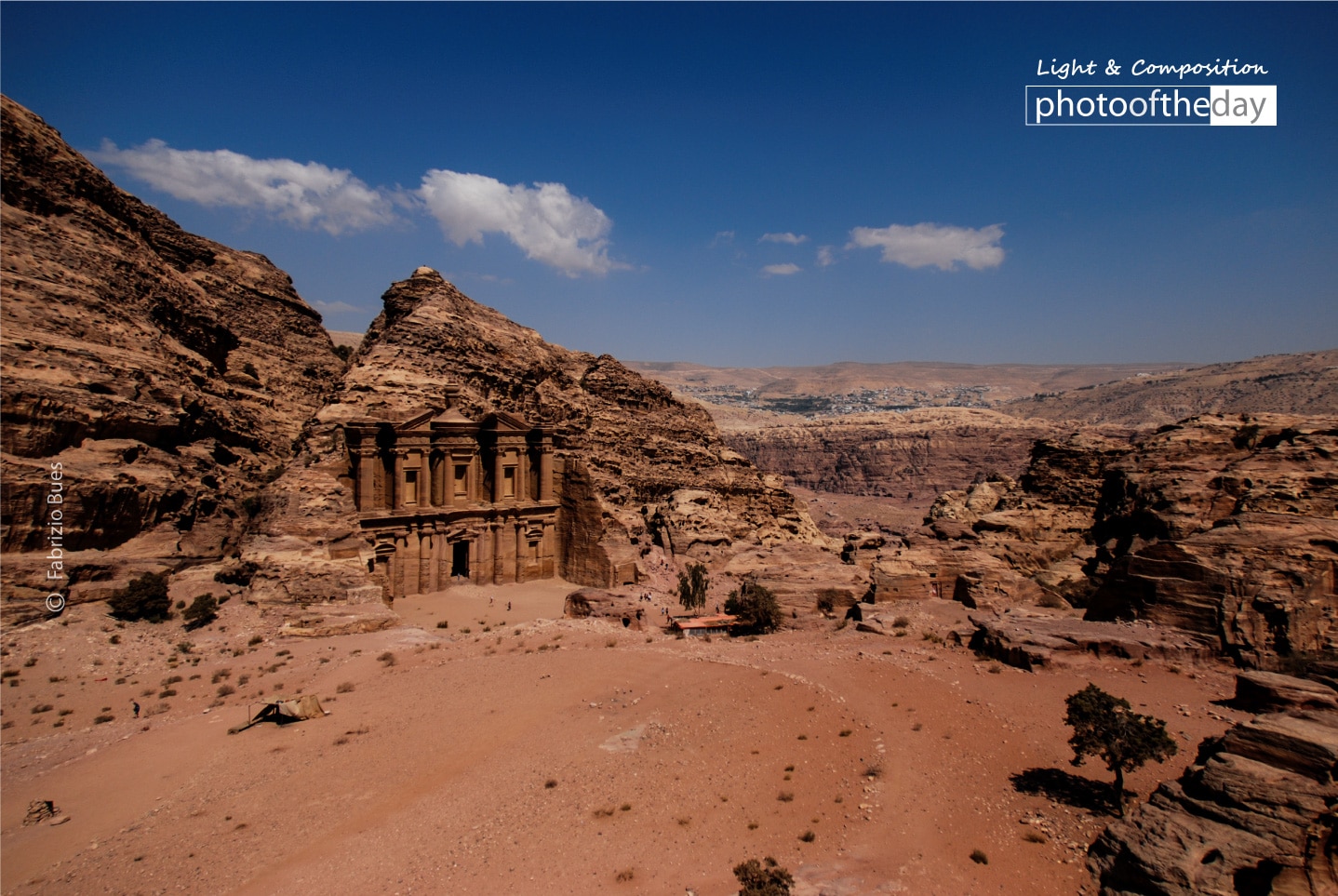
Captured high above the well-trodden paths of the Petra archaeological site, this photograph reveals the majestic scale of the mountain temple. By venturing beyond the popular Treasure Temple, the photographer discovered a vantage point where the architecture appears to be carved directly into the living rock. The composition emphasizes the seamless integration of human craftsmanship with the rugged, expansive Jordanian landscape. This image is award-worthy for its ability to transform a famous historical site into a serene, monumental study of light and geology, offering a fresh perspective on a world-renowned landmark through careful exploration and patient framing.
Fabrizio Bues
Born in Turin, Italy, in 1972, Fabrizio Bues balances a professional career in Information Technology with a deep-seated passion for global exploration. His work as a project manager provides frequent opportunities to travel, which he utilizes to document the world through his Nikon camera. Dedicated to continuous growth, he actively pursues advanced photography education to refine his technical skills and artistic vision. Based in his hometown of Turin, he remains committed to capturing the intersection of culture and landscape during his international journeys.
Resonance Score Breakdown
Transparency Note: The resonance score (11.1/20) is calculated based on social engagement metrics collected before the award announcement.
Expert Photography Reviews · 8
Carved Into the Silence
It is 3:15 am. The house is holding its breath, and for once, I am not trying to fill the silence with noise. There is a specific kind of weight to things that have been here longer than us.
Read the reflection →The Breath of Ancient Stone
The smell of sun-baked dust is a dry, chalky taste on the back of the tongue, the kind that settles deep in the throat after a long walk through a canyon.
Read the reflection →Reviews & Comments
Share your thoughts about this award-winning photograph. Your reviews contribute to the community engagement score.
The vertical axis here is anchored by a rigid, near-perfect golden ratio between the temple’s facade and the surrounding sandstone mass. It’s a masterclass in spatial equilibrium. The diagonal vectors of the rock face converge precisely at the temple’s entrance, forcing the eye into a locked, rhythmic loop. I’m genuinely breathless at how the geometry resolves the tension between human artifice and geological chaos. It’s a perfectly solved equation of light, shadow, and sheer, immovable weight.
The obsession with crisp, high-resolution rock faces here feels a bit safe, doesn’t it? I’m left wondering why Bues didn’t let the heat haze or the grit of the sandstone dissolve the architecture entirely. It’s technically competent, yet I crave the deliberate instability of Hiroshi Sugimoto’s long-exposure theatres. Why resolve every crevice? I’d have loved to see the temple surrender its form to the light, turning geology into a ghost of human ambition.
It’s jarring to look at this arid, sun-baked sandstone after years of fighting the ocean’s relentless light absorption. Down there, the red spectrum vanishes within meters, but here, the rock holds its warmth perfectly. I’m struck by the absolute stillness; there’s no backscatter to cloud the horizon, no refractive index distorting the architecture. It’s a strange, dry clarity I rarely encounter. I’d trade my strobe kit for this kind of atmospheric stability any day.
The sandstone’s jagged, ochre skin dictates the rhythm here, its ancient fissures echoing the deliberate chisel marks of the Nabataeans. It’s a dialogue between geology and geometry that leaves me breathless. When I look at how the mountain swallows the architecture, I don’t just see a temple; I see a civilization’s quiet surrender to the earth. The rock isn’t merely a backdrop; it’s the primary character, holding the human effort within its vast, silent, sun-drenched embrace.
Bues captures the tension between the tectonic and the geological, where the threshold of the temple dissolves into the mountain’s raw mass. The light rakes across the facade, emphasizing the depth of the carved fenestration against the void of the rock. I’m struck by the scale; it’s humbling to see how the datum of the architecture bows to the landscape. It’s a rare, honest frame that doesn’t just document stone, but the weight of history.
The silence here is deafening. It’s a wide shot that refuses to blink, locking the temple into the mountain’s throat. I’ve seen Petra a thousand times, but Bues finds the edit point where geology swallows history whole. The light doesn’t just hit the rock; it carves it. I’m breathless looking at how the stone holds the frame. It’s a masterclass in stillness. You don’t cut away from a shot this heavy. It’s perfect.
We look at these stone walls and we don’t just see geology; we see the ghosts of those who carved them. Fabrizio Bues didn’t just climb a mountain; he listened to the silence of Raqmu until the rock began to whisper its history. It’s a portrait of a place that’s forgotten how to speak, yet it’s still breathing. I feel a profound, aching stillness here. It’s a photograph that asks to be returned to, again and again.
You climbed where the tourists don’t go, and that’s where the truth lives. I’ve stood in Petra, but I’ve never seen the stone breathe like this. It’s quiet. You didn’t just frame a temple; you felt the weight of those centuries pressing against the cliffside. Because you waited for that light, the rock feels alive. It’s a lonely, beautiful perspective. I can feel the dust in my own throat looking at it. Good work.