The White-rumped Vulture by Saniar Rahman Rahul
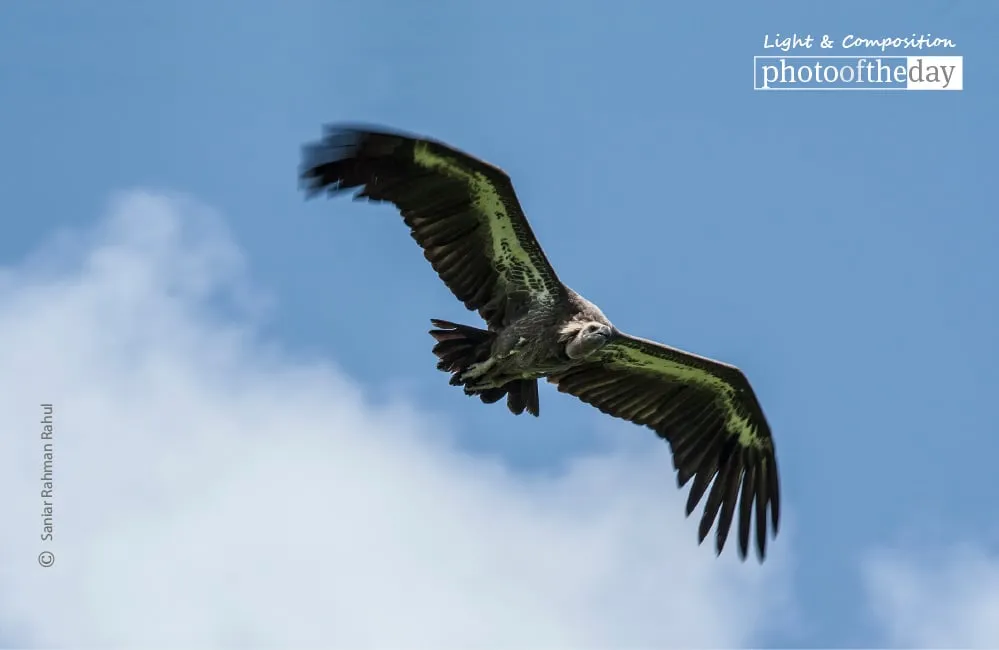
Captured within the lush canopy of Lawachara National Park in Sreemangal, this portrait of a White-rumped Vulture serves as a poignant reminder of a species once abundant, now critically endangered. The photographer skillfully isolates the bird against the natural backdrop, highlighting the intricate textures of its plumage and the intense gaze of a creature that has faced a 99.9% population decline. By documenting this rare encounter, the image transcends simple wildlife photography, acting as a vital visual record of a species struggling for survival. Its technical precision and the quiet dignity afforded to the subject make this a compelling and award-worthy piece of conservation storytelling.
Saniar Rahman Rahul
Based in Dhaka, Bangladesh, Saniar Rahman Rahul is an accomplished Art Director at Grey Worldwide with a career deeply rooted in the creative industries. His photographic journey began in childhood, inspired by his father, and was later refined through his extensive professional background in graphic design and advertising. Since rediscovering his passion for the lens in 1997, Rahul has balanced his high-profile career in global advertising with a dedicated pursuit of wildlife and nature photography, earning recognition for his artistic eye and technical execution in international competitions.
Resonance Score Breakdown
Transparency Note: The resonance score (11.6/20) is calculated based on social engagement metrics collected before the award announcement.
Expert Photography Reviews · 7
The Weight of Quiet Wings
There is a profound gravity in the way a creature holds its stillness. We often mistake silence for an absence, yet in the wild, silence is a language of endurance. To watch a life that has weathered the turning of many seasons is to witness a living history.
Read the reflection →The Weight of the Watcher
In the quiet corners of history, we often find that the creatures we once deemed common are the very ones whose absence leaves the deepest silence.
Read the reflection →Reviews & Comments
Share your thoughts about this award-winning photograph. Your reviews contribute to the community engagement score.
The vulture’s perch acts as a jagged datum, a structural interruption in the soft, verdant void of the canopy. Rahul’s frame isolates the bird, yet I’m struck by how the light rakes across those feathers, articulating mass against the blurred depth of the forest. It’s a quiet, brutal architecture of survival. I find myself leaning in, wanting to see the threshold where the branch meets the sky. It’s a haunting, spatial stillness I rarely encounter.
We look into those ancient, unblinking eyes and we aren’t just seeing a bird; we’re meeting a survivor. Saniar Rahman Rahul didn’t just point a lens; he waited in the silence of Lawachara until the vulture allowed him into its world. It’s a haunting, heavy gaze that makes my chest ache with the weight of what’s vanishing. I’ve never felt such a profound, quiet dignity in a creature so close to the edge of forever.
Rahul’s vulture evokes the stark, unblinking taxidermy of early Victorian natural history plates, yet it’s stripped of their clinical detachment. The plumage detail recalls the sharp, high-contrast clarity of Eliot Porter’s dye-transfer prints, but with a haunting, modern fragility. I’ve spent decades cataloging the decline of the natural world, but that singular, desperate gaze stopped me cold. It’s a rare, visceral confrontation that forces us to reckon with what we’ve already lost to the silence.
Before the eye identifies the vulture, a sudden stillness anchors the chest. The bird’s gaze isn’t just sharp; it’s an indictment. I feel a prickle of shame in my throat, a visceral recognition of what we’ve hollowed out. When I return to this frame, the plumage’s intricate, dusty grey feels heavier, like a shroud. It’s not just a portrait; it’s a quiet, persistent ache that follows me into the dark, long after I’ve looked away.
You caught that vulture looking back at us, and it’s haunting. I’ve spent enough time in the field to know that look; it’s not just a bird, it’s a survivor staring down a vanishing world. You didn’t just snap a portrait; you waited until the stillness felt heavy. Because you held your ground, I feel the weight of what we’re losing. There’s something honest happening here. You’ve captured a quiet, desperate dignity that stays with me.
The vulture’s silhouette anchors the frame, forcing a rigid verticality against the chaotic foliage. It’s a masterclass in spatial tension. The plumage’s intricate geometry creates a necessary fulcrum, balancing the bird’s heavy mass against the negative space of the canopy. I’ve rarely seen such disciplined isolation in wildlife work. The composition doesn’t rely on the subject’s plight; it holds because the architecture is sound. It’s cold, precise, and entirely unforgiving. That’s why it works.
The focal plane here is razor-thin, perfectly isolating the vulture’s nictitating membrane. Rahul’s lens has resolved the keratin structure of the beak with a clarity that pushes against the diffraction limit, revealing textures our eyes simply can’t process. It’s a haunting optical achievement. When I look at the micro-contrast in those feathers, I’m genuinely moved; it’s as if the glass has peeled back the veil of extinction, forcing us to confront a creature that’s vanishing before us.