The Exit Strategy by Andrea Migliari
Captured within the decaying walls of an abandoned factory near Milan, this image centers on a singular, poignant exit point. The photographer was drawn to the dramatic interplay of light as the midday sun pierced through the doorway, casting long, ethereal shadows across the desolate interior. This composition masterfully balances the harsh geometry of industrial ruin with the soft, transient quality of natural light. It is an evocative study of urban exploration, where the simple act of leaving becomes a profound visual narrative, earning its place as an award-winning piece through its technical precision and atmospheric storytelling.
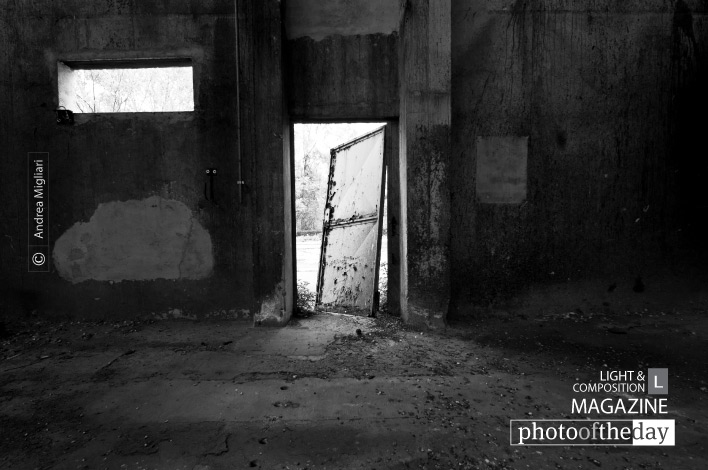
Andrea Migliari
Born in Italy in 1981, Andrea Migliari is a passionate photographer currently based near Bergamo. His creative journey began with film and darkroom processing before transitioning to digital in 2009, leading to a refined workflow that spans landscapes, portraits, and live music. Having earned recognition in prestigious Italian art magazines and winning the 'Passione Italia' competition, Migliari continues to explore the beauty found in everyday surroundings, aiming to share his profound love for visual art through every frame he captures.
Resonance Score Breakdown
Transparency Note: The resonance score (12.4/20) is calculated based on social engagement metrics collected before the award announcement.
Expert Photography Reviews · 4
The Architecture of Departure
We spend our lives building walls, brick by heavy brick, convinced that the structure is the point of the endeavor. We define ourselves by the rooms we inhabit, the boundaries we draw, and the ceilings we place over our heads to keep the vast, indifferent sky at bay.
Read the reflection →The Dust of Leaving
The air in an empty room has a specific weight, a thickness that tastes of dry limestone and forgotten winters.
Read the reflection →Reviews & Comments
Share your thoughts about this award-winning photograph. Your reviews contribute to the community engagement score.
At f/6.3, the 14mm lens renders the factory’s decay with startling micro-contrast. The diffraction limit hasn’t softened the edges of those jagged concrete shards, allowing the light’s transition from the doorway to remain razor-sharp. It’s a rare, clinical beauty. I’m genuinely breathless at how the sensor captured the photon density in those shadows; it’s as if the lens is peeling back the very skin of the ruin. It doesn’t just show light; it dissects it.
Most urban exploration shots are just hollow ruins, but this one sticks. The 14mm lens pushes the factory walls into a claustrophobic frame, forcing your eye toward that singular, blinding rectangle of light. It’s the tension between the decaying concrete and that sharp, hopeful exit that makes me ache for the person who walked through it. I’ve seen thousands of these, yet this one lingers because it captures the exact moment silence turns into a departure.
The factory’s throat is wide, yet it’s the darkness clinging to the floor that holds the truth. Migliari doesn’t just capture a doorway; he captures the weight of an ending. It’s heavy, almost suffocating. When I look at those long, jagged shadows stretching toward the light, I feel a sudden, cold ache in my chest. We’re all trying to leave something behind, aren’t we? The light here doesn’t invite; it merely exposes our inevitable departure.
The jury’s obsession with the clarity of these industrial ruins misses the point entirely. Migliari’s 1/25th shutter speed creates a ghostly, kinetic smear that I find genuinely haunting. It’s closer to Sugimoto’s long-exposure theatres than standard urban decay documentation. Why resolve the texture of the floor when the light itself is screaming? I’m bored by the sharpness; I’d rather know why they chose to let the shadows bleed into the void. It’s a beautiful, messy surrender.