The Paddyfield Pipit by Saniar Rahman Rahul
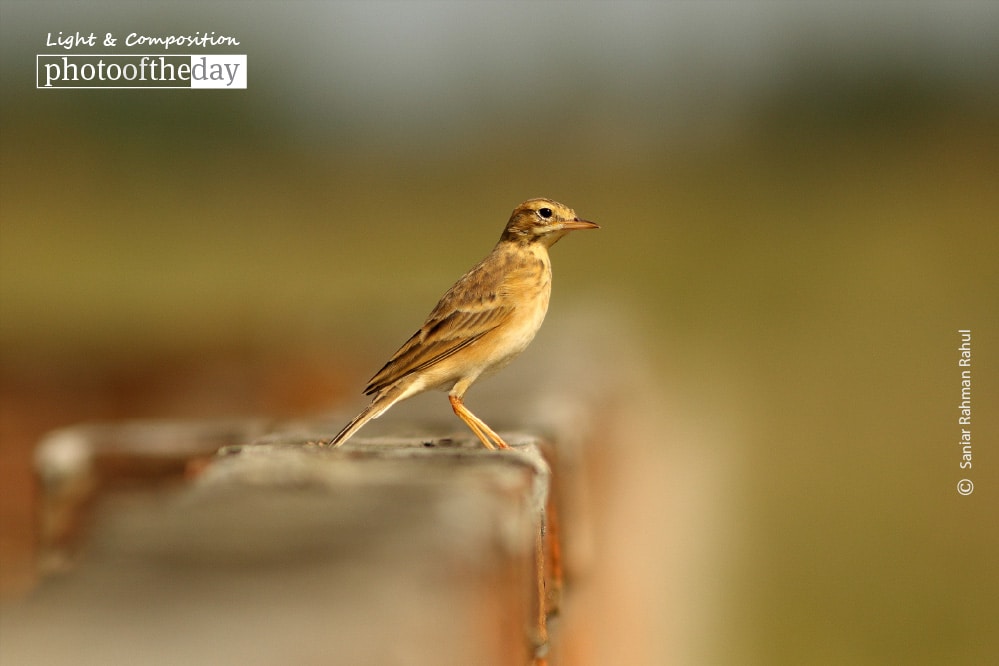
Captured in the lush, open landscapes of Purbachal, Dhaka, this photograph showcases the Paddyfield Pipit in its natural habitat. The image highlights the delicate features of this small passerine bird, which is known for its distinctive fluttery flight and repetitive song during the breeding season. By focusing on the bird amidst the scrub and grasslands between the Shitalakhya and Balu rivers, the photographer captures a serene moment of wildlife in Southern Asia. The composition is particularly award-worthy for its sharp clarity and the intimate perspective it provides of a species that thrives in the region's unique dry-season environment.
Saniar Rahman Rahul
Based in Dhaka, Bangladesh, Saniar Rahman Rahul is an accomplished Art Director at Grey Worldwide with a deep-rooted passion for visual storytelling. His journey into photography began in childhood, inspired by his father, and was later refined through his extensive professional background in graphic design and advertising. Since his early recognition as a monthly award winner in 2010, Rahul has balanced a successful career in the creative industry with a dedicated pursuit of wildlife and nature photography, consistently demonstrating a keen eye for detail and composition.
Resonance Score Breakdown
Transparency Note: The resonance score (11.9/20) is calculated based on social engagement metrics collected before the award announcement.
Expert Photography Reviews · 6
The Architecture of Stillness
The meadow pipit, when it descends to the earth, does not simply land; it folds itself into the landscape, becoming an extension of the dry grass and the shifting soil. It understands a form of dormancy that is not sleep, but a profound, alert stillness.
Read the reflection →The Architecture of a Breath
There is a quiet geometry to the way a field holds its breath. We often mistake stillness for absence, forgetting that the earth is always busy with the slow, rhythmic labor of growing.
Read the reflection →Reviews & Comments
Share your thoughts about this award-winning photograph. Your reviews contribute to the community engagement score.
Of the thousands of wildlife shots I’ve reviewed, most are just technical exercises. This one survives because it’s honest. The bird’s posture against that muted, dry-season scrub isn’t just sharp; it’s quiet. I’ve spent decades looking for this kind of restraint. It doesn’t scream for attention, yet it holds the frame with a stillness that makes me want to lean in and listen. In thirty years, this humble, precise observation will still feel entirely necessary.
The bird occupies a precise intersection, anchored by the diagonal vector of the stalk. It’s a study in balanced tension; the negative space in the upper quadrant creates a perfect 1:2 ratio against the dense, textured scrub below. I’m genuinely struck by how the avian form disrupts the horizontal grain of the grass. It’s a clean, solved equation of mass and void. Rahul’s geometry here is sharp, turning a simple field into a rigorous, satisfying spatial proof.
We look at this Paddyfield Pipit and we aren’t just seeing a bird; we’re meeting a neighbor. In the quiet scrub of Purbachal, Saniar Rahman Rahul clearly sat still long enough for this little soul to trust him. It doesn’t feel like a capture, but a conversation held in silence. I find myself holding my breath, afraid to startle it. It’s a portrait of a life lived in the tall grass, and it’s beautiful.
The Pipit sits in the dry scrub, yet it’s the encroaching gloom of the Purbachal grass that truly holds my gaze. We’re often told to seek the light, but here, the darkness is where the bird’s solitude actually breathes. It’s a quiet, heavy tension I’ve felt in the landscapes of Tarkovsky. I find myself shivering, not from the cold, but from the realization that this creature is merely a flicker against an indifferent, deepening void.
Purbachal’s scrubland feels like a stage set here. Why does the bird look so isolated from the encroaching urban sprawl of Dhaka? It’s technically sharp, sure, but I feel a strange, cold distance looking at it. Does this frame erase the tension between wildlife and the rapid development displacing these creatures? We’re consuming nature as a pristine object, ignoring the reality of the land. It’s pretty, but it doesn’t tell me the whole truth.
The light here is soft, the kind that only arrives when the sun has finally stopped its aggressive climb. He stood in the tall, dry grass of Purbachal, waiting for the Pipit to settle. It’s a quiet, humble stillness. I find myself holding my breath, feeling the damp earth beneath my own boots. He didn’t chase the bird; he let the landscape reveal it. It’s a rare, patient grace that makes my heart ache for home.