At the Speed of Light by Andrew R. Braley
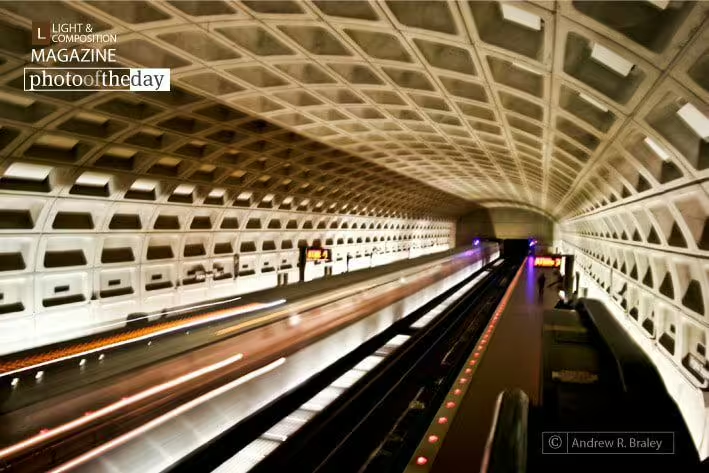
Captured during a brief window of opportunity in a Washington, D.C. transit station, this image explores the fluid nature of motion. The photographer utilized a long exposure technique to transform the mundane rush of commuters into a dynamic blur of light and energy, contrasting the stillness of the architecture with the kinetic pace of city life. The success of the shot lies in its spontaneous execution; despite the limited time to compose, the photographer captured a compelling sense of speed and transition, elevating a fleeting moment into a sophisticated study of motion photography.
Andrew R. Braley
Based in Kaneohe, Hawaii, Andrew R. Braley balances a professional career as a Registered Landscape Architect with a growing passion for photography. His creative journey began with traditional black and white film processing in college, a foundation that informs his current exploration of digital techniques and wide-angle perspectives. Drawing inspiration from the lush landscapes of his home state and his experiences living across the United States, Braley continues to refine his artistic voice while documenting the world around him with curiosity and technical dedication.
Resonance Score Breakdown
Transparency Note: The resonance score (12.1/20) is calculated based on social engagement metrics collected before the award announcement.
Expert Photography Reviews · 6
The Hum of Passing Ghosts
The smell of ozone always brings me back to the subway platforms of my youth—that sharp, metallic tang that clings to the back of the throat like a secret.
Read the reflection →The Architecture of Passing
In the nineteenth century, the arrival of the locomotive forced the human eye to recalibrate. Suddenly, the landscape was no longer a series of static portraits to be studied, but a smear of color, a frantic ribbon of earth and sky. We were not built for such velocity.
Read the reflection →Reviews & Comments
Share your thoughts about this award-winning photograph. Your reviews contribute to the community engagement score.
It’s a slick bit of motion, certainly. One suspects Braley caught this while dodging transit security, which is a sport I’ve played often enough to respect. Yet, it feels hurried. The architecture is sharp, but the blur lacks the deliberate weight of a long, shivering vigil. It’s a clever snapshot, not a conquest. I’d have preferred he missed the train and stayed until the light—and the commuters—finally surrendered to his patience.
The ochre of the station’s vaulted ceiling bleeds into the electric, frantic cerulean of the commuters’ motion, creating a chromatic dissonance that feels, quite frankly, like a fever dream. It’s a collision of Turner’s atmospheric turbulence and the cold, industrial stillness of a Morandi still life. I’m utterly breathless watching these blurred streaks of light dissolve into the shadows; it’s as if the very air has been stained by the velocity of human transit.
Of the thousands of motion studies I’ve reviewed, most are just blurry gimmicks. Braley’s work survives because the rigid, brutalist geometry of the station acts as a cage for the frantic, ghostly commuters. It’s that tension between the permanent architecture and the fleeting human vapor that hits me. I’ve walked through stations like this a hundred times, but this frame makes me feel the actual exhaustion of the daily grind. It’s a haunting, timeless document.
The architecture’s rigid geometry anchors the frame, providing a necessary fulcrum for the blurred kinetic energy. It’s a precarious balance. The vertical pillars impose a discipline that the motion threatens to dissolve. I’m genuinely unsettled by how the light streaks pull the eye toward the periphery, nearly breaking the frame’s containment. It doesn’t collapse, though. The structural integrity holds against the chaos. It’s a rare instance where the blur doesn’t devolve into mere noise.
The city’s architecture holds its breath, a stone anchor against the frantic pulse of commuters. Braley didn’t just record motion; he listened to the hum of the transit station until the blur felt like a prayer. I’ve stood in such places, waiting for the chaos to find its rhythm. It’s a strange, lonely comfort to see the light streak like that. It makes me feel small, watching the world rush toward a destination I don’t share.
Braley’s commuters aren’t people; they’re ghosts haunting the architecture of D.C. transit. I’m unsettled by how the light bleeds into the void, erasing the human form until only the velocity remains. It’s a cold, mechanical purgatory. Where the shadows should anchor us, they instead dissolve, leaving a hollow kineticism that feels like a frantic escape from existence itself. It’s beautiful, I suppose, but it’s a beauty that refuses to let me rest.