The Window Seat by Ankush Kochhar
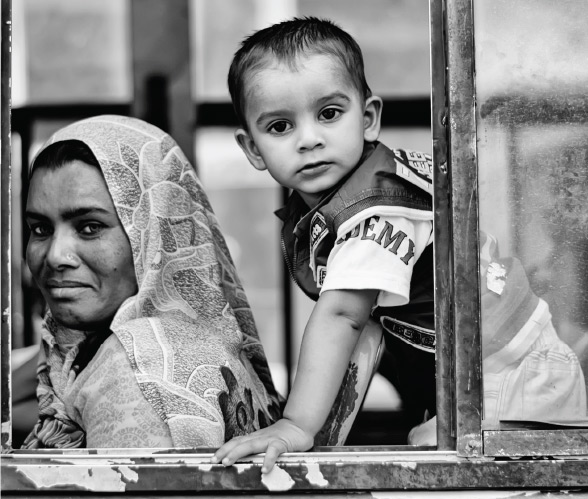
Captured in the vibrant atmosphere of Pushkar, India, this poignant street photograph features a young child peering curiously from a bus window. The photographer masterfully balances the child's inquisitive gaze with the gentle, knowing smile of the mother nearby, creating a narrative of fleeting human connection. The image is award-worthy for its candid intimacy and the photographer's ability to transform a mundane transit moment into a compelling visual story. By focusing on the interplay of expressions, the photographer captures a universal sense of wonder, demonstrating a keen eye for the quiet, evocative details of everyday life.
Ankush Kochhar
Based in Delhi, India, Ankush Kochhar is a passionate photographer whose journey began in 2008 with a simple point-and-shoot camera. Transitioning from a hobbyist to a dedicated professional, he is known for his minimalist approach and his commitment to capturing authentic moments from unique perspectives. Kochhar is a lifelong learner who travels extensively to document the world through his lens, consistently seeking to refine his craft and translate his deep appreciation for nature and human connection into evocative street photography.
Resonance Score Breakdown
Transparency Note: The resonance score (12.1/20) is calculated based on social engagement metrics collected before the award announcement.
Expert Photography Reviews · 8
Between Here and There
I remember sitting on a train pulling out of a station in Rajasthan, watching the platform blur into a smear of ochre and grey. Across the aisle, a young boy pressed his forehead against the glass, his breath fogging the pane as he traced patterns in the condensation.
Read the reflection →The Geography of Transit
We are all travelers caught in the architecture of the in-between. A window is not merely a frame of glass; it is a thin, fragile membrane separating the self from the vast, unspooling world.
Read the reflection →Reviews & Comments
Share your thoughts about this award-winning photograph. Your reviews contribute to the community engagement score.
The frame’s geometry is rigid, anchored by the bus window’s sharp, rectangular boundary. It’s a clean containment. The child’s face occupies the lower quadrant, creating a precise fulcrum against the mother’s soft, peripheral presence. The spatial tension between these two points is undeniable. I’ve rarely seen such disciplined framing in street work. It doesn’t rely on sentiment; it relies on the architecture of the shot. The composition holds. It’s a rare, structural success.
Before the eye identifies the bus, something in the chest tightens. It’s that sudden, sharp recognition of a threshold. The child’s gaze pulls at my own peripheral vision, demanding a response I can’t quite name. When I return to this, I’m struck by the mother’s stillness; it’s a quiet anchor in the chaos of transit. I’ve found myself tracing that window frame, feeling the weight of a world passing by, held in a fleeting, fragile breath.
You didn’t just snap a bus window; you caught a heartbeat. That child’s curiosity is raw, and the mother’s smile feels like a secret they’re sharing against the chaos of Pushkar. I’ve spent years in transit, but I rarely see this kind of quiet grace. It’s honest. And because you waited for that exact look, I feel like I’m sitting right there in the dust with them. You earned this moment, and it’s a beautiful one.
Most street photography is noise, but this frame hits differently. Of the thousands I’ve reviewed, few capture the specific, heavy stillness of a bus window quite like this. The mother’s weary, knowing smile anchors the child’s frantic curiosity, grounding a fleeting transit moment into something permanent. It’s the tension between her resignation and his wonder that gets me; I find myself wanting to know their destination. Thirty years from now, that gaze will still feel alive.
1/200sec at f/1.8, ISO 100. A Nikon D800 pushed to its shallowest limit. At f/1.8, the plane of focus is razor-thin. It’s a gamble that pays off, isolating the child’s iris while the mother’s features soften into a necessary blur. I’ve seen too many street shots ruined by excessive depth, but this choice is surgically precise. It’s cold, calculated, and frankly, it’s the only way this composition survives the chaos of a bus window.
The ochre dust of Pushkar clings to the frame, yet it’s the child’s tunic—a bruised, electric violet—that anchors the soul, vibrating against the bus’s weathered, sun-bleached teal like a Morandi still life caught in transit. I’m breathless at how the light, filtered through the glass, turns the mother’s skin into the soft, luminous gold of a Vermeer. It’s a chromatic ache, a fleeting collision of pigments that makes one’s heart simply stop in the heat.
The bus frame cuts the world. It’s a hard edge against the dust of Pushkar. The child’s face occupies a sliver of the glass. The rest is just air. A void. I’ve spent minutes staring at that unpainted metal. It’s heavy. It’s quiet. Nothing here is accidental. The empty corner is not empty. It’s the breath between the mother’s smile and the boy’s wide eyes. I feel a sudden, sharp ache for that stillness.
We look at this face and we understand something about the world beyond the glass. In Pushkar, the bus window becomes a frame for a child’s quiet wonder, anchored by a mother’s gentle, knowing presence. Ankush didn’t just snap a shutter; he waited for the conversation to settle. It’s a fleeting moment, yet it feels eternal. I’ve found myself lingering on the child’s eyes, feeling a sudden, sharp ache for the simplicity of being truly seen.