A Gypsy Girl in Dharavi by Kristian Bertel
Captured amidst the bustling environment of Dharavi, Mumbai, this portrait of a young girl from a nomadic tribe offers a poignant glimpse into the lives of India’s marginalized communities. The photographer utilized the natural light and raw atmosphere of the setting to highlight the subject's presence, documenting a human story within one of the world's most densely populated districts. The image is award-worthy for its empathetic approach to portraiture, successfully bridging the gap between the viewer and the subject while shedding light on the complex social fabric of Maharashtra’s nomadic and denotified tribes.
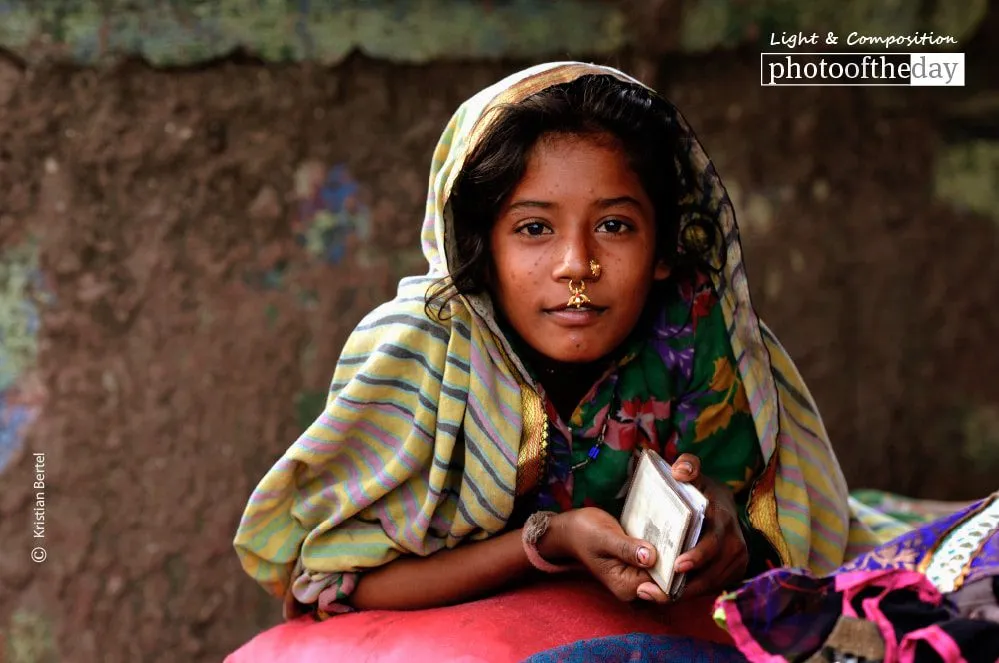
Kristian Bertel
Based in Aarhus, Denmark, Kristian Bertel has been dedicated to the art of photography since 2006. He is internationally recognized for his extensive long-term documentation of India, a project he initiated in 2008 to explore the human condition, urban poverty, and the lives of street children. Through his travel photography, Bertel masterfully combines technical skill with a deep commitment to storytelling, aiming to bring visibility to the social realities faced by inhabitants across India’s diverse landscapes.
Resonance Score Breakdown
Transparency Note: The resonance score (12.0/20) is calculated based on social engagement metrics collected before the award announcement.
Expert Photography Reviews · 7
The Weight of a Gaze
I met a woman once in a crowded market in Istanbul who sold nothing but hand-woven ribbons. She spent her days watching the tide of tourists flow past her stall, her eyes tracking the movement of strangers with a stillness that felt ancient.
Read the reflection →The Salt of Unspoken Stories
The air in the heat of the afternoon tastes of iron and dry earth, a fine grit that settles on the back of the tongue. I remember the sensation of walking barefoot on sun-baked clay, the way the ground pushes back against the soles, firm and unforgiving.
Read the reflection →Reviews & Comments
Share your thoughts about this award-winning photograph. Your reviews contribute to the community engagement score.
This is Photo of a particular Peoples culture traces from their cultural journey !
Dharavi’s density is usually a chaotic blur, yet here, the girl’s stillness creates a profound datum against the corrugated metal. The light rakes across the rusted, vertical textures, emphasizing the precarious solid-void relationship of her shelter. It’s a rare, honest threshold. I’m struck by how the frame isolates her from the crushing urban scale, forcing us to confront the human cost of such architecture. It’s not just a portrait; it’s a spatial ache I can’t ignore.
You didn’t just take a portrait; you sat with her. I’ve spent enough time in places like Dharavi to know that look in her eyes—it’s not staged, it’s a quiet, heavy truth. You waited for the light to catch her face just right, and it makes my chest ache a little. You didn’t turn her into a prop. You let her be a person. And that’s the only reason this matters. Good work.
Dharavi’s grit frames her, but does it define her? I find myself unsettled by the way this girl’s gaze is curated for our consumption. Why does the background blur into a romanticized smear of poverty? It’s a polished aesthetic that feels uncomfortably detached from the girl’s actual reality. Does she know she’s being framed as a symbol of marginalization? I’m left wondering if we’re looking at a human being or just a prop for a narrative.
We look at this girl’s eyes and we feel the weight of Dharavi’s dust. Kristian Bertel didn’t just point a lens; he sat with her, letting the silence of the alleyway settle before he clicked. It’s a haunting, intimate exchange. I’ve spent hours staring at her expression, and it’s the quiet dignity that breaks my heart. She isn’t just a subject; she’s a story waiting to be heard. This is a photograph that asks to be returned to.
The blur around the girl’s eyes isn’t a failure; it’s a deliberate refusal to pin her down. I’m genuinely moved by how the motion renders her environment as a ghost-like smear, echoing the transience of nomadic life. It’s closer to Sugimoto’s long-exposure theatres than standard portraiture. Why resolve the background when the subject’s reality is so fleeting? It’s a brave choice to let the focus drift, capturing the pulse of Dharavi rather than just its skin.
f/2.8 at 50mm, 1/125s, ISO 200. A standard portrait configuration, yet it’s executed with clinical precision. The shallow depth of field isolates the subject from the chaotic Dharavi background, forcing the eye exactly where it belongs. I’ve seen enough messy street shots to appreciate this restraint. It’s technically sound, though I’d prefer a tighter shutter speed to eliminate that slight motion blur in the eyes. It’s a sharp, calculated choice that actually works.
Most portraits from Dharavi rely on the grit of the slums to do the heavy lifting, but this one doesn’t. It’s the girl’s gaze, anchored by that singular, piercing highlight in her left eye, that holds the frame together. I’ve seen thousands of street portraits, yet this one lingers because she isn’t performing for the lens. It’s haunting. In thirty years, we won’t remember the location; we’ll remember the weight of her quiet, unyielding defiance.