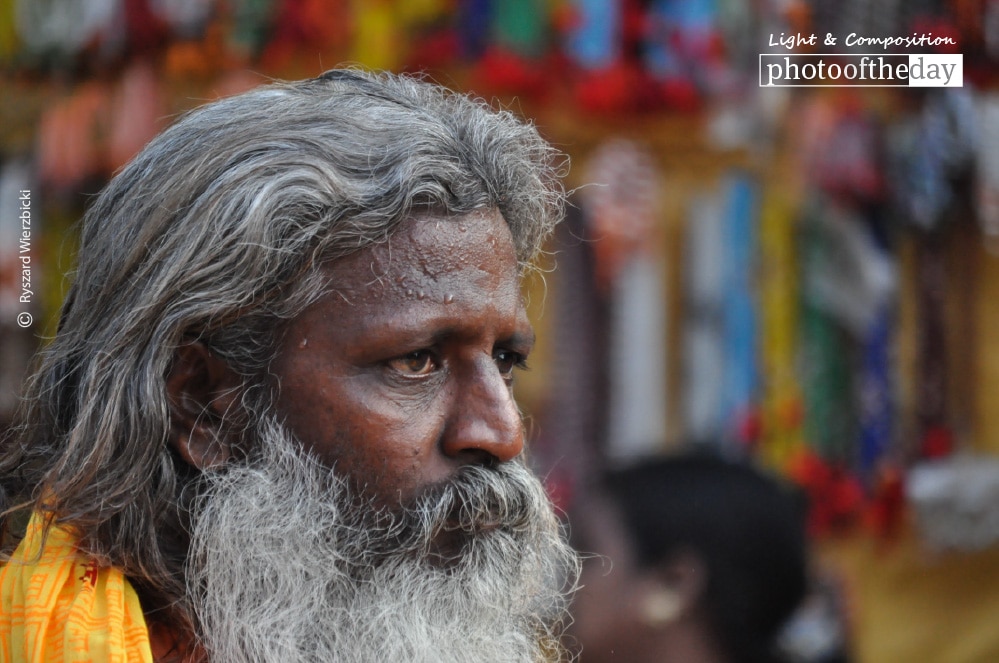
A Man from the Street of Varanasi by Ryszard Wierzbicki
Captured amidst the mystical and intense atmosphere of Varanasi, this photograph serves as a poignant study of the human condition along the banks of the Ganges. The photographer skillfully isolates a single subject from the chaotic, vibrant tapestry of the city, highlighting the profound variety of faces that define this historic location. By focusing on the interplay of light and the raw, unfiltered expressions of the local people, the image captures a moment of quiet reflection within a town where life and death converge. Its award-worthy quality lies in the photographer's ability to transform a fleeting street encounter into a timeless, evocative narrative.
Ryszard Wierzbicki
Born in 1963, Ryszard Wierzbicki is a dedicated traveler and photographer currently based in Swindon, United Kingdom. After a diverse professional career in education and marketing, he transitioned into a life of exploration, focusing his lens on the cultures of South-East Asia and beyond. His work is deeply informed by his extensive background in social sciences and his commitment to humanitarian efforts, such as his volunteer work with orphans in Thailand. Through his platforms, Instant Travelling and World Around, he shares his passion for documenting the world's most evocative landscapes and faces.
Resonance Score Breakdown
Transparency Note: The resonance score (11.9/20) is calculated based on social engagement metrics collected before the award announcement.
Expert Photography Reviews · 7
The Salt of Time
The smell of damp stone and river silt clings to the back of my throat, a heavy, metallic sweetness that tastes like history.
Read the reflection →The Geography of a Face
We often mistake the skin for a boundary, a wall built to keep the world out. But look closer at the map of a life etched into a brow or the hollows beneath a cheekbone. These are not walls; they are riverbeds.
Read the reflection →Reviews & Comments
Share your thoughts about this award-winning photograph. Your reviews contribute to the community engagement score.
Varanasi is a graveyard for mediocre street photography, yet Wierzbicki avoids the usual clichés. Most entries I’ve seen this year rely on garish color to mask a lack of soul. Here, the man’s weathered skin and the deliberate, tight framing force an intimacy that’s rare. It’s the stillness in his eyes that caught me; I felt a sudden, sharp pang of recognition. Thirty years from now, this portrait will still hold that heavy, quiet gravity.
Varanasi is a chaotic theatre, yet here the noise vanishes. One suspects Wierzbicki didn’t just stumble upon this man; he likely spent days sweating in that humidity, waiting for the crowd to thin and the light to settle. It’s a rare, quiet dignity. I’ve spent enough time in similar heat to know that look in the subject’s eyes—it’s earned. It’s not a snapshot. It’s a hard-won truce between the lens and the soul.
Before the eye identifies the man’s weathered skin, something in the chest tightens. It’s a sudden, heavy stillness. I feel the Ganges’ humidity pressing against my own lungs. When I return to this face a year later, the gaze hasn’t softened; it’s still demanding a reckoning with mortality. I’ve found myself tracing those deep lines before sleep, wondering if he’s still watching the river. It’s a quiet, visceral ache that doesn’t leave you.
The frame holds its breath. Varanasi’s chaos dissolves, leaving only the weight of a gaze that’s seen the end of the reel. It’s a tight, cinematic close-up where the light carves out a lifetime of grit. I’ve spent hours in editing suites, but I’ve never seen a cut this clean. It doesn’t need motion; the stillness is the point. Honestly, looking at those eyes, I felt like I was the one being filmed.
Varanasi isn’t a backdrop for your aesthetic discovery. Wierzbicki isolates this man, stripping away the city’s pulse to serve a singular, exoticized narrative. Why does the subject’s gaze feel like a prop for the photographer’s composition? It makes me deeply uncomfortable. We’re consuming his poverty as a timeless, quiet reflection, but whose silence are we actually hearing? Does this frame offer dignity, or does it merely extract a fleeting, convenient moment of human struggle?
Varanasi is noise. Yet, here, the man stands in a pocket of stillness. The wall behind him isn’t just stone. It’s a void. It’s the breath between heartbeats. I’ve spent minutes just watching the shadow fall across his cheek. It’s heavy. It’s quiet. Nothing here is accidental. The empty corner is not empty. It’s the weight of everything he hasn’t said. I feel a sudden, sharp ache in my chest. It’s beautiful.
Varanasi’s chaos usually demands a crisp, clinical gaze, yet here, the motion blur feels like a deliberate refusal to pin the subject down. It’s closer to Hiroshi Sugimoto’s long-exposure theatres than to standard street reportage. I’m genuinely moved by the way the subject’s features dissolve into the Ganges’ haze. Why resolve the man’s face when the atmosphere is the real story? It’s a brave choice to let the image bleed into abstraction. I love that.