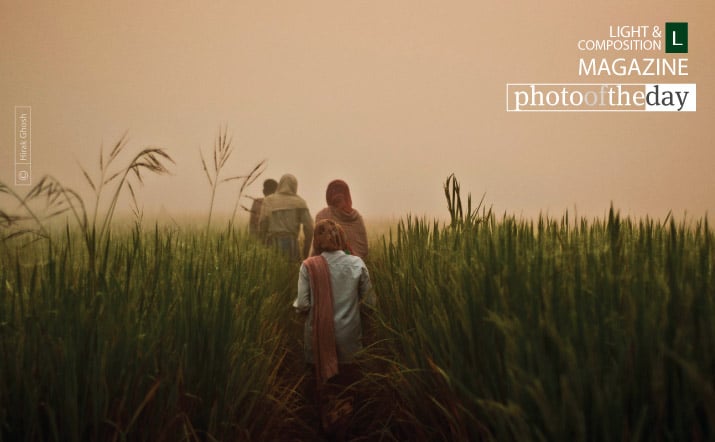
Going to Work by Hirak Ghosh
Captured on a misty morning in a rural West Bengal village, this photograph documents the quiet rhythm of daily life. As farmers made their way through the lush paddy fields, the dense fog transformed the landscape into an ethereal, mystic environment. The photographer seized this fleeting moment, balancing the soft, diffused light with the purposeful movement of the subjects. This image is award-worthy for its evocative atmosphere and its ability to turn a mundane commute into a timeless, cinematic scene that highlights the profound beauty found in the simplicity of rural existence.
Hirak Ghosh
Hailing from a small village in West Bengal, India, Hirak Ghosh is a dedicated student and emerging photographer who views the medium as his true life's passion. He frequently travels to remote villages to document the daily activities and authentic lives of local people. His work is defined by a keen observational style that captures the human spirit within the rural landscapes of his home region.
Resonance Score Breakdown
Transparency Note: The resonance score (3.9/20) is calculated based on social engagement metrics collected before the award announcement.
Expert Photography Reviews · 4
The Weight of the Path
The morning does not ask for permission. It arrives in gray layers, stripping the world of its edges until only the movement remains. We walk because we must.
Read the reflection →The Weight of Morning
There is a specific silence that belongs only to the very early hours, before the world has fully remembered its obligations. It is a heavy, damp sort of quiet, the kind that clings to the hem of a coat or the edges of a thought.
Read the reflection →Reviews & Comments
Share your thoughts about this award-winning photograph. Your reviews contribute to the community engagement score.
Fog isn’t merely weather here; it’s an ontological veil. Ghosh captures these figures dissolving into the gray, where the boundary between the laborer and the land blurs into nothingness. I’ve stared at these silhouettes until my eyes ache, searching for the solid ground they’ve abandoned. It’s haunting how the light refuses to define them, leaving only the ghost of a commute. It doesn’t invite us in; it demands we acknowledge the void they’re walking through.
Most entries in this category rely on the exoticism of the setting, but this one earns its place by stripping away the noise. The way the fog swallows the horizon line forces you to focus on the rhythmic stride of the figures. It’s haunting. I’ve stared at these silhouettes for years, and they still feel like they’re walking toward something vital. It’s a rare, quiet endurance that makes me wish I were standing in that field.
The frame’s architecture relies on the interplay of vertical stalks against the horizontal void of the mist. It’s a precarious balance. The subjects provide the necessary fulcrum, anchoring the composition before it dissolves into the grey. I’m genuinely unsettled by how the negative space threatens to swallow the figures entirely. It doesn’t lean on sentiment; it leans on the geometry of the commute. The discipline here holds, barely, against the encroaching white. It’s rigorous work.
The palette here evokes the muted, chalky stillness of a Morandi study, where the verdant greens of the paddy fields dissolve into a fog the colour of wet limestone. It’s a haunting, spectral wash that makes my heart ache with its quietude. One finds the light isn’t merely illuminating the scene; it’s dissolving the figures into the very atmosphere, turning a simple commute into a sublime, monochromatic meditation on the ephemeral nature of existence.