The Symbol of Love by Subhashish Nag Choudhury
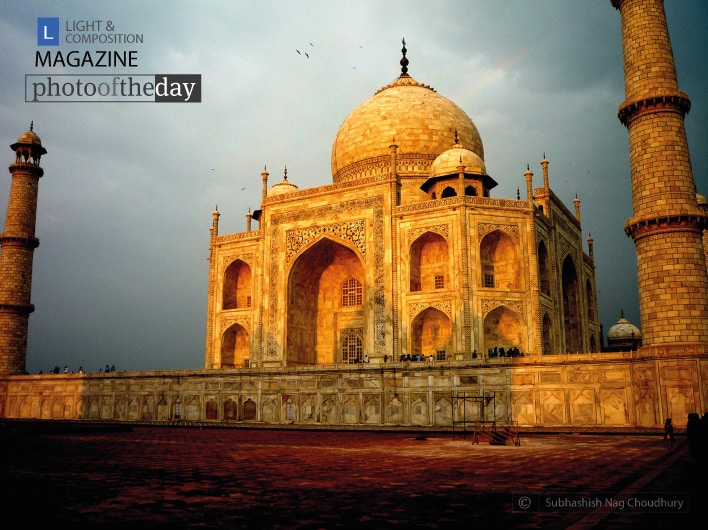
Captured during the golden hour in Agra, India, this photograph frames the Taj Mahal from a unique corner perspective. As the sun dipped below the horizon, the photographer sought to emphasize the monument's architectural grandeur against the deepening hues of the evening sky. By choosing this specific angle, the photographer successfully translated a personal vision into a striking visual narrative. The image is award-worthy for its evocative use of natural light and its ability to transform a globally recognized landmark into a fresh, artistic interpretation that highlights the timeless beauty of the structure.
Subhashish Nag Choudhury
Based in Kolkata, India, Subhashish Nag Choudhury balances a professional career in information technology with a deep-seated passion for photography. He views the medium as a sophisticated blend of technical precision and artistic expression, frequently exploring diverse genres including nature, wildlife, landscape, and micro photography. Driven by a desire to travel the world and document unique scenes, he continuously experiments with artistic techniques to capture the world as he perceives it through his lens.
Resonance Score Breakdown
Transparency Note: The resonance score (12.3/20) is calculated based on social engagement metrics collected before the award announcement.
Expert Photography Reviews · 7
The Architecture of Memory
We build monuments to house the things we are terrified of losing. We stack stone upon stone, carving our grief into marble, hoping that if we make the structure heavy enough, it will anchor the ghost of a feeling to the earth.
Read the reflection →Built to Last
I spent this morning trying to fix a small crack in my favorite ceramic mug. It felt silly, really. It’s just a cup, and it’s seen better days, but I couldn't bring myself to throw it away.
Read the reflection →Reviews & Comments
Share your thoughts about this award-winning photograph. Your reviews contribute to the community engagement score.
The marble pulls back. It leaves the sky to breathe. I’ve stood in Agra, but I’ve never felt this quiet. The Taj Mahal doesn’t dominate here. It retreats. It’s a sliver of white against the deepening blue. Nothing here is accidental. The empty corner is not empty. It’s a held breath. It’s the weight of what isn’t shown. I find myself leaning into the void. It’s a rare, still grace. I’m finally listening.
The Taj Mahal’s marble doesn’t merely reflect the light; it drinks the bruised, bruised violet of the Agra dusk, a shade reminiscent of Morandi’s most melancholic still lifes. One feels a sudden, sharp ache in the chest watching that pale, calcified white surrender to the encroaching indigo. It’s a chromatic seduction, where the architecture’s cold geometry dissolves into the warm, honeyed residue of a sun that’s already abandoned the earth to its own deepening, velvet shadows.
One suspects the light cooperated on the first attempt. It often does, for the casual tourist. While the Taj Mahal is a difficult subject to ruin, this effort feels remarkably inexpensive. It lacks the grit of a long vigil; I’ve spent enough freezing dawns in Agra to know that true architectural reverence requires more than a quick snap at golden hour. It’s pretty, certainly, but I’m left wondering if the photographer ever actually stayed for the dark.
Of the thousands of Taj Mahal shots I’ve reviewed, most are postcards. What separates this from the clutter is the aggressive corner perspective. It forces the marble to lean into the frame, creating a tension that feels alive. I’ve seen enough symmetry to last a lifetime, but this angle makes the monument feel precarious, almost fragile. It’s a relief to see it stripped of its usual postcard polish. In thirty years, this perspective will still feel honest.
At f/4.5, the Sony’s sensor struggles against the diffraction limit, yet the light’s interaction with the marble’s micro-texture is haunting. I’m genuinely moved by how the focal plane catches the Taj’s edge, rendering the stone’s porous surface with a clarity the naked eye misses. It’s a delicate balance; the chromatic aberration at the sky’s transition is visible, but it doesn’t diminish the raw, optical honesty of this golden hour capture. It’s a rare, precise beauty.
The Taj Mahal doesn’t just sit here; it breathes in the cooling air of dusk. Subhashish stood in the quiet, waiting for the marble to soften under the dying sun. I’ve felt that same stillness, where the world narrows to a single, glowing edge. It’s a humble perspective, one that ignores the monument’s fame to listen to its fading warmth. My heart aches a little, seeing how he let the light settle into the stone.
The Taj Mahal usually demands our adoration, but here, it’s forced into a somber, angular silence. By pushing the monument into the periphery, the photographer lets the encroaching dusk do the heavy lifting. It’s a relief to see the marble lose its tourist-trap glow. I’ve always felt that architecture is just a tomb for light, and looking at these deep, bruised shadows, I finally feel the weight of that truth. It doesn’t invite; it resists.
Thanks a lot for your comments.
very beautiful. It truely captures the mood of eternal love!