A Dead Reflection by Liton Chowdhury
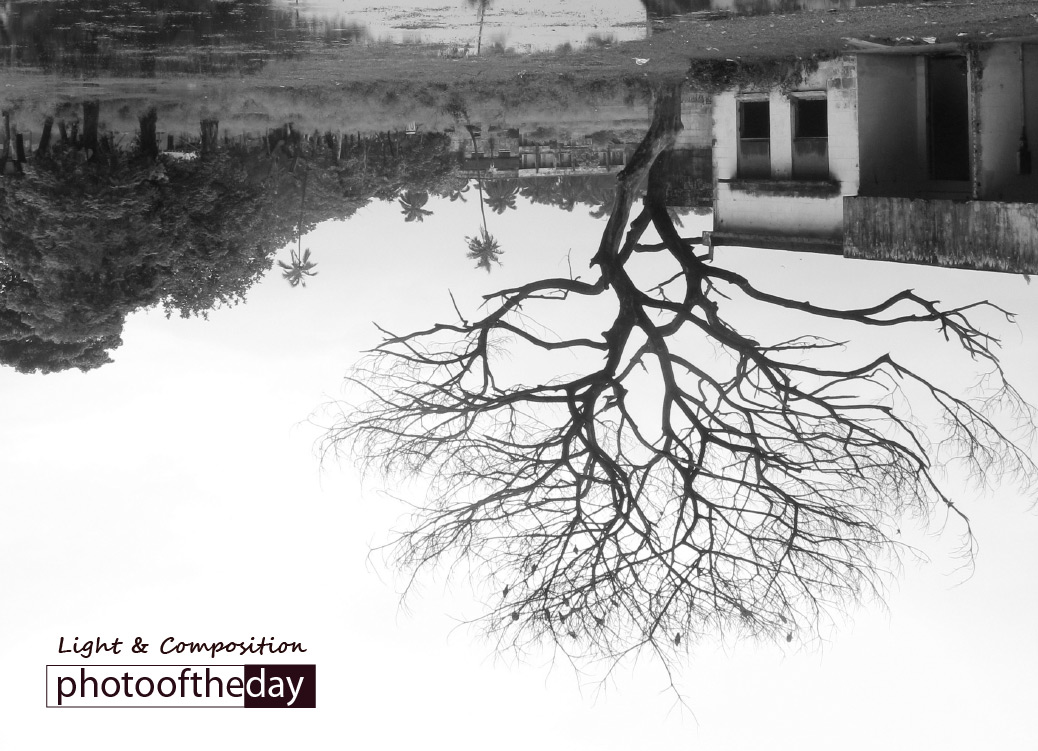
Captured in Batanagar, West Bengal, this poignant image serves as a visual metaphor for a deeply personal struggle. During a time when the photographer’s father was battling a terminal illness, the artist sought to reconcile the pain of the situation with the desire for peace. By flipping the composition, the photographer transforms a standard reflection into a haunting, ethereal mirror of reality. This creative decision elevates the image beyond a simple landscape, imbuing it with emotional weight and conceptual depth. The resulting symmetry and stillness make the photograph a powerful, award-worthy exploration of grief, acceptance, and the quiet beauty found in difficult moments.
Liton Chowdhury
Based in Kolkata, India, Liton Chowdhury balances a professional career in software development with a dedicated passion for photography. His creative journey began with the desire to document his daughter’s childhood, a pursuit that has since evolved into a refined artistic practice. As his daughter remains his primary muse and most frequent subject, Chowdhury continues to explore the intersection of personal narrative and visual storytelling, consistently capturing intimate moments with a thoughtful and evocative lens.
Resonance Score Breakdown
Transparency Note: The resonance score (12.6/20) is calculated based on social engagement metrics collected before the award announcement.
Expert Photography Reviews · 4
The Mirror of What Remains
I remember sitting in a waiting room in Leeds, watching a man trace the pattern of the linoleum floor with his shoe. He wasn't looking at the magazines or the clock on the wall; he was staring at the way the fluorescent light pooled in a puddle of spilled coffee near his feet.
Read the reflection →The Mirror of Quiet Waters
We spend our lives trying to hold the world upright, as if the earth were a glass we could shatter with a single clumsy movement. But sometimes, the world is most honest when it is turned on its head.
Read the reflection →Reviews & Comments
Share your thoughts about this award-winning photograph. Your reviews contribute to the community engagement score.
It’s easy to flip a reflection, but harder to sit with the stillness required to make it ache. Chowdhury’s choice of a modest PowerShot suggests he wasn’t hiding behind expensive glass, but rather standing in the mud, waiting for the water to settle. I’ve spent enough dawns shivering by stagnant pools to recognize that quiet, heavy resignation. It’s a bleak, honest bit of work. One suspects he returned until the world finally stopped moving.
The horizontal axis bisects the frame with surgical precision, creating a perfect 1:1 ratio between the terrestrial and the reflected. By inverting the vertical orientation, Chowdhury forces the eye to reconcile two identical masses. It’s a brilliant spatial inversion. The symmetry creates a claustrophobic, locked-in geometry that feels almost mathematical in its grief. I’ve stared at this for ten minutes; the sheer stability of that central line is haunting. It’s a perfectly solved equation of loss.
You’re staring into the water, and I can feel the weight of what you were carrying that day. It’s a quiet, heavy kind of grief. By flipping the frame, you’ve turned the world upside down, mirroring the disorientation of losing someone you love. It’s not just a reflection; it’s a surrender. I’ve been in that dark place, and seeing this stillness makes my chest tighten. You didn’t look away. That’s the truth I’m looking for.
The frame hits like a sudden cut to black. It’s a disorienting, inverted world where the water holds the weight of a terminal silence. I’ve spent hours staring at this reflection, and honestly, it makes my chest ache. Chowdhury didn’t just flip the horizon; he edited out the noise of reality. It’s a sequence frozen in grief. The stillness is absolute. You don’t look at this shot, you inhabit the edit. It’s perfect.
fabulous!! best of luck
Beautiful ! I love the concept !
It’s good. I love the concept.