Where the Mountains Meet You by Tisha Clinkenbeard
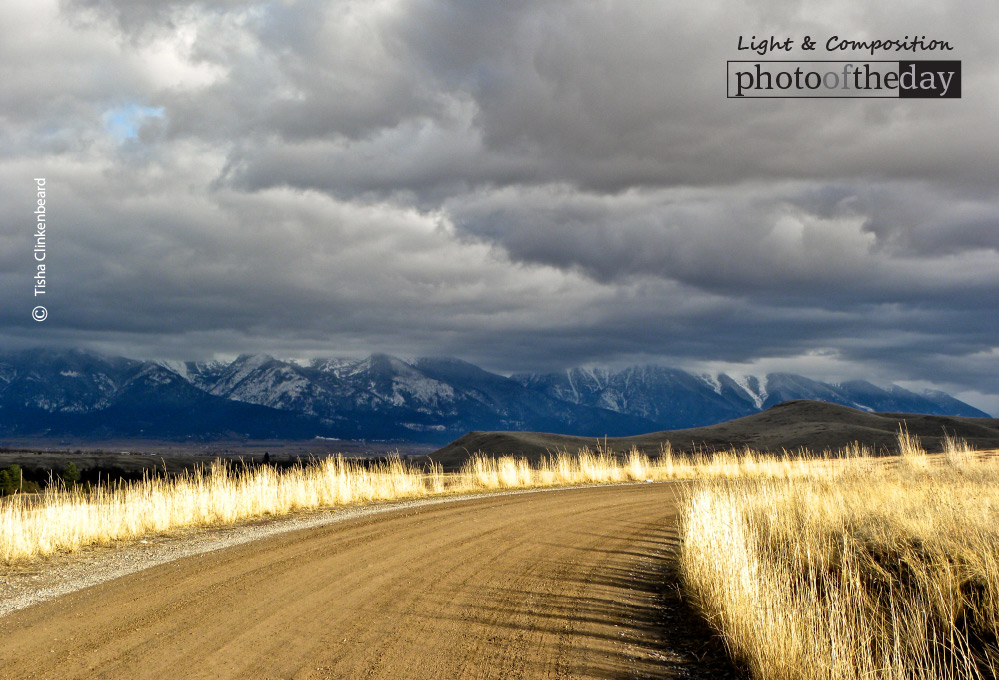
Captured at the National Bison Range in Montana, this photograph masterfully juxtaposes the warmth of golden, sun-drenched grasses against the encroaching chill of a blue and grey winter storm. The photographer skillfully framed the scene to emphasize the dramatic atmospheric contrast between the serene, illuminated foreground and the moody, incoming weather in the distance. This image is award-worthy for its evocative use of natural light and color theory, which transforms a simple landscape into a compelling narrative of seasonal transition and the raw, untamed beauty of the American wilderness.
Tisha Clinkenbeard
Based in Powderly, Texas, Tisha Clinkenbeard is an accomplished photographer whose work has been featured in prestigious venues such as The Fine Arts Center of Hot Springs and Portland’s Black Box Gallery. Her artistic journey, which began long before the advent of modern digital technology, is driven by a desire to document the beauty she encounters while wandering the earth. Through her blog, Found Round & About, she shares her unique perspective on the world, consistently earning recognition for her ability to capture the essence of her surroundings.
Resonance Score Breakdown
Transparency Note: The resonance score (12.1/20) is calculated based on social engagement metrics collected before the award announcement.
Expert Photography Reviews · 7
Between the Warmth and Cold
I spent this morning trying to decide whether to wear my heavy coat or just a sweater. The sun was hitting the kitchen floor, making it look like spring, but when I stepped onto the porch, the wind felt like it was still stuck in January.
Read the reflection →The Breath of the Divide
We often mistake the horizon for a wall, a finality where the earth decides it has done enough. But the horizon is merely a conversation between the ground and the sky, a place where the heavy, rooted things of the world lean in to hear what the clouds are whispering.
Read the reflection →Reviews & Comments

Share your thoughts about this award-winning photograph. Your reviews contribute to the community engagement score.
Most landscape submissions this year relied on tired, oversaturated sunsets. Tisha’s work avoids that trap. The tension here isn’t just color; it’s the way those golden grasses refuse to yield to the encroaching blue storm. I’ve stared at this for weeks, and it still makes me shiver. It’s the rare piece that captures a fleeting, brutal transition with such quiet authority. Thirty years from now, people will still feel that cold wind biting through the warmth.
The jury’s obsession with clarity here feels stifling. Tisha’s landscape is technically competent, yet it’s trapped by its own sharpness. I’m craving a rupture in that crisp horizon. Why resolve every blade of grass when the storm’s arrival demands a dissolution of form? It’s closer to a postcard than Sugimoto’s ethereal voids. I’d love to see her surrender that resolution; it’s the only way to truly capture the violence of a Montana winter.
The golden grass hits like a sudden jump cut, blinding and warm before the blue storm swallows the frame. It’s a tension I’ve felt on set—that breathless second before the weather turns. The composition holds the horizon line with a steady, cinematic hand. I find myself shivering just looking at those encroaching clouds. It’s the perfect establishing shot for a story about to break. The editor keeps this frame because the transition is already written in the light.
Golden grasses glow, yet I can’t stop thinking about the National Bison Range’s history. Why does this frame erase the displacement of the Salish and Kootenai people? It’s a beautiful storm, sure, but who owns this wilderness now? I feel a cold knot in my stomach looking at these pristine, empty hills. Does the aesthetic pleasure of a seasonal transition justify ignoring the land’s actual inhabitants? We’re looking at a ghost story disguised as scenery.
The horizon acts as a brutal datum here, slicing the frame between the golden, sun-drenched foreground and the encroaching void of the storm. It’s a study in mass and atmosphere, yet I find myself longing for a threshold—a structure to anchor this vastness. Without a vertical element to define the scale, the space feels untethered. Still, the way the light clings to those grasses makes me ache for the silence of that Montana air.
The golden grasses hold the sun’s last breath, refusing to surrender to the blue, encroaching storm. Tisha stood there in the cooling hour, listening to the wind shift. It’s a fragile, quiet dialogue between warmth and the coming frost. I’ve felt that same shiver on my own skin, the sudden realization that the land is turning its back on the day. It’s a beautiful, lonely moment of transition, captured just before the light finally fades away.
The frame divides into a precise 1:2 ratio, anchoring the golden foreground against the heavy, atmospheric blue mass. A strong diagonal vector pulls the eye from the lower-left corner toward the mountain’s peak, creating a perfect spatial tension. It’s a beautifully solved equation of light and density. I’ve spent hours tracing these lines, and honestly, the way the geometry stabilizes such a volatile sky makes my heart race. It’s a rare, balanced triumph of form.