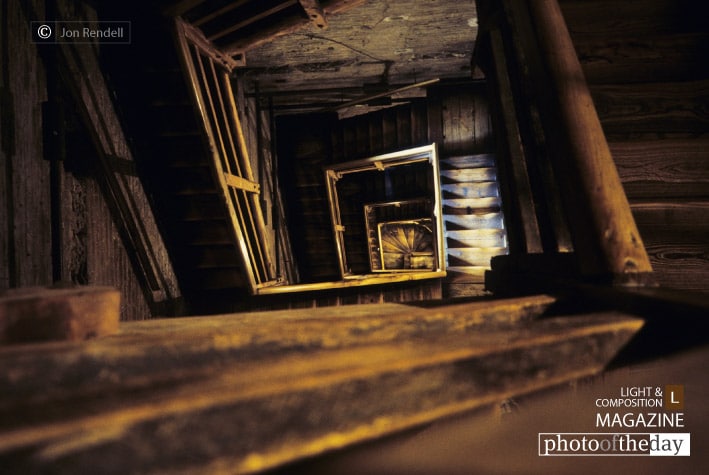
Staircase by Jon Rendell
Captured within the historic bell towers of Bologna, Italy, this image highlights the weathered beauty of a traditional wooden staircase. The photographer utilized the natural, ambient light filtering through the campanile to emphasize the rich textures and age-worn surfaces of the structure. By focusing on the rhythmic geometry of the steps, the image transforms a functional architectural element into a compelling study of light and shadow. This photograph is award-worthy for its masterful composition and its ability to evoke the deep sense of history and culture that defines the city of Bologna, turning a simple climb into a profound visual narrative.
Jon Rendell
Born in Melbourne, Australia, in 1957, Jon Rendell grew up immersed in a family of photographers and filmmakers. After honing his craft in the 1970s under the mentorship of renowned photographer Athol Shmith, Rendell developed a signature focus on the interplay of transitory, abstract shapes and available light. Now based in San Francisco, he continues to explore the world through his lens, drawing upon a lifelong fascination with shadows and structural form to create evocative, award-winning architectural and fine art photography.
Resonance Score Breakdown
Transparency Note: The resonance score (14.8/20) is calculated based on social engagement metrics collected before the award announcement.
Expert Photography Reviews · 6
The Architecture of Ascent
In the quiet hours of a house, one often finds themselves tracing the worn edges of a banister, a ritual of touch that connects the present hand to the ghosts of those who climbed before.
Read the reflection →The Echo of Footsteps
The smell of damp stone always brings me back to the cellar of my childhood home, where the air felt thick, like wool pressed against the skin.
Read the reflection →Reviews & Comments
Share your thoughts about this award-winning photograph. Your reviews contribute to the community engagement score.
The staircase doesn’t merely ascend; it anchors the frame with rhythmic, geometric precision. The light carves the wood, establishing a rigid spatial tension that demands attention. It’s a rare instance where the negative space doesn’t collapse under the weight of the architecture. I’ve spent years looking for this kind of structural discipline, and frankly, it’s refreshing. The fulcrum of the frame holds perfectly, refusing to let the viewer’s eye wander from the calculated, rhythmic descent.
The wood here doesn’t just hold weight; it holds time. I can feel the cool, damp air of the campanile against my skin. Jon waited for that soft, directional light to trace the grain of the steps, turning a climb into a prayer. It’s quiet, isn’t it? I’ve spent enough hours in old towers to know that silence. He didn’t rush the shadows. He let the stone and timber breathe before he finally pressed the shutter.
Most architectural shots of Bologna’s towers fall into the trap of grandiosity, but Rendell’s staircase succeeds because it’s intimate. The way the light clings to the splintered wood grain creates a tactile history that digital sensors rarely capture. I’ve stared at this for years, and it still makes me feel the vertigo of that climb. It’s not just geometry; it’s the weight of centuries pressing against the lens. That’s why it’ll still matter in thirty years.
The ochre of these Bologna stairs, a hue reminiscent of Morandi’s dust-laden still lifes, breathes with a weary, ancient warmth that I find utterly intoxicating. It’s not merely wood; it’s the amber glow of centuries trapped in shadow. As light spills across the grain, one feels the tactile weight of time itself, a golden, melancholic resonance that doesn’t just sit upon the surface, but vibrates with the quiet, rhythmic pulse of history’s own fading heartbeat.
Bologna’s campanile isn’t just wood and stone; it’s a throat through which time exhales. Rendell’s staircase doesn’t merely climb; it descends into a silence that feels heavy, almost suffocating. I’ve stood in such shafts, and it’s the darkness clinging to the grain that truly haunts me. It’s not the light that defines these steps, but the encroaching void. When shadows swallow the geometry, they reveal the only truth that matters: we are all just passing through.
One suspects Rendell didn’t just stumble upon this. That light—soft, directional, and entirely unforgiving of a hasty shutter—suggests he spent a fair few hours shivering in that bell tower. It’s a quiet, rhythmic piece of work. I’ve climbed enough of these Italian stairs to know the ache in the knees required to find this angle. It’s earned, plain and simple. He waited for the dust to settle, and frankly, I’m rather envious of the result.
Hehe!
I see it from my office window. It alway strikes me how beautiful it is, with the sun, in a snow tempest, under the rain, with heavy grey clouds… a great subject that can’t fail!
It sure is Linda. :-)
Great picture!!
Is it the Asinelli Tower 999 step staircase?
Great light and great composition!!
Simply stunning!
Reminds me of European marquetry, evocative stuff!
AWESOME shot. Love the composition and the blurred foreground.
Amazing photo!
beautifully shot, very nice indeed.