Birds, Sea, and the Fiery Sky by Arindam Guptaray
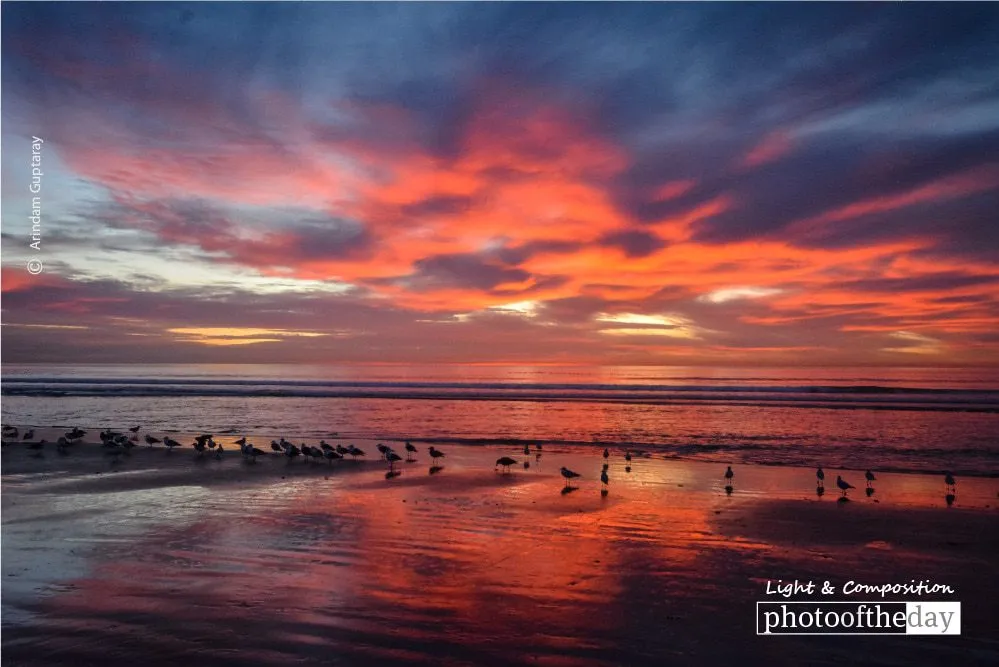
On a frigid day at Fletcher's Cove in Solana Beach, the photographer initially faced a lackluster sunset. However, persistence rewarded him when, thirty minutes after the sun dipped below the horizon, the sky ignited in a surreal, fiery display. Capturing this fleeting transformation required patience and a keen eye for the atmospheric shift. The resulting image is award-worthy for its evocative portrayal of nature's unexpected drama, successfully translating a profound, transient moment into a permanent visual narrative that echoes the intensity of a classic rock anthem.
Arindam Guptaray
Based in San Diego, California, Arindam Guptaray is an accomplished amateur photographer with a dedicated six-year focus on landscape photography. His work has garnered international recognition, appearing in various Indian travel magazines and receiving significant acclaim across digital platforms like 500px. Currently, he is curating a coffee table book that highlights the breathtaking sunrises and sunsets found along the coastline of San Diego, further cementing his reputation as a keen observer of coastal beauty.
Resonance Score Breakdown
Transparency Note: The resonance score (12.3/20) is calculated based on social engagement metrics collected before the award announcement.
Expert Photography Reviews · 6
The Ember After the Flame
We are taught to watch for the arrival of light, to track the sun as it climbs the ladder of the morning or burns its final gold into the hem of the evening. But there is a secret geography in the aftermath, a quiet theater that opens only after the main event has retreated.
Read the reflection →The Afterglow of Waiting
There is a peculiar human tendency to pack up our belongings the moment the main event concludes. We see this at the theater when the final curtain falls, or at the beach when the sun dips beneath the waterline.
Read the reflection →Reviews & Comments
Share your thoughts about this award-winning photograph. Your reviews contribute to the community engagement score.
The horizon line holds the weight. Above, the fire burns. Below, the tide retreats into shadow. I’ve spent minutes watching those birds drift through the void. They don’t clutter the frame; they anchor the stillness. It’s a rare patience. I feel a sudden, sharp ache in my chest looking at that expanse. Nothing here is accidental. The empty corner is not empty. It’s a breath held long enough to finally see the light.
You waited. I can feel it in the way the light holds that final, desperate heat against the cold tide. Most people would’ve packed up when the sun dipped, but you stayed. And that’s where the truth lives—in the persistence. It’s a quiet, lonely kind of fire. Looking at those birds against that burning sky, I felt a sudden, sharp ache for the stillness of a beach at dusk. You caught the transition perfectly.
Waiting thirty minutes after sunset for the sky to ignite is the kind of discipline I respect. It’s a quiet, cold commitment that separates the observer from the tourist. The birds remain undisturbed, caught in a natural rhythm rather than a forced frame. I’ve spent enough freezing dawns on the coast to know this wasn’t extracted; it was earned. It’s a rare, honest moment where the photographer simply let the wild world happen.
Most sunset shots are forgettable clichés, but this one survives because of the timing. By waiting thirty minutes after the sun vanished, Guptaray captured a bruised, violent violet that feels genuinely alien. I’ve seen thousands of coastal shots, yet this one keeps me staring at the birds’ silhouettes against that burning horizon. It’s the patience that wins here. It’s not just a pretty sky; it’s a rare, fleeting mood that I’m genuinely glad someone bothered to catch.
f/11 at 1/15s, ISO 100, 24mm. A calculated gamble on the tripod. The narrow aperture holds the foreground rocks in sharp relief against the atmospheric ignition. It’s technically sound, though the shutter speed leaves the birds as mere smudges of motion. I’ve spent enough time in the cold to respect that patience. He didn’t chase the light; he waited for the physics of the atmosphere to align. It’s a precise, cold, and correct execution.
The Rayleigh scattering across this horizon is exquisite. By pushing the sensor’s dynamic range, Guptaray has captured the precise wavelength shift as the sun retreated, avoiding the diffraction limit that usually plagues such high-contrast coastal scenes. The focal plane remains razor-sharp across the birds’ silhouettes, resolving details the human eye would simply blur into the dusk. It’s a rare, visceral thrill to see the physics of light rendered with such clinical, yet haunting, atmospheric clarity.