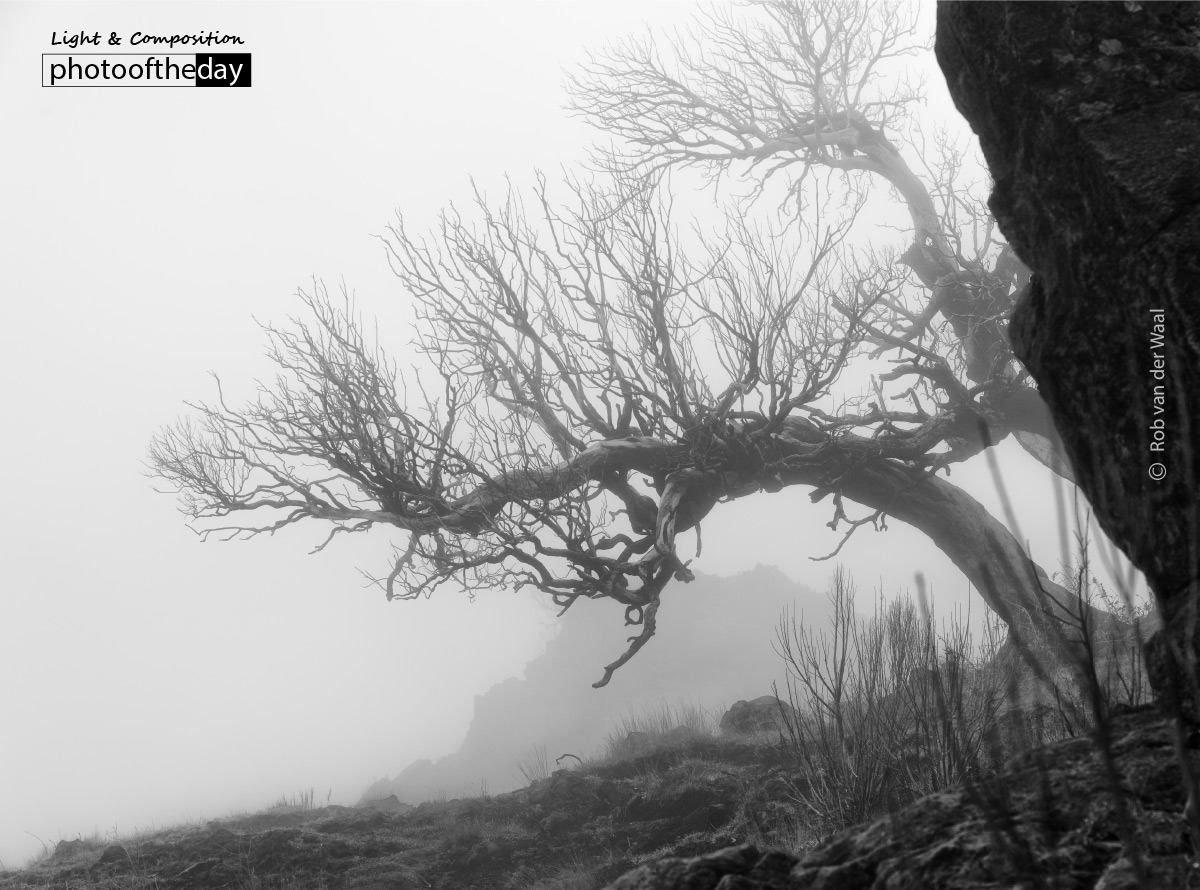
Foggy Tree by Rob van der Waal
Captured during a hike to the summit of Pico Ruivo in Madeira, this photograph highlights the haunting beauty of the island's high-altitude landscape. The photographer encountered dense, swirling fog that transformed the charred remains of trees into a stark, atmospheric study of nature’s resilience. By focusing on the interplay between the skeletal forms and the muted, ethereal light, the image captures a somber yet captivating moment. This work is award-worthy for its masterful use of negative space and texture, effectively conveying the raw, sinister elegance of a post-fire environment through a minimalist and evocative lens.
Rob van der Waal
Born in 1957 in Rotterdam, Rob van der Waal was introduced to the craft by his father, a dedicated photographer who maintained a home darkroom. An autodidact who refined his skills through practice and observation, van der Waal is known for a pure and honest approach to his subjects. He finds his greatest inspiration in the natural world, particularly maritime environments and the harbor life near his home in Hellevoetsluis. His work is defined by a persistent desire to capture the shifting qualities of light and the stories hidden within fleeting moments.
Resonance Score Breakdown
Transparency Note: The resonance score (12.3/20) is calculated based on social engagement metrics collected before the award announcement.
Expert Photography Reviews · 4
The Weight of White
There is a specific density to the fog that rolls off the North Sea in late October, a heavy, damp white that erases the horizon and turns the world into a room with no corners. It is a quiet, suffocating kind of clarity.
Read the reflection →The Architecture of Resilience
We often mistake the city for its buildings, forgetting that the true urban fabric is woven from the scars of what came before. Just as a neighborhood carries the memory of a fire or a demolition, landscapes hold the history of their own survival.
Read the reflection →Reviews & Comments
Share your thoughts about this award-winning photograph. Your reviews contribute to the community engagement score.
There’s a haunting loneliness in these charred branches, but I find myself searching for a pulse that isn’t there. It’s a beautiful study of texture, sure, but it’s cold. I’ve spent my life looking for the flicker of humanity in a frame, and here, the fog just swallows everything whole. It’s technically sharp, but it doesn’t breathe. I miss the weight of a person’s gaze. It’s a landscape that’s forgotten how to tell a story.
It’s refreshing to see a D800 used for something other than clinical sharpness. Van der Waal lets the fog dissolve the charred bark into a ghostly, charcoal wash. It’s closer to Sugimoto’s long-exposure theatres than conventional landscape practice. I’m genuinely moved by the way the branches bleed into the white void. Why resolve the background when the mystery is far more compelling? He’s chosen to embrace the blur, and it’s a brilliant, haunting subversion.
There’s a haunting stillness here that I genuinely admire. In the high-altitude silence of Pico Ruivo, it’s easy to trample the fragile recovery of a post-fire landscape for a better angle. Van der Waal didn’t. He let the fog dictate the composition, respecting the skeletal remains rather than forcing a narrative. It’s a rare, restrained study of resilience. I’ve spent enough time in these woods to know that patience like this is earned, not taken.
We look at these charred, skeletal limbs reaching through the Madeira fog and we don’t see a landscape; we see a survivor. Rob van der Waal listened to the silence of the mountain before he clicked the shutter. It’s a portrait of endurance, stripped of vanity. I feel a quiet ache in my chest looking at those twisted, blackened fingers. It’s a photograph that asks to be returned to, because it’s really about us.
this is really cool =)