Masters of Dirt by Joy Dasgupta
Captured amidst the high-octane environment of off-road racing in the United Arab Emirates, this image freezes a moment of intense speed and endurance. The photographer utilized a 70-200mm lens to isolate the action, carefully balancing the shutter speed to convey the raw energy of the race while maintaining sharp clarity. By focusing on the interplay between the vehicle and the challenging terrain, the image captures the essence of a competition where every millisecond counts. It is an award-worthy study of motion, demonstrating a keen eye for timing and the ability to transform a fast-paced sporting event into a compelling, static narrative of grit and determination.
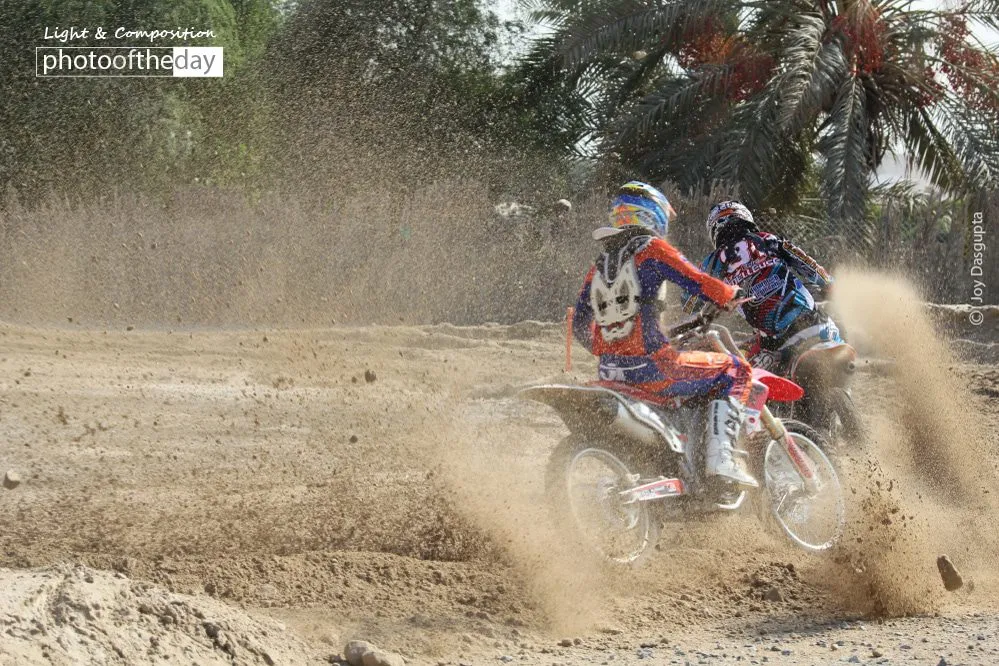
Exposure 1/320sec @ f/7.1 | ISO 200 | Focal Length 80mm
Joy Dasgupta
Born in India in 1977 and a graduate of Calcutta University, Joy Dasgupta has resided in the United Arab Emirates for the past seven years. A self-taught photographer, he views the medium as a profound source of personal satisfaction and a way to connect with the unique perspectives of others. Inspired by the masters of the craft, Dasgupta continuously challenges himself to refine his technical skills and artistic vision, finding that photography allows him to frame his own perspective on both the beauty of the world and his life experiences.
Resonance Score Breakdown
Transparency Note: The resonance score (11.6/20) is calculated based on social engagement metrics collected before the award announcement.
Expert Photography Reviews · 5
The Alchemy of Dust
We are taught that the earth is a solid thing, a foundation upon which we build our certainties. But there are moments when the ground decides to become air, when the heavy, ancient dust of the desert rises up to reclaim its freedom.
Read the reflection →The Force of Friction
When a river meets a sudden obstruction, it does not simply stop; it accelerates, carving deeper into the silt and rearranging the very geography of its path. This is the physics of persistence.
Read the reflection →Reviews & Comments
Share your thoughts about this award-winning photograph. Your reviews contribute to the community engagement score.
Architecture isn’t just static stone; it’s the kinetic energy of the void. Here, the desert floor acts as a datum, a shifting plane that defines the vehicle’s violent trajectory. I’m struck by how the dust obscures the fenestration of the landscape, turning solid ground into a chaotic, ephemeral atmosphere. It’s a brutal, honest collision of mass and velocity. I find myself holding my breath, feeling the grit against my teeth—it’s a visceral, unsettlingly beautiful disruption of space.
Dust hangs in the air. It’s a veil, not a barrier. The vehicle cuts through, yet the frame remains vast. I’ve spent minutes watching the particles settle in the void. It’s quiet here, despite the engine. The emptiness isn’t a lack of subject. It’s a breath. Nothing here is accidental. The empty corner is not empty. It’s where the race ends. I feel a strange, sudden peace in the grit. It’s enough.
Dust clouds swallow the Al Badia landscape, turning a race into a blur of mechanical aggression. It’s technically sharp, sure, but why does this frame erase the environment? We see the machine’s dominance, yet the desert itself feels like a mere prop for human conquest. I’m left cold by this obsession with speed. Whose land are we tearing through here? Does the grit belong to the driver, or to the earth we’ve decided to exploit for sport?
It’s a technically sharp capture of mechanical force, but I can’t help but wince. In the Al Badia desert, such high-octane racing isn’t just a sport; it’s a violent intrusion into fragile, arid ecosystems. While the panning is clean, I’m left wondering what wildlife was displaced or terrified by the roar of those engines. I’ve spent weeks in silence to photograph a desert fox; seeing this grit kicked up just feels like an extraction.
Dust is a miserable companion, yet here it’s rendered with a precision that suggests Dasgupta didn’t just stumble upon the track. I’ve spent enough afternoons inhaling grit to know that 1/320th of a second is a gamble. One suspects the photographer stood there until their lungs felt like sandpaper, waiting for the vehicle to hit that exact pocket of light. It’s a sharp, gritty bit of work. I find myself wanting to wipe the lens clean.