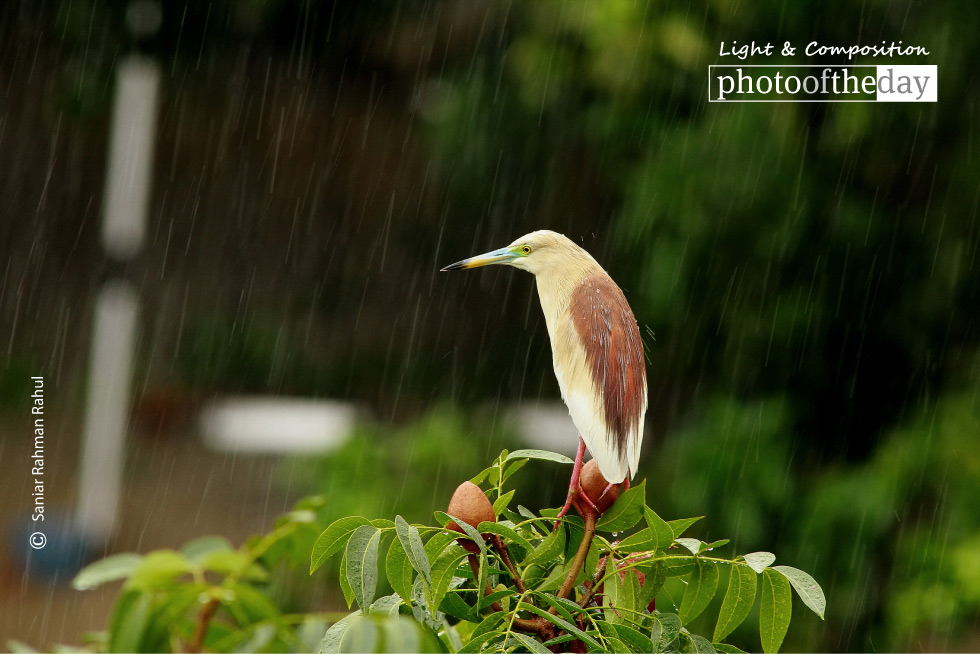
Indian Pond Heron by Saniar Rahman Rahul
Captured amidst the gentle rhythm of rainfall in Gulshan, Dhaka, this portrait of an Indian Pond Heron—known locally as Kani Bok—highlights the subtle elegance of a bird often overlooked in its natural habitat. The photographer skillfully navigated the challenging, wet conditions to isolate the heron as it stalked prey near the water's edge. This image is award-worthy for its intimate perspective on a common species, transforming a quiet moment of avian patience into a striking study of texture and atmosphere, revealing the hidden beauty found within the small water-bodies of a bustling urban environment.
Saniar Rahman Rahul
Saniar Rahman Rahul is a dedicated photographer based in Bangladesh with a keen eye for the diverse avian life inhabiting the region's wetlands and urban water-bodies. His work focuses on documenting the intricate behaviors of local species, often capturing them in challenging environmental conditions to highlight their resilience and natural grace. Through his lens, Rahul bridges the gap between human-dominated landscapes and the wild, offering viewers a refined and observant perspective on the delicate ecosystems that thrive within the heart of Dhaka.
Resonance Score Breakdown
Transparency Note: The resonance score (13.5/20) is calculated based on social engagement metrics collected before the award announcement.
Expert Photography Reviews · 7
The Architecture of Stillness
Patience is a language spoken by those who have learned to fold themselves into the rhythm of the earth. We are so often obsessed with the arc of the flight, the sudden rush of wings, the frantic pursuit of the next horizon.
Read the reflection →The Patience of Rain
There is a particular grace in waiting. We often mistake stillness for inactivity, forgetting that the earth itself is constantly in motion, even when it appears to be holding its breath.
Read the reflection →Reviews & Comments
Share your thoughts about this award-winning photograph. Your reviews contribute to the community engagement score.
The heron’s plumage, a muted palette of wet slate and the pale, bruised ochre of a Morandi still life, dissolves into the rain-slicked atmosphere of Gulshan. It’s a haunting, monochromatic symphony where the grey of the water mirrors the bird’s own weary elegance. I’m utterly breathless at how the light clings to those damp feathers, turning a common urban encounter into a soft, melancholic meditation on the quiet, persistent grace of the overlooked.
In the rain-slicked quiet of Gulshan, we find a gaze that isn’t merely avian; it’s a portrait of patience. We look at this Kani Bok and we understand the weight of waiting. Rahul didn’t just snap a bird; he sat with it until the heron revealed its stillness. It’s a haunting, intimate encounter. I find myself holding my breath, afraid to disturb the silence he’s captured. This is a photograph that asks to be returned to.
Rainfall softens the edges of Gulshan, turning the world into a muted, silver sanctuary. Rahul stood here in the cooling damp, waiting for the heron to settle into its own stillness. It’s a quiet communion. I’ve spent hours in similar rain, and I can almost feel the chill on his skin. He didn’t just capture a bird; he listened to the rhythm of the water. It’s a rare, humble grace that truly moves me.
The heron’s verticality anchors the frame, slicing through the chaotic bokeh of the rain. It’s a rigid geometry that demands attention. The negative space isn’t merely empty; it’s a deliberate buffer against the urban noise of Gulshan. I’ve rarely seen such precise spatial tension in wildlife work. The bird’s neck creates a sharp fulcrum, balancing the composition perfectly. It’s cold, calculated, and frankly, it’s the only thing keeping this frame from collapsing into sentimentality.
You waited in the rain for this, didn’t you? I can feel the dampness in the air just looking at the heron’s ruffled feathers. It’s easy to ignore these birds in a city like Dhaka, but you slowed down enough to see the quiet intensity in its eye. And that’s what matters. You didn’t just snap a bird; you captured a moment of stillness in a frantic place. There’s something honest happening here. I respect that.
f/5.6 at 400mm, 1/500s, ISO 800. A calculated gamble against the Dhaka gloom. The shutter speed barely arrests the heron’s micro-movements, yet the focus is surgically precise on the eye. I’ve spent years staring at soft bird portraits; this one actually holds the line. The noise at ISO 800 is a necessary tax for the exposure. It’s a cold, clinical success. I find myself respecting the restraint shown here. The technical discipline justifies the frame.
Rain falls on Gulshan. The heron waits. It’s a study in stillness. I’ve spent minutes watching the grey water swallow the edges of the frame. The bird doesn’t move. It doesn’t need to. The negative space here isn’t just distance; it’s a breath held in the humidity. Nothing here is accidental. The empty corner is not empty. It’s a quiet I rarely find in Dhaka. I feel a sudden, sharp ache for this silence.