Dally Day by Eshank Kanojia
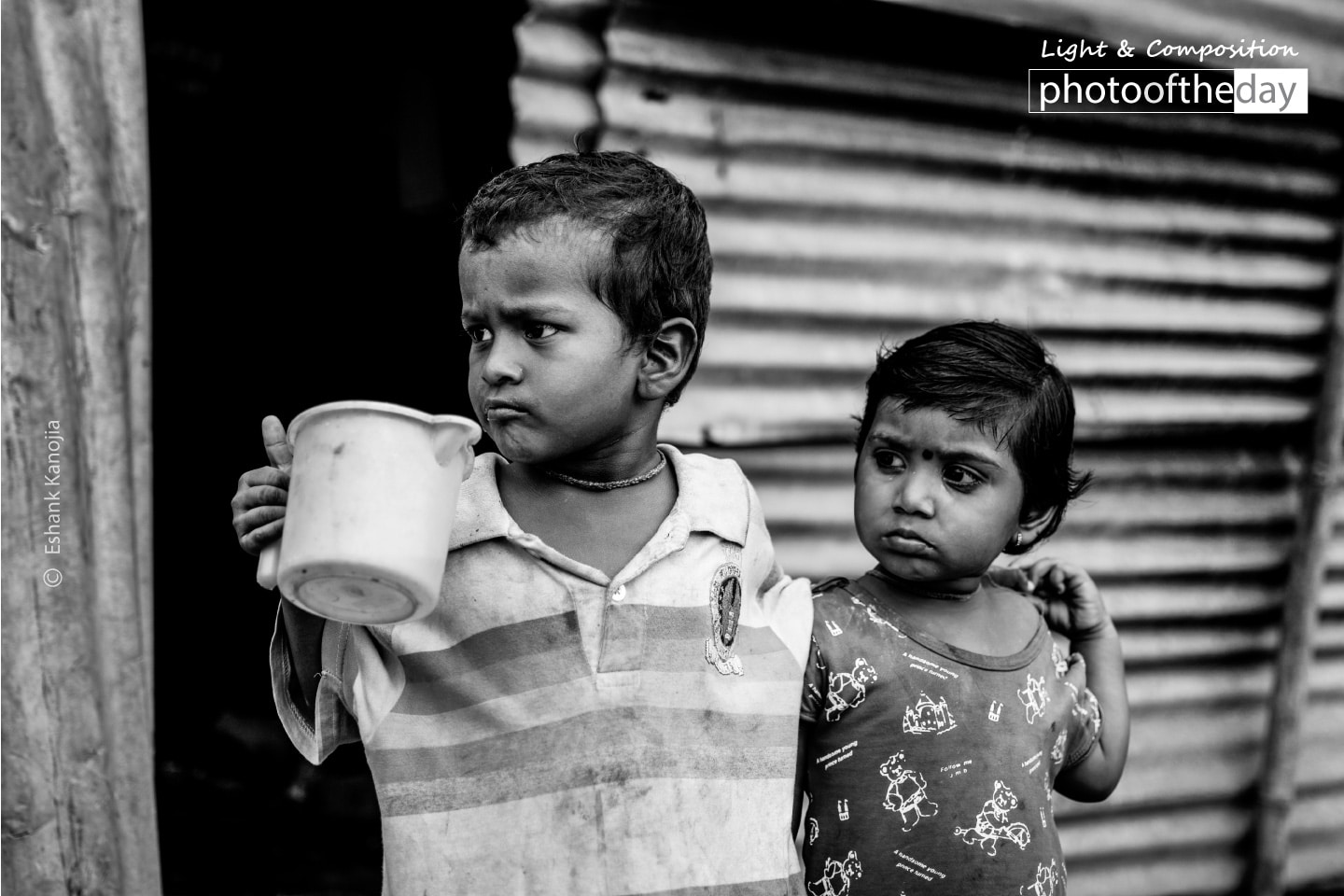
Dally Day captures a poignant juxtaposition between youthful innocence and the harsh realities of urban existence in India. By focusing on the lives of those dwelling in slums, the photographer highlights the stark contrast between a seemingly happy moment and the systemic struggles of homelessness and child abuse. This image serves as a powerful social commentary, challenging viewers to confront the uncomfortable truths of modern society. Its award-worthy quality lies in its ability to evoke deep empathy while forcing a critical reflection on human rights, housing crises, and the uncertain future facing the nation's most vulnerable children.
Eshank Kanojia
Born in Lucknow and currently based in Mumbai, Eshank Kanojia is a dedicated visual storyteller who honed his craft through a diploma in professional photography and fine arts at the Pearl Academy in Delhi. His work is deeply rooted in his personal background and an emotional connection to his subjects, driving him to travel across various cities to document raw human experiences. Kanojia specializes in capturing evocative moments that bridge the gap between artistic expression and social narrative, consistently seeking to tell the stories of those often overlooked by society.
Resonance Score Breakdown
Transparency Note: The resonance score (11.3/20) is calculated based on social engagement metrics collected before the award announcement.
Expert Photography Reviews · 4
The Weight of a Childhood
I keep a small, rusted tin box in my desk drawer, filled with the smooth, grey pebbles my brother and I collected from the riverbank when we were children. They are cold to the touch, heavy with the weight of afternoons that felt like they would never end.
Read the reflection →The Weight of Small Hands
It is 3:14 am. The house is holding its breath, and I am sitting with the ghosts of things I chose to ignore while the sun was up. We walk past so many lives during the day, treating them like scenery, like background noise that doesn't belong to our own story.
Read the reflection →Reviews & Comments
Share your thoughts about this award-winning photograph. Your reviews contribute to the community engagement score.
Most entries in this category rely on poverty as a shortcut to pathos, but Eshank’s work avoids that trap. The boy’s gaze doesn’t beg; it anchors the frame, forcing us to acknowledge a dignity that isn’t diminished by the surrounding squalor. I’ve looked at thousands of portraits, and this one actually hurts to hold. It’s the stillness in his eyes that ensures we’ll still be grappling with this child’s reality thirty years from now.
Delhi’s heat hits you in the gut, but Eshank caught the pulse here. That kid’s grin isn’t just a smile; it’s a defiance of the dust. I’ve spent years chasing these ghosts, and he nailed the geometry. One tenth of a second later and the light would’ve flattened the grit, the frame collapsing into noise. It’s raw, it’s honest, and damn, it makes me miss the chaos of the streets. He was ready.
There’s a jarring lack of agency here. While the jury praises the social commentary, I’m struck by the transactional nature of the gaze. It’s an extraction, not a connection. When I spend weeks in a blind, I’m waiting for the subject to forget I exist. Here, the subject is clearly performing for the lens. It’s uncomfortable to watch. I’d rather see the photographer earn that trust than simply demand a pose from a child.
The subject’s gaze anchors the vertical axis, creating a perfect 1:2 ratio between the figure and the chaotic urban backdrop. I’m struck by how the diagonal lines of the corrugated metal intersect with the child’s shoulder, locking the composition into a rigid, inescapable grid. It’s a brutal, beautiful equation of space. The geometry doesn’t just frame the poverty; it traps it. I find the mathematical precision of this visual tension absolutely exhilarating to behold.
Great thinking & great initiative.. Keep going ???
Very Good
Good.
Awesome
Great
Good work
Different way of looking (thats ur way eshank)