The Horse Shoe Bend by Mazhar Hossain
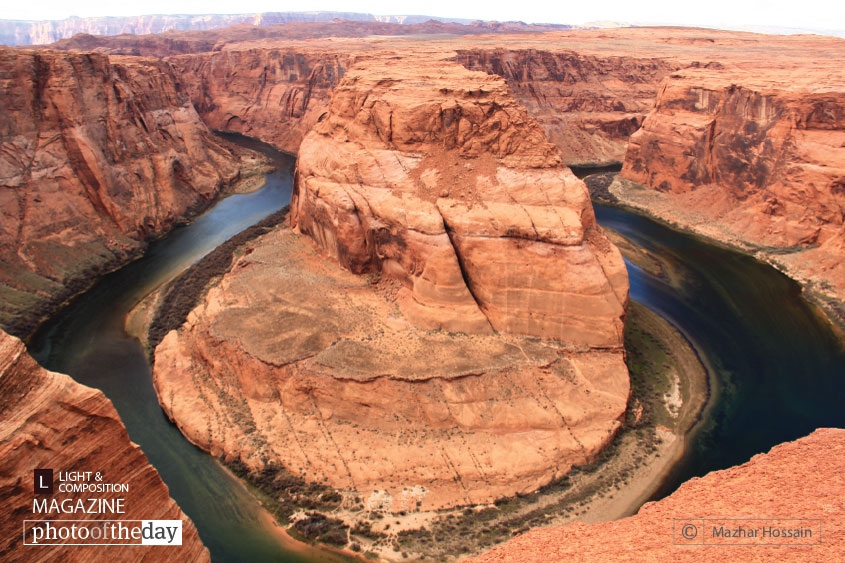
Captured during a journey returning from Antelope Canyon, this photograph showcases the majestic Horseshoe Bend in Page, Arizona. The photographer was drawn to the dramatic, sweeping curves of the Colorado River as it carves through the rugged landscape, creating a breathtaking natural amphitheater. By carefully framing the vast scale of the canyon against the expansive desert sky, the image highlights the raw, geological beauty of the American Southwest. This shot stands out as an award-worthy composition, effectively conveying the awe-inspiring atmosphere and the profound sense of scale that defines this iconic landmark.
Mazhar Hossain
Born in Dhaka, Bangladesh, and currently based in Toronto, Canada, Mazhar Hossain is a dedicated photographer who balances a professional career in Human Resources with a deep-seated passion for the visual arts. Since acquiring his first DSLR in 2010, he has focused on exploring the nuances of landscape, architecture, and portrait photography. Driven by a desire to document the world's diverse cities and natural wonders, he continues to refine his technical skills and artistic vision while traveling globally to capture the beauty of his surroundings.
Resonance Score Breakdown
Transparency Note: The resonance score (11.2/20) is calculated based on social engagement metrics collected before the award announcement.
Expert Photography Reviews · 4
What the River Carves
Time is not a line. It is a slow, patient grinding. We look at the stone and see permanence, but the stone is only waiting.
Read the reflection →The River’s Long Memory
Time is not a straight line, though we often draw it that way to feel safe. It is a loop, a coil, a slow-motion dance between the stone and the current.
Read the reflection →Reviews & Comments
Share your thoughts about this award-winning photograph. Your reviews contribute to the community engagement score.
Geology is merely time made visible, yet here, the light feels thin, almost apologetic. Hossain captures the Colorado River’s violent incision, but he’s afraid of the abyss. Where the shadows should deepen into a philosophical silence, they remain shallow, hesitant. I’ve stood at that precipice; it’s a place that demands a darker, more brutal contrast. It doesn’t terrify me enough. The canyon is a throat, but in this light, it’s only a postcard.
Horseshoe Bend is the tourist’s default setting, a place where one usually finds more selfie sticks than solitude. It’s a convenient stop on the way back from the canyon, isn’t it? I’ve stood on that ledge, shivering in the wind, waiting for the light to actually do something interesting. This composition is competent, certainly, but it lacks the grit of a long vigil. It’s a snapshot of a landmark, not a hard-won victory.
The focal plane here is remarkably deep, yet I’m struck by the micro-contrast within the Navajo Sandstone’s strata. Hossain has pushed the sensor’s resolution to the diffraction limit, capturing textures the naked eye simply misses. It’s a clinical, sharp rendering of geological time. Honestly, the way the light scatters across those sheer canyon walls makes my pulse quicken. It’s not just a landscape; it’s a precise, high-fidelity map of erosion that feels almost tactile.
Horseshoe Bend is a cliché, yet Hossain’s frame avoids the usual postcard trap. Most photographers here lose the river to over-saturation, but he lets the Colorado’s deep, muddy green anchor the composition. It’s the sheer weight of that rock wall against the horizon that makes me stop and breathe. I’ve seen thousands of these, but this one doesn’t feel like a tourist snapshot. It’s a quiet, geological truth that will still hold gravity in thirty years.