Seeking the Warmth by Abdellah Azizi
While on assignment documenting the historic Ksur and Kasbah architecture in southern Morocco, the photographer encountered two women resting against an ancient wall in the village of N'kob. Seeking the warmth of the setting sun, the subjects created a striking visual harmony as the vibrant tones of their traditional clothing echoed the earthy hues of the surrounding landscape and the evening sky. This image is award-worthy for its masterful use of natural light and color, capturing a poignant, quiet moment of human connection that feels both timeless and deeply rooted in the Moroccan landscape.
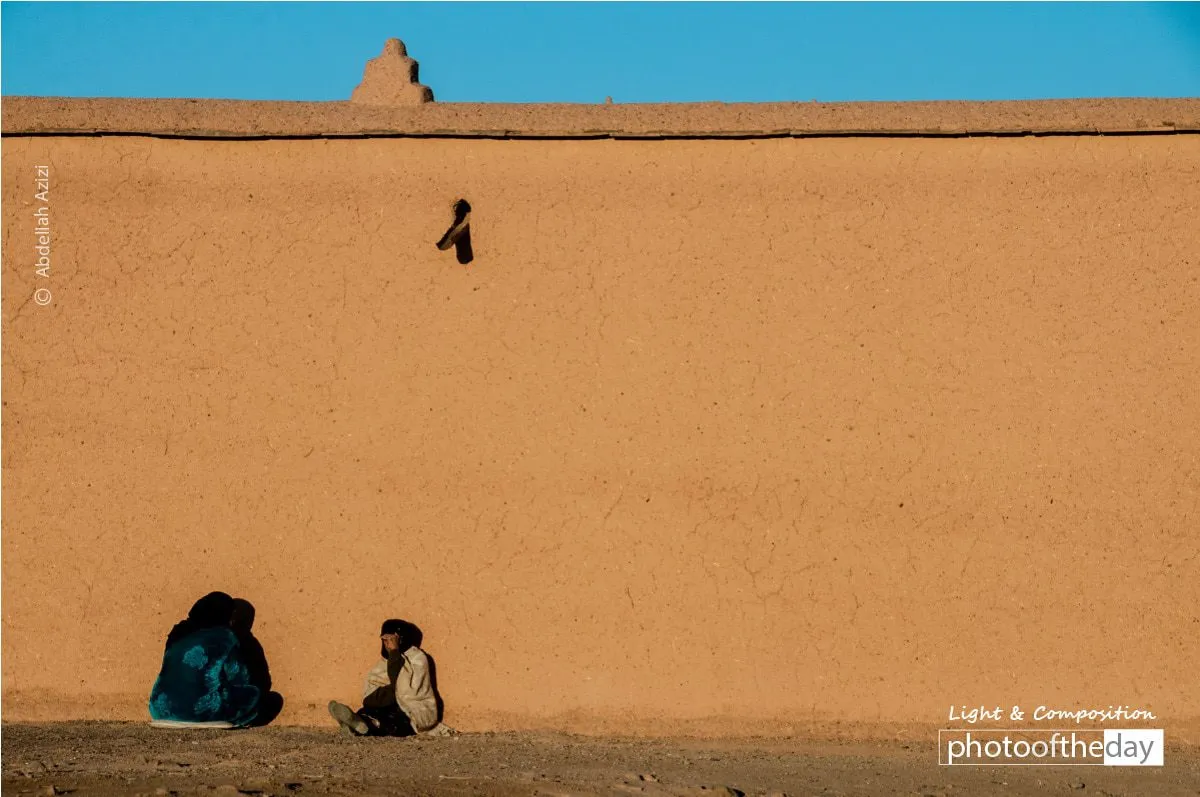
Exposure 1/250sec @ f/13 | ISO 320 | Focal Length 105mm
Abdellah Azizi
Born in Ouarzazate in 1987, Abdellah Azizi is a Moroccan photographer dedicated to capturing the landscapes, culture, and vibrant life of North Africa. Following formal training in film lighting, grip techniques, and audio-visual post-production, he transitioned from a career in videography to photography, drawn by the creative freedom the medium provides. His work is defined by a deep appreciation for his heritage, focusing on the authentic stories of the people and environments that shape the rich tapestry of the Moroccan south.
Resonance Score Breakdown
Transparency Note: The resonance score (12.5/20) is calculated based on social engagement metrics collected before the award announcement.
Expert Photography Reviews · 6
The Weight of the Sun
I spent this morning sitting on my back porch, waiting for the sun to finally clear the neighbor’s fence. It was one of those biting, sharp-edged mornings where the air feels like it’s trying to wake you up against your will.
Read the reflection →The Weight of Sun-Baked Stone
There is a specific temperature to silence, a dry heat that settles into the marrow of your bones like fine, sifted sand. I remember the feeling of leaning against a wall that had spent the entire day drinking the sun.
Read the reflection →Reviews & Comments
Share your thoughts about this award-winning photograph. Your reviews contribute to the community engagement score.
Before the eye identifies the figures, a sudden stillness settles in the chest. The ochre wall absorbs the light, and I feel my own shoulders drop, mirroring their quiet posture. It’s a physical tether to the sun’s fading heat. When I return to this, I don’t see architecture; I feel the weight of the fabric against stone. It’s a rare, visceral comfort that follows me into the evening, long after the screen goes dark.
Most entries I see in this category rely on exoticism to do the heavy lifting. Azizi avoids that trap. By aligning the women’s vibrant textiles with the crumbling, sun-drenched masonry, he turns a simple rest into a geological event. It’s the way the light clings to the texture of the wall that gets me; I felt a genuine shiver of heat looking at it. Thirty years from now, this quiet, grounded dignity will still matter.
At f/13, the Nikon’s sensor pushes toward the diffraction limit, yet the micro-contrast on that weathered masonry is startling. The 105mm focal length compresses the depth, rendering the women’s textures with a clinical, almost tactile precision. I’m genuinely moved by how the light wraps around those fabric folds; it’s a rare moment where the lens’s glass perfectly resolves the heat of the Moroccan sun. It doesn’t just capture a scene; it’s a triumph of optical clarity.
The ochre of the N’kob wall bleeds into the burnt-sienna folds of the women’s djellabas, creating a chromatic resonance that recalls the dusty, muted stillness of a Morandi canvas. It’s a symphony of earth-tones where the light doesn’t just fall; it clings, heavy and golden, to the fabric. I’m breathless at how the shadows soften, turning the air into a warm, amber nectar that makes one ache for the quiet, sun-drenched permanence of the desert.
1/250sec at f/13, ISO 320, 105mm. Stopping down to f/13 on a D90 sensor invites diffraction, yet here it’s a calculated necessity to keep the textured Kasbah wall sharp. It’s a rigid choice that pays off. The compression at 105mm flattens the space, forcing the subjects into the architecture. I’ve spent too long looking at soft, lazy portraits; this level of technical discipline is refreshing. It’s not just a snapshot. It’s a precise, geometric alignment.
The vertical axis of the wall bisects the frame, creating a precise 1:1 tension between the subjects and the negative space. Azizi’s geometry relies on the diagonal slope of the women’s posture, which perfectly counters the rigid, horizontal mortar lines. It’s a beautifully solved spatial equation. I’m genuinely moved by how the vibrant fabric weights the lower quadrant, grounding the composition. It’s rare to see such chaotic textures resolved into such a stable, elegant mathematical equilibrium.