Fishing for Salmon by Claudio Bacinello
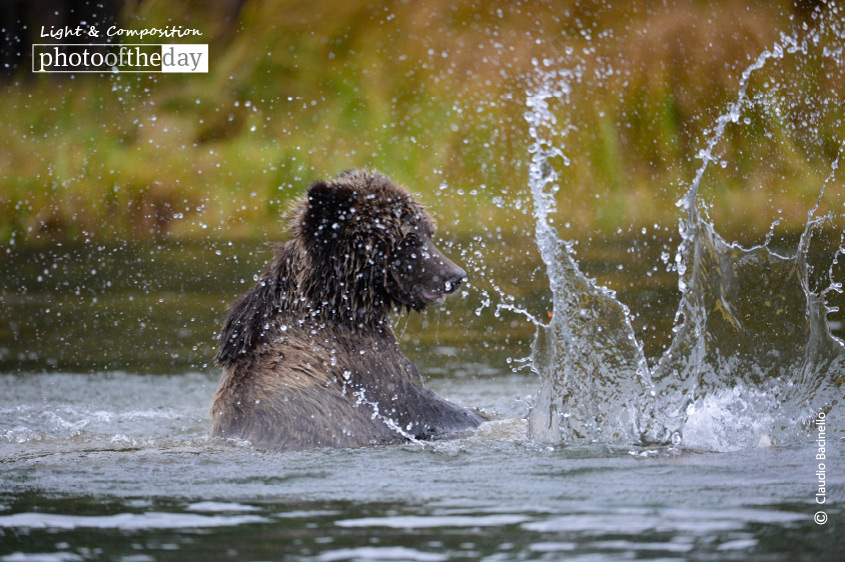
In the remote wilderness of the Chilcotin, the annual salmon run draws grizzly bears to the river in a desperate, vital race against the coming winter. Claudio Bacinello captured this raw moment of survival as a bear lunged into the rushing water, claws extended to secure a catch. The image is a masterclass in wildlife action photography, freezing the chaotic splash and the bear's intense focus with remarkable clarity. By isolating the subject against the natural backdrop, Bacinello highlights the primal connection between predator and environment, earning recognition for his ability to document the fleeting, dramatic rhythms of the natural world.
Claudio Bacinello
Born in Italy, Claudio Bacinello is a Thornhill, Canada-based photographer with a distinguished career spanning three decades. His diverse portfolio encompasses weddings, portraits, and corporate work, though he currently dedicates his lens to capturing the beauty of wildlife, nature, and global travel. With a particular passion for the landscapes of Africa and South America, Bacinello’s work has garnered international publication and is widely sought after as fine art for private and corporate collections.
Resonance Score Breakdown
Transparency Note: The resonance score (12.1/20) is calculated based on social engagement metrics collected before the award announcement.
Expert Photography Reviews · 5
The Hunger of the Current
There is a language spoken by the wild that has no need for syllables. It is a dialogue of muscle and tide, a desperate negotiation between the one who hungers and the one who flows.
Read the reflection →The Rhythm of the River
There is a quiet urgency in the way the seasons turn. We often speak of nature as a backdrop, something static that waits for our gaze, but it is a living, breathing cycle of necessity. In the wild, there is no wasted movement.
Read the reflection →Reviews & Comments
Share your thoughts about this award-winning photograph. Your reviews contribute to the community engagement score.
1/1000sec at f/4, 350mm, ISO 2500. The shutter speed is the bare minimum to freeze a lunge at this focal length. Bacinello pushed the D4 to ISO 2500 to maintain that f/4 aperture, sacrificing signal-to-noise ratio for the sake of the action. It’s a calculated risk that pays off. I’ve spent years looking at motion blur in wildlife shots; seeing this level of crispness at 350mm actually makes me exhale. The technical discipline holds.
The water’s churn, a frantic, frothy white like Turner’s tempestuous seas, clashes against the bear’s fur, which holds the deep, somber umber of a Morandi still life. It’s a visceral, shivering collision of temperatures that leaves me breathless. One feels the biting chill of the Chilcotin in those icy, slate-grey shadows, where the salmon’s flash of metallic, bruised-plum silver provides a fleeting, desperate harmony against the predator’s heavy, earth-bound, and utterly relentless chromatic weight.
The shutter snap hits like a jump cut. It’s pure kinetic energy, that split second where the water turns to glass and the bear’s claws become lethal geometry. I’ve spent years watching frames like this, but the raw, desperate focus in those eyes still makes my pulse race. Bacinello didn’t just catch a fish; he held the entire rhythm of the Chilcotin in a single, violent frame. It’s the shot the editor keeps, every time.
At 350mm and f/4, the focal plane is razor-thin, yet Bacinello’s tracking holds the bear’s intent perfectly. The diffraction of light across the turbulent water creates a chaotic bokeh that doesn’t distract; it amplifies the kinetic energy. I’m genuinely breathless at how the sensor resolves the individual droplets against the bear’s coarse fur. It’s a rare instance where the glass doesn’t just capture the action—it dissects the very physics of the splash. Truly, it’s beautiful.
One doesn’t capture a lunge like this by stumbling upon it during a weekend hike. Bacinello clearly spent days shivering in the Chilcotin muck, waiting for that specific, frantic splash. It’s a brutal, honest bit of work. I’ve spent enough hours in cold rivers to know the ache in his shoulders behind that 400mm lens. He didn’t just find this moment; he sat in the damp until the bear finally decided to cooperate. Respect.