Nane and Jamu by Dipanjan Mitra
Captured during a trek to the remote mountain village of Kalapokhari in West Bengal, this poignant image features a local child and a pet dog sharing a quiet, sun-drenched moment. Despite the biting cold of the high-altitude morning, the photographer successfully framed the warmth of the interaction against the stark, freezing landscape. The composition is award-worthy for its ability to convey a sense of intimate connection and resilience in a harsh environment, showcasing the photographer's keen eye for the subtle, humanizing details that define travel photography.
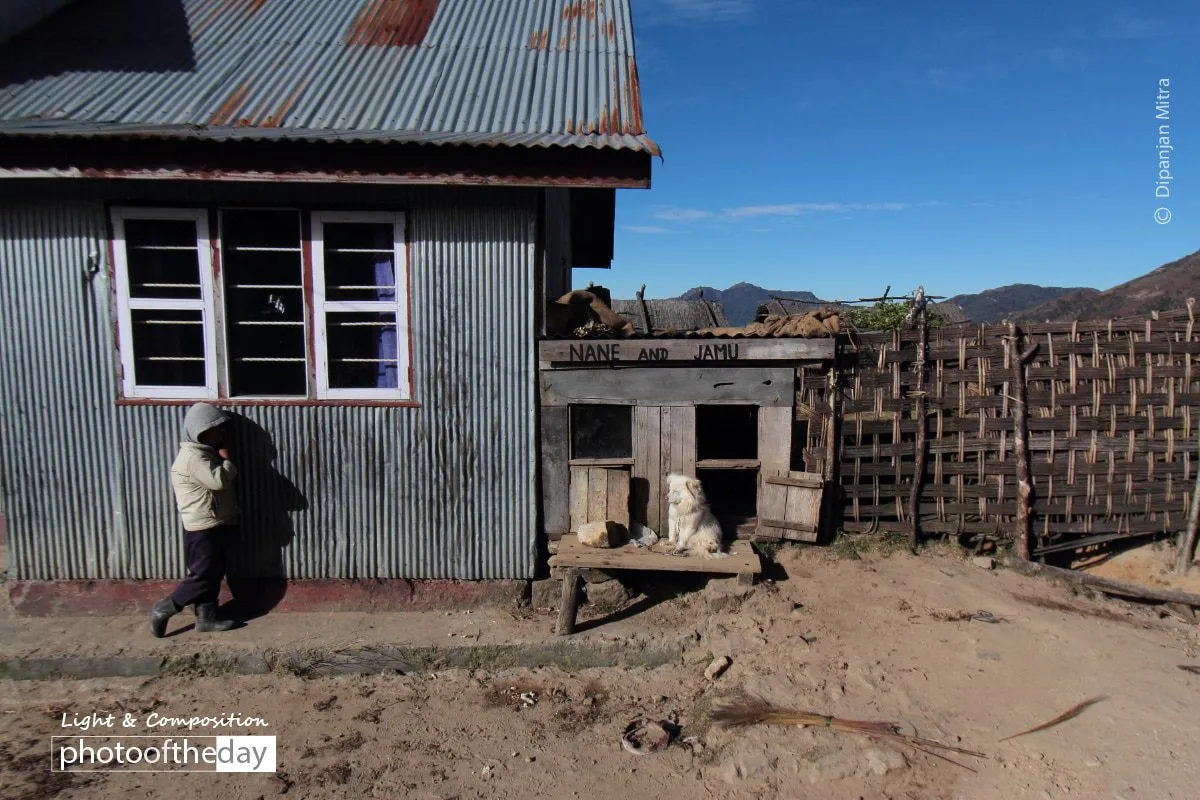
Exposure 1/400sec @ f/10 | ISO 100 | Focal Length 10mm
Dipanjan Mitra
Based in Calcutta, India, Dipanjan Mitra is a software professional who transitioned into photography in 2006 to document the diverse terrains of his home country. His creative journey evolved from early experiments with compact digital cameras to a dedicated practice using professional Canon equipment. Driven by an enduring fascination with the mechanics of light and composition, Mitra continues to explore the Indian landscape, seeking to capture the profound magic he finds behind the lens.
Resonance Score Breakdown
Transparency Note: The resonance score (10.8/20) is calculated based on social engagement metrics collected before the award announcement.
Expert Photography Reviews · 7
The Weight of a Shared Breath
In the high, thin air of the mountains, silence takes on a physical weight. It is not merely the absence of noise, but a presence that presses against the skin, demanding a different kind of attention.
Read the reflection →The Breath of Wool
The smell of damp wool always brings me back to the hearth. It is a heavy, earthy scent, like rain-soaked soil clinging to the hem of a winter coat.
Read the reflection →Reviews & Comments
Share your thoughts about this award-winning photograph. Your reviews contribute to the community engagement score.
Most travel photography is just scenery with a prop. Of the thousands I’ve reviewed, this succeeds because it’s not about the mountains; it’s about the boy’s hand resting on the dog’s fur. That tiny, tactile anchor against the vast, biting cold of Kalapokhari is why I’ll remember this in thirty years. It’s a quiet, honest connection that makes me want to reach out and touch the frame myself. It’s rare to find such genuine warmth.
Sun-drenched intimacy in Kalapokhari feels staged, doesn’t it? Mitra captures a child and dog, but I’m left unsettled by the power dynamic. Why is this remote life framed as a picturesque backdrop for a traveler’s lens? It’s beautiful, sure, but it feels like we’re consuming their struggle as a cozy aesthetic. Does the child know they’re performing for us? I’ve seen this gaze before, and it always prioritizes the photographer’s comfort over the subject’s reality.
At 10mm, the Canon’s wide-angle distortion stretches the foreground, yet the f/10 aperture keeps the focal plane remarkably deep. It’s a clever choice; the diffraction limit hasn’t softened the child’s hair or the dog’s fur, which remain crisp against the high-altitude haze. I’m genuinely moved by how the light catches the textures here. It’s rare to see such optical clarity in the biting cold of Kalapokhari. They’ve captured a moment that feels physically, perfectly real.
Sunlight here isn’t a gift; it’s a desperate negotiation with the void. Mitra captures the child and dog huddled against the biting, thin air of Kalapokhari, yet I’m haunted by the encroaching dark at the frame’s edge. It’s where the cold truly lives. I’ve felt that same shivering isolation in Tarkovsky’s frames. The warmth they share doesn’t conquer the landscape; it merely survives it. It’s a fragile, stubborn defiance against the inevitable, encroaching silence of the mountains.
The mountain air doesn’t move. A child. A dog. They occupy a sliver of the frame, leaving the rest to the vast, cold silence of Kalapokhari. It’s a quiet geometry. I’ve stared at this for an hour, and I’m shivering. The emptiness isn’t a void; it’s a weight. Nothing here is accidental. The empty corner is not empty. It’s the breath between two heartbeats. Mitra understands that sometimes, the world is best captured by what we leave behind.
The biting chill of Kalapokhari doesn’t touch them. I’ve felt that thin, high-altitude air, and it’s unforgiving, yet here, the light is a soft, golden benediction. He stood there in the cooling hour, waiting for the mountain to soften its gaze. Watching this child and his dog, I feel a sudden, quiet ache in my chest. It’s a rare, holy stillness. He didn’t just capture a moment; he listened until the land finally exhaled.
The frame’s geometry relies on the diagonal thrust of the stone wall, anchoring the subjects against the void. It’s a rigid architecture that prevents the sentiment from collapsing into mere anecdote. The negative space above the child provides the necessary breath, yet the tension remains tight. I’m genuinely unsettled by how the wide-angle distortion pulls the horizon inward. It doesn’t just document a moment; it forces the eye to reconcile the scale of the landscape.