London Cross Traffic by Mark Paulda
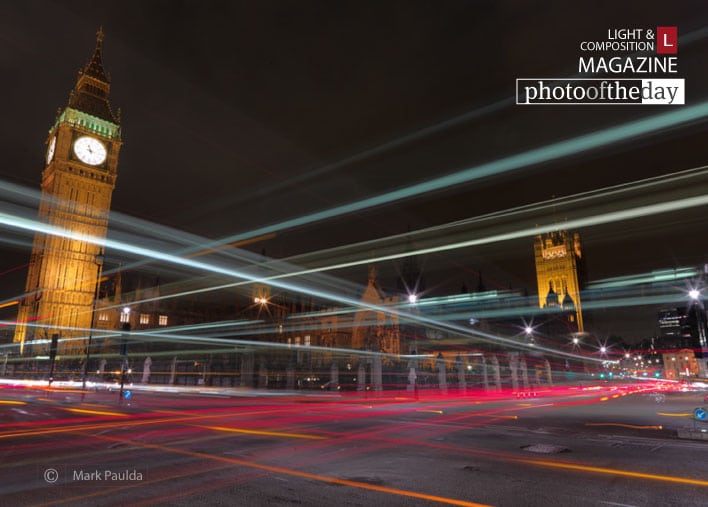
Captured at the intersection of Westminster Bridge Road and Whitehall, this long-exposure photograph masterfully transforms the chaotic pulse of London into a serene, ethereal vision. By utilizing a 64-second exposure, the photographer allowed the movement of iconic double-decker buses and city traffic to dissolve into fluid streaks of light, contrasting sharply against the stoic, timeless presence of Big Ben and the Houses of Parliament. This technical precision creates a surreal, dreamlike atmosphere, elevating a familiar urban scene into a poetic study of motion and stillness. The image stands as an award-worthy exploration of time, where the frenetic energy of the city is distilled into a singular, luminous moment.
Mark Paulda
Dividing his time between London and Texas, Mark Paulda is a multifaceted photographer celebrated for his ability to transform everyday environments into abstract, evocative forms. His work, often described as possessing the sensuality of Renaissance painting, explores the paradoxes of life through a lens that is both mystical and deeply observant. As an award-winning travel photographer and best-selling author, Paulda continuously challenges his own perceptions, capturing the tension between spontaneity and control to create images that are as poetic as they are technically precise.
Resonance Score Breakdown
Transparency Note: The resonance score (12.1/20) is calculated based on social engagement metrics collected before the award announcement.
Expert Photography Reviews · 6
The Hum of Passing Time
The smell of damp wool and wet pavement always brings me back to the city at dusk. It is a heavy, metallic scent, like coins pressed against a warm palm.
Read the reflection →The Ghost of Movement
We are taught that to exist is to be solid. We build walls of stone and iron, believing they will hold back the tide of time. But look closely at the city at night.
Read the reflection →Reviews & Comments
Share your thoughts about this award-winning photograph. Your reviews contribute to the community engagement score.
The ochre glow of the Parliament buildings bleeds into the bruised, indigo velvet of a London twilight, creating a chromatic tension that feels like a Morandi still life set in motion. It’s the streaks of cadmium red and electric amber, dissolving into the grey-blue fog of the Thames, that truly steal my breath away. One finds here a sublime, liquid alchemy where the city’s frantic pulse finally surrenders to the quiet, haunting permanence of light.
Sixty-four seconds in the middle of a Westminster intersection isn’t a casual stroll; it’s a commitment to being a nuisance. Most would’ve packed up after the first bus blurred into a smear. Paulda clearly didn’t. I’ve spent enough nights shivering on damp pavement to appreciate the discipline required to keep that tripod steady while the city rushes past. It’s a quiet, stubborn piece of work. One suspects he waited for the light to finally behave.
Sixty-four seconds of exposure doesn’t just blur traffic; it erases the human pulse. Paulda’s Westminster is a ghost ship, where the architecture looms like a tombstone over the vaporized city. I’m unsettled by how the shadows here aren’t merely absent light, but hungry voids consuming the street’s frantic history. It’s a cold, calculated haunting. When I look at these streaks, I don’t see motion. I see the silence that waits for us after the clock stops.
Of the thousands of long-exposure cityscapes I’ve reviewed, most are just gimmicky light trails. What separates this from the pack is the sixty-four-second commitment to stillness. By letting the buses dissolve into ghostly ribbons, Paulda forces the architecture to anchor the frame. It’s haunting. I find myself wanting to step into that quiet, frozen Westminster. It’s a rare piece that captures the city’s pulse without losing its soul. Thirty years from now, it’ll still breathe.
At f/22, the diffraction limit softens the fine detail of the stonework, yet it’s a necessary sacrifice for that 64-second integration. The light from the buses bleeds across the sensor, creating a beautiful, viscous flow that defies the rigidity of the lens. I’m genuinely moved by how the photon accumulation turns the chaos of Westminster into a soft, glowing hum. It’s a rare moment where the physics of the glass actually enhances the dreamlike stillness.
Sixty-four seconds of stillness in the heart of Westminster. Mark didn’t just capture traffic; he listened to the city’s frantic pulse until it finally exhaled. I’ve stood in such places, waiting for the chaos to surrender to the stone. It’s haunting how the buses dissolve into ghosts, leaving the clock tower to watch over the void. Looking at these light trails, I feel a strange, quiet peace—as if London finally stopped rushing for a moment.